Dubai, UAE – The security equation in the Gulf is no longer viewed only through the lens of a direct Iranian threat. In recent years, Iraq has shifted from being seen historically as a geographic buffer between Iran and the Gulf to becoming a fragile arena where armed factions, smuggling networks, and overlapping political and economic forces operate. Some of these actors are linked to Tehran, while others move according to their own interests.
The paradox is that the threat does not necessarily come from the official Iraqi state. Baghdad continues to affirm its rejection of cross-border attacks, but the deeper problem lies in the fact that part of the armed power inside Iraq is no longer easy to control politically or militarily. The 2016 Popular Mobilization Forces law made these forces part of Iraq’s armed forces and placed them under the commander-in-chief, while banning political activity by their members. Yet the reality on the ground remains far more complex than the legal text.
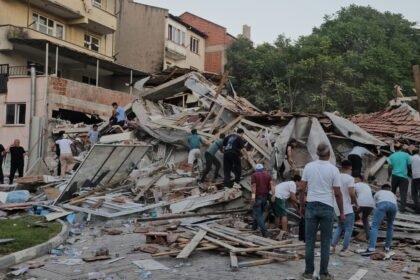
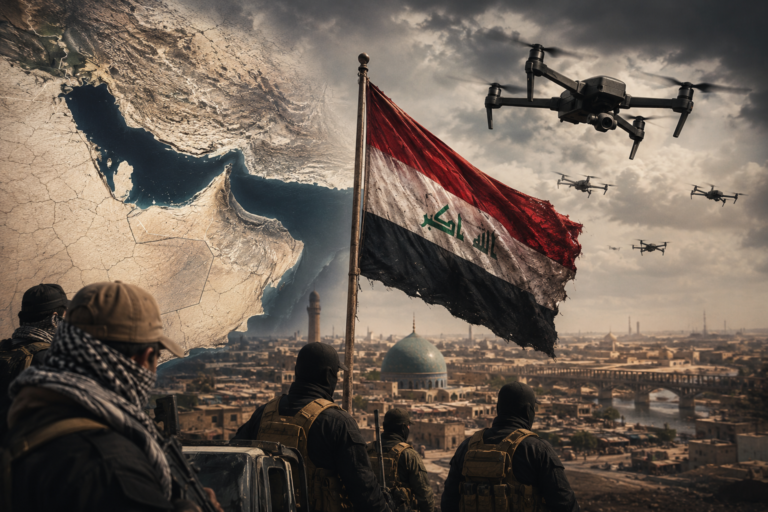
The most dangerous shift has appeared in the drone file. In May 2026, the UAE Ministry of Defense said that the drones that targeted the Barakah nuclear power plant on May 17 “originated from Iraqi territory,” according to technical tracking results. The ministry also said air defenses dealt with six drones that attempted to target civilian and vital areas within 48 hours.
This accusation moved Gulf concerns from the question, “What will Iran do?” to a more complicated one: “Who can use Iraq as a launchpad?” Saudi Arabia also announced that it intercepted three drones it said had entered from Iraq, stressing that it reserved the right to respond and take the necessary measures to protect its sovereignty and security.
Gulf Security Facing an Iraq of Multiple Weapons and Divided Decision-Making
The core of the danger is that Iraq is no longer a closed internal arena. The factions that fought ISIS gained combat experience, weapons networks, and political and economic influence. Some of these factions are now being used — or accused of being used — within a strategy of “plausible deniability”: an attack is launched from Iraq, but responsibility gets lost among front groups, official silence, and Iranian denial.
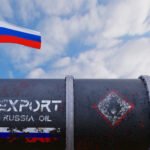
The U.S. Treasury said in October 2025 that the Iranian regime relies on armed Iraqi proxies, including Kataib Hezbollah, to infiltrate Iraq’s security forces and economy. It accused these groups of corruption, weapons smuggling, and undermining the Iraqi economy. It also pointed to the use of Iraqi territory to smuggle Iranian oil while presenting it as Iraqi oil.
The picture does not stop at attacks on the Gulf. The “Islamic Resistance in Iraq” has emerged since October 2023 as a front claiming attacks against American and Israeli targets. The Washington Institute, which tracks these attacks, describes it not as a single organization but as an announcement mechanism used by factions such as Kataib Hezbollah, Asaib Ahl al-Haq, Harakat al-Nujaba, and Kataib Sayyid al-Shuhada.
The United States has designated or sanctioned several of these factions and their leaders. In the U.S. Federal Register in 2025, Harakat al-Nujaba, Kataib Sayyid al-Shuhada, Harakat Ansar Allah al-Awfiya, and Kataib al-Imam Ali were designated as foreign terrorist organizations.
There is also a non-military threat that is no less significant: drugs and smuggling. A report published by OCCRP, based on data from the United Nations Office on Drugs and Crime, indicated that Iraq has become a growing major transit route for drug trafficking. The report said 24 million Captagon pills were seized in 2023, and that the quantities confiscated had risen sharply compared with previous years.
Iraq as a complex risk environment: A threat without a formal address complicates Gulf security
For Gulf states, this means that the Iraqi threat is no longer only a missile or a drone, but a complex system of risks: porous borders, armed factions, shadow economies, drug smuggling, and opaque funding routes. More dangerously, these threats sometimes operate outside the logic of the state, placing Baghdad in a defensive position and confronting the Gulf with an adversary that has no single official address.
The conclusion is that Iraq has not turned into an “enemy” of the Gulf, but into a risk environment. The difference is significant, yet decisive. The Iraqi state may not want escalation, but its weak monopoly over weapons, the overlap between factions, politics, and the economy, and the transformation of its territory into a possible platform for attacks have made Gulf security view Iraq as a parallel threat front to Iran — not merely an arena subordinate to it.