- What is IMEC?
- Why Haifa?
- But the surprise isn’t on the railways.
- Israel says: “Gateway to Europe”
- The bottleneck: Haifa’s power
- The biggest obstacle is not economic.
- Israel itself fears being bypassed.
- Egypt is not out of the equation.
- Could IMEC replace the Suez Canal?
- Why doesn’t the Suez Canal disappear then?
- The real battle: a “network,” not a “channel.”
- The dimension that doesn’t appear in the headlines: Energy
- What does Israel ultimately want?
- But there is a tough test ahead for the project.
- Haifa is not a ready-made alternative to Suez.
Cairo, Egypt – Israel is moving to establish Haifa Port as a key link in the India-Middle East-Europe Economic Corridor (IMEC) project, a move with implications that extend beyond traditional port competition and could reshape trade routes between Asia and Europe. In May 2026, the Israeli Ministry of Transport presented its “National Master Plan for International Trade” and its vision for “corridors of peace” linked to IMEC, placing Haifa Port at the heart of a plan to transform Israel into a logistics hub connecting East and West. However, this ambitious project does not mean that Israel can replace the Suez Canal, nor that Haifa is a ready alternative to the Egyptian maritime route. The reality is more complex. The real competition is not just between two ports, but between entire transportation networks vying to determine the path Asian trade will take to Europe in the coming decades.
What is IMEC?
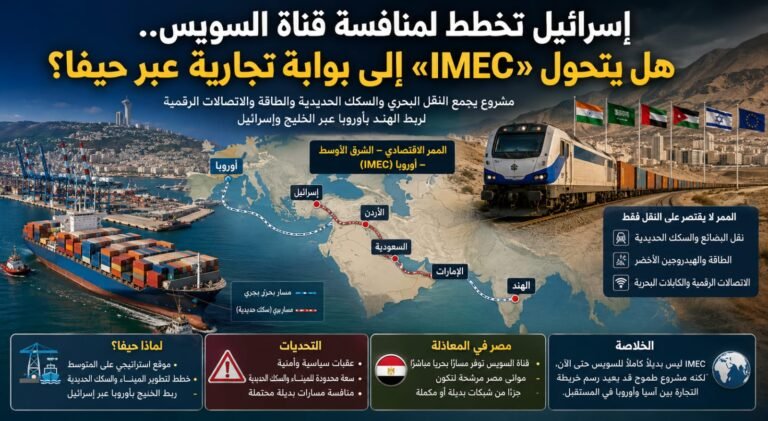
The India-Middle East-Europe Economic Corridor (IEEC) was announced at the 2023 G20 summit in New Delhi. The core concept is a multimodal network connecting India to the Gulf states, then extending overland through Saudi Arabia and Jordan to Israel, before goods are transported by sea to Europe. In the current Israeli vision, the port of Haifa serves as the key maritime link at the end of the land route. A request for information document published in March 2026, related to the Haifa Bay Development Project, outlines the vision, which includes transporting goods from Indian ports to the UAE by sea, then by rail from the UAE, Saudi Arabia, and Jordan to the port of Haifa, and from there to European ports. The document also sets projections of reducing transit time by approximately 40% and logistics costs by about 30%, along with the development of energy and digital communications infrastructure. However, these figures represent project targets or estimates, not yet proven operational results on a large commercial scale.
Why Haifa?
For Israel, it’s not simply about increasing container traffic; the stated goal is to transform the country from a geographical endpoint into a hub within an international trade network. In the plan proposed by the Israeli Ministry of Transport, the Port of Haifa serves as the land-sea link connecting the Gulf states to the Mediterranean. Israeli plans also include developing a railway network and land transport corridors connecting the Haifa area to Beit She’an and the Jordanian border, theoretically allowing for integration into a future regional network. The Haifa Bay Project document indicates that the railway line and the Jordan River crossing area are key components of the Israeli vision for the corridor. Thus, Haifa is not the entire project; it is the endpoint of a logistical hub that also depends on the success of infrastructure located east of Israel.
But the surprise isn’t on the railways.
The least visible aspect of the project in media coverage is its digital infrastructure. The European Union has declared the “Digital Corridor between Europe, Africa, and India” to be a practical application of the IMEC concept. At the heart of the project is the planned 11,700-kilometer Blue-Raman submarine cable, designed to connect Europe to India via the Middle East and East Africa. According to the European Commission, the project aims to provide high-speed, secure, and diverse digital connectivity along the corridor’s geographical route. This fundamentally alters the nature of the project. The corridor is no longer just about containers. It integrates goods, rail, ports, energy, data, and telecommunications. The potential battle, therefore, is not simply about who controls the flow of trade, but rather who owns the infrastructure that manages and digitally connects that trade.
Israel says: “Gateway to Europe”
The Israeli narrative surrounding the project is clear. The Israeli Foreign Ministry described IMEC as a project that could transform Israel and Greece into a “crossroads” connecting the East with Europe, emphasizing that the Israeli government is working to expedite projects related to the corridor. Domestically, the project is being viewed as an opportunity to reposition Haifa and the northern regions on the global trade map. But here lies the first fundamental problem: Is Haifa’s existing infrastructure capable of supporting the role Israel aspires to play?
The bottleneck: Haifa’s power
A recent study by the Middle East Institute indicates that the capacity of Israeli ports represents one of the main constraints for IMEC. The study estimates the capacity of Haifa port at approximately 1.5 million TEUs annually, making it significantly smaller than some Gulf ports in the proposed route. For comparison, the study notes that the capacity of Jebel Ali port in the UAE is more than ten times that of Haifa. This means the question is not whether Haifa can handle a trainload of containers, but rather whether it can become a major hub in a continent-sized trade network. The answer requires massive investments in the port, railways, warehousing, customs, and maritime connectivity.
The biggest obstacle is not economic.
Even if the port and railway issues are resolved, the political question remains. The corridor’s primary land route needs to pass through: the UAE → Saudi Arabia → Jordan → Israel, making its success highly dependent on political stability and coordination among these countries. Furthermore, Saudi-Israeli normalization is a crucial element in the project’s original vision. The Middle East Institute notes that regional conflicts and political complexities have hampered the project’s progress, and that completing the railway line from northern Saudi Arabia to Israel requires a political and security solution that has yet to materialize. Therefore, IMEC is not merely an infrastructure project; it requires a political environment conducive to the functioning of that infrastructure.
Israel itself fears being bypassed.
Herein lies a crucial paradox. While Israel seeks to make Haifa the hub of the corridor, analysts and international institutions are discussing the possibility of building a broader network of routes that could bypass Israel if the original route proves unfeasible. A recent Atlantic Council report indicates that the original IMEC concept remains incomplete, and that potential alternatives include Egypt and Syria via Jordan and Oman, along with other routes within the region. The report concludes that the corridor’s future may lie closer to a network of multiple routes rather than a single, fixed line. This is a critical point: if IMEC becomes a network rather than a single line, the question will shift from “Will Haifa compete with the Suez Canal?” to “Which port will become the most efficient node within the network?”
Egypt is not out of the equation.
Although Egypt is not among the signatories to the original vision for the corridor, its geographic location and ports make it a natural candidate for any redesign of the routes. A study by the Egyptian Center for Economic and Social Studies in collaboration with the Observer Research Foundation suggests integrating Egypt into an expanded corridor framework, utilizing ports such as Alexandria and Safaga to provide alternatives to the Haifa-based route. The study presents a vision for an Egyptian route that could reduce reliance on Haifa and discusses solutions for maritime and land transport within a broader regional network. A recent analysis by ORF indicates that the Gaza war disrupted the implementation of the IMEC in its original form, and that the idea of “IMEC with Egypt” has garnered Egyptian and French support as an alternative route to enhance connectivity between East and West. Here, the competition becomes more complex. Egypt does not necessarily need to confront the IMEC; theoretically, it could become part of its expanded version.
Could IMEC replace the Suez Canal?
The current answer, while not entirely conclusive, is that the reason is primarily physical rather than political. The Suez Canal allows the same ship to travel between the Red Sea and the Mediterranean without unloading its cargo, transferring it to a train, and then reloading it onto another vessel. IMEC, on the other hand, relies on a multimodal model: ship → port → train → border → train → port → ship. Each transfer entails additional costs, handling, customs coordination, time, and operational risks. Therefore, the two routes cannot be compared simply by stating that one is “faster” than the other. A true comparison should be between: the cost per container + total transit time + number of handling operations + security risks + fees + route reliability.
Why doesn’t the Suez Canal disappear then?
Because it remains a direct sea route with enormous capacity to handle container, energy, and bulk cargo traffic. Moreover, no global shipping company chooses a new route simply because governments want it created. Companies choose the route that offers: lowest cost + highest reliability + lowest risk + best delivery time. Therefore, the success of IMEC will not only be a political matter; it will be a commercial test.
The real battle: a “network,” not a “channel.”
Here the picture becomes clear: Israel wants Haifa, the UAE has one of the world’s most important logistics hubs, Saudi Arabia is at the heart of the proposed land bridge, Jordan is a link, Egypt has the Suez Canal and Mediterranean and Red Sea ports, India wants more diverse routes to Europe, and Europe wants to reduce the risks of relying on bottlenecks. Thus, IMEC could turn into a regional competition for network contracts, and not just a project aimed at eliminating the Suez Canal.
The dimension that doesn’t appear in the headlines: Energy
IMEC’s vision extends beyond trade. The project also encompasses an energy infrastructure, including plans for transporting clean energy and hydrogen from the Gulf region to European markets. In Israeli project documents, energy, alongside transport and digital communications, appears as a key pillar of the corridor. This suggests that the corridor’s success could grant some countries a role in the European clean energy value chain, not just in transporting goods. This underscores the project’s strategic importance.
What does Israel ultimately want?
Based on Israeli plans and statements, the objective appears to extend beyond mere transit fees. Israel aspires to become a logistics hub, a Mediterranean gateway, a digital center, an energy hub, and a technology partner. The Haifa Bay project’s request for information reveals that Israel views the corridor as a multi-layered project encompassing transportation, energy, and digitalization. In this sense, Haifa is not simply a “mini-Suez Canal.” It is an attempt to construct a new economic hub.
But there is a tough test ahead for the project.
To date, the vision has not yet materialized into a fully operational, integrated trade corridor. Specialized analyses indicate that the necessary cross-border infrastructure, particularly the railway lines in Jordan and the connections with Saudi Arabia and Israel, still require significant investment and political and security arrangements. Furthermore, regional security risks could drive up insurance costs and undermine the confidence of transport companies. This presents the project with a difficult dilemma: the greater the regional instability, the greater the need for alternatives to traditional routes; but the greater the instability itself, the more challenging it becomes to establish and operate the new corridor.
Haifa is not a ready-made alternative to Suez.
The available data does not yet support the claim that Israel is “destroying the Suez Canal.” However, it does support a more accurate conclusion: Israel is working to establish Haifa as a hub within a new trade network, and IMEC occupies a central position in this vision. The project is not just about containers; it integrates trade, railways, ports, energy, data, and telecommunications.
On the other hand, the route faces real obstacles: the lack of a complete regional land connection – the political complexities between Saudi Arabia and Israel – the security risks – the limited current capacity of Haifa compared to the major Gulf ports – the need for huge investments – the existence of regional alternatives that can bypass Israel. As for the Suez Canal, it still enjoys a fundamental advantage: the direct sea route without the need to unload and reload the container between multiple means of transport.
Therefore, the more accurate question is not, “Will Israel replace the Suez Canal?” but rather, “Will Israel succeed in transforming Haifa into an indispensable hub within the trade network between Asia and Europe?” If it succeeds, the battle will not be over. It will have just begun, because the 21st century may not witness a war between a canal and a port, but rather a competition between entire networks vying for control over the movement of goods, energy, and data between continents.
IMEC does not yet represent a complete alternative to the Suez Canal, but it does represent a serious attempt to redistribute some trade routes and logistical value between Asia and Europe. Haifa is Israel’s main bet in this equation, while Egypt, the UAE, Saudi Arabia, and others possess geographical and logistical advantages that could determine the final shape of the network. The real stake is not “who will defeat the Suez Canal,” but rather “who will become the indispensable hub for global trade.”