- From the Middle East to the Arctic
- Three routes… and a changing trade map
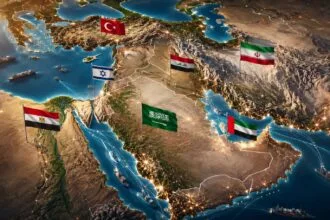
- Why does the Middle East matter?
- “Escape north”… but where to?
- The Arctic: An alternative or a “safety valve”?
- The ship “Dubai Tower”… more of a test than a revolution
- The great paradox: climate enters the equation
- What about the Suez Canal?
- Three scenarios that shape the future
- Egypt… why does it remain at the heart of the equation?
- Is the era of the Suez Canal over?
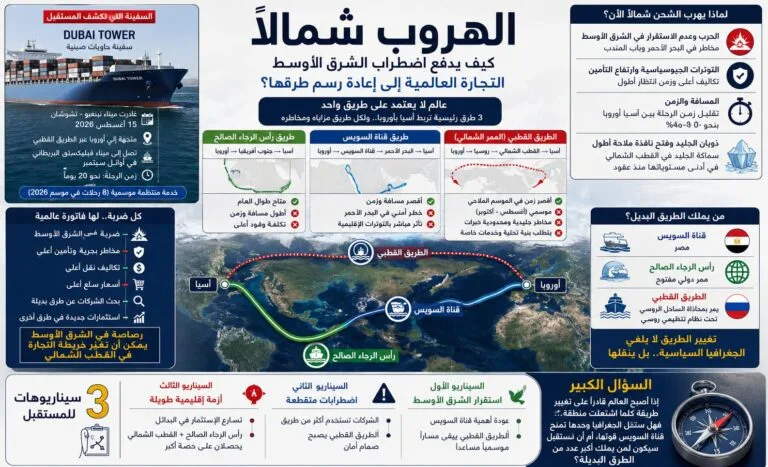
Abu Dhabi, UAE – Shipping crises in the Middle East are no longer just a problem for vessels transiting the Red Sea or the Strait of Hormuz; they have begun to prompt companies and countries to reconsider a more fundamental question: Does the global economy need alternative trade routes in anticipation of traditional shipping lanes becoming bottlenecks? In this context, the voyage of the Chinese container ship “Dubai Tower” takes on significance that transcends its commercial scale. The vessel departed the port of Ningbo-Zhoushan in China on August 15, inaugurating a regular seasonal Chinese service transporting containers to Europe via the Arctic Northern Sea Route, with a schedule of eight weekly voyages during the 2026 shipping season.
The vessel, with a capacity of approximately 1,740 TEUs, is scheduled to arrive at the British port of Felixstowe on September 5, before distributing cargo to other European destinations. This voyage marks a transition from a single-venue service in the previous season to a scheduled seasonal service, a significant development in the story. However, the question is not whether China is replacing the Suez Canal; the more pertinent question is whether the crises in maritime routes are pushing global trade from seeking the “shortest route” to the “most resilient route.”
From the Middle East to the Arctic
For years, trade between Asia and Europe relied primarily on the Suez Canal and the Red Sea route, the natural sea route between major Asian production centers and European markets. However, disruptions in the Red Sea, threats to shipping, and broader regional tensions have prompted shipping companies to reassess the risks of using traditional routes. In response, the Cape of Good Hope route has gained renewed importance as an alternative, despite adding distance, time, and operating costs.
Then a third option emerged: the Arctic route, or Northern Sea Route, which runs along the Russian coast in the Arctic Ocean. It shortens the distance between Northeast Asia and Northern Europe compared to the Suez Canal route, but remains a seasonal route governed by ice conditions, weather, infrastructure, and geopolitical risks. Recent reports indicate that China has already begun treating it as a genuine commercial option, not just a research experiment.
Three routes… and a changing trade map
The landscape can be summarized in three routes:
1. The Suez Canal
Asia → Red Sea → Suez Canal → Mediterranean Sea → Europe
The most established route, supported by a vast network of ports, services, and supply chains.
2. The Cape of Good Hope
Asia → Indian Ocean → South Africa → Atlantic Ocean → Europe
An alternative route when risks are high in the Red Sea, but it is longer and more fuel- and time-consuming.
3. The Northern Sea Route
Asia → Bering Strait → Russian Arctic Coast → Northern Europe
Relatively shorter, but it relies on a seasonal shipping window, polar conditions, and infrastructure that is radically different from traditional routes.
The new Chinese service aims to reach Britain from Ningbo in about 20 days, according to the announced schedule, compared to longer durations for traditional sea routes under current conditions.
Why does the Middle East matter?
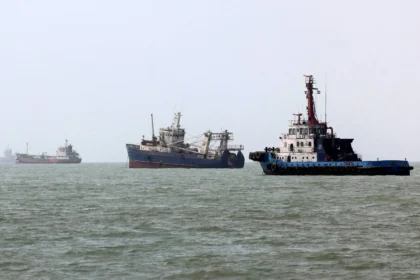
Because a business decision made in China could be underpinned by a security crisis thousands of kilometers away. As navigation in the Red Sea becomes more dangerous, insurance costs rise, routes are more likely to be altered, ship arrival schedules become more complicated, and the added distance translates into a direct cost for businesses and consumers. Reuters has documented changes in tanker and ship routes in recent weeks due to security risks in the Red Sea, including some vessels returning to safer routes after warnings linked to the Houthis. Meanwhile, disruptions in the Strait of Hormuz have increased pressure on the shipping and energy markets, demonstrating that sea lanes have become part of the geopolitical conflict itself, not just routes for transporting goods. Herein lies the paradox: a crisis may be centered in the Middle East, but one of its far-reaching effects could be felt as far away as the Arctic.
“Escape north”… but where to?
The Arctic route presents a clear allure: shorter distances and less transit time under favorable navigational conditions. But shorter distances do not automatically equate to shorter risks. The Northern Sea Route remains seasonal, requires specialized navigational capabilities in polar waters, and its rescue and logistics infrastructure is far less developed than that of traditional sea routes. The Financial Times notes that, despite current interest, the route remains a marginal trade route compared to global shipping networks, with sanctions, geopolitical risks, and seasonal conditions posing challenges to its widespread adoption. Furthermore, using the route means navigating a different geopolitical reality; the corridor runs alongside the Russian coast, and Moscow wields considerable influence over the regulation of navigation and associated infrastructure. The question then becomes: Is global trade simply escaping one geopolitical realm for another?
The Arctic: An alternative or a “safety valve”?
In the short term, it’s unlikely to be a complete replacement for the Suez Canal. But its importance may lie elsewhere: as a backup route. This represents a significant shift in shipping companies’ thinking. Instead of saying, “This is the route I’ll always use,” the question might become, “What routes can I use if the main route is disrupted?”
Here, the Suez Canal, the Cape of Good Hope, and the Arctic route become components of a flexible network, rather than one being an absolute substitute for the others. A study published in Frontiers in Marine Science indicates that the Northern Sea Route could provide strategic value as a backup route in case of Suez Canal disruptions, though its viability remains dependent on factors such as ice, seasonality, shipping type, and geopolitical risks.
The ship “Dubai Tower”… more of a test than a revolution
The significance of the Chinese ship lies not in its ability to single-handedly transform global trade, but rather in what will happen after its maiden voyage. The project encompasses eight scheduled voyages during the 2026 season, utilizing seven ships in service—a radical departure from a single trial voyage.
Herein lies the real test:
Will the ships arrive on time?
Can the weekly schedule be maintained?
Will customers be willing to pay for the route?
Can the service handle insurance and polar risks?
Can it be expanded beyond the summer and autumn window?
If the answers are positive in the long run, the route could transform from a seasonal experiment into a permanent fixture in global trade. However, if the project encounters obstacles such as operating costs, weather, infrastructure, and geopolitics, it will remain a niche route.
The great paradox: climate enters the equation
There is another factor that cannot be ignored. The retreat of Arctic sea ice has made navigation along parts of the route more feasible for longer periods than before. Paradoxically, however, the phenomenon that opens the way for ships also carries significant environmental risks. Increased maritime activity in this highly sensitive region raises the risk of pollution and accidents, while the Arctic remains one of the world’s most vulnerable areas to climate change. Thus, the Arctic route exemplifies a 21st-century paradox: climate change opens a new trade route, but the very use of this route adds environmental pressures to the region.
What about the Suez Canal?
Here, we must be wary of drawing hasty conclusions. There are no indications that China has begun to dispense with the Suez Canal. The new polar route is seasonal and limited compared to the volume of global trade, while the Suez Canal possesses infrastructure, services, and a geographic location that cannot be easily replaced. But there is a more important strategic lesson: the more crises that affect maritime routes, the greater the value of having alternatives. This means that the long-term challenge to the Suez Canal does not necessarily come from a competing ship or route, but rather from a change in the behavior of global shipping companies themselves if risk management becomes permanently dependent on distributing traffic across multiple routes. Conversely, as the security of the Red Sea improves and the region stabilizes, the Suez Canal’s advantages—its location, efficient infrastructure, and the short distance between Asia and Europe—will once again become prominent.
Three scenarios that shape the future
Scenario 1 | Stability in the Middle East
Shipping traffic gradually returns to the Red Sea and the Suez Canal, while the Arctic route remains a limited, seasonal option.
Scenario 2 | Intermittent Disruptions
Companies adopt a multi-route strategy: Suez when safe, and the Cape of Good Hope or the Arctic when risks increase.
Scenario 3 | Protracted Regional Crises
Investments in alternative routes accelerate, and having more than one logistical option may become a permanent part of the strategy for major shipping companies.
In this case, the risk to the Suez Canal is not its replacement, but rather a decrease in some companies’ reliance on it as the sole route.
Egypt… why does it remain at the heart of the equation?
For Egypt, the shift towards alternative routes does not mean the Suez Canal’s importance has diminished. On the contrary, the new competition may compel the canal to further enhance its advantages: safety, speed, logistics, ports, industrial zones, and the ability to offer value beyond mere ship transit. In a world fraught with crises, the battle will not be solely about who possesses the shortest route, but rather about:
Who possesses the safest route?
Who can guarantee its regularity?
Who can withstand shocks?
And who can connect the waterway to ports, markets, and logistics services?
Here, the Suez Canal can transform from a mere passage between two seas into an integral part of a comprehensive logistics system.
Is the era of the Suez Canal over?
The Dubai Tower voyage doesn’t signify the end of the Suez Canal era, nor that China has found a way to absorb Asian and European trade.
But it does reveal a quieter, more significant shift: the world is beginning to treat geopolitical risks as a permanent variable in the design of supply chains. A war in the Middle East can alter the calculations of a shipping company in Asia, drive investments to the Arctic, and redistribute risks across maritime routes stretching from the Suez Canal to the Cape of Good Hope.
Thus, the story of the Chinese ship may not be so much about a “new route to rival the Suez Canal,” but rather about a world learning that trade cannot forever rely on a single route. The question is no longer: Who will replace the Suez Canal?, but rather: Who will possess the largest network of routes capable of withstanding the changing landscape of risks?