- Seven keys determine a country’s weight
- Egypt: The key to geography and Arab influence
- Saudi Arabia: The Key to Energy and Money
- The UAE: A power that transcends geographical size
- Türkiye: The key to geography between East and West
- Iran: The key to regional disruption and pressure
- Israel: The key to military and technological superiority
- So… who holds the keys to the Middle East?
- The real question is… who can collect the keys?
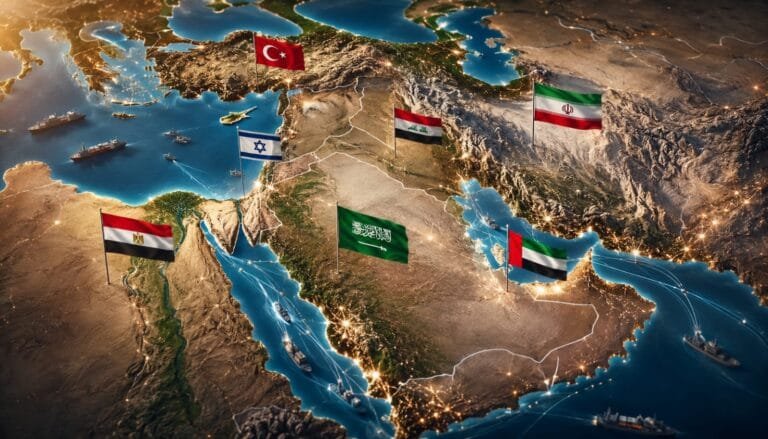
Abu Dhabi, UAE – The question of “which country is the strongest in the Middle East?” can no longer be answered simply by comparing the number of aircraft and tanks or the size of military spending. The regional balance of power has become far more complex, incorporating elements of economics, energy, population, geographic location, alliances, diplomatic influence, technology, and the ability to influence crises. At the heart of this equation stand six major regional powers: Egypt, Saudi Arabia, the UAE, Turkey, Iran, and Israel, while the United States, China, and Russia remain influential external powers shaping the region’s power dynamics.
This comparison gains even greater significance in light of the security shifts the region is witnessing in 2026, including the potential for war with Iran, escalating risks in the Gulf and the Red Sea, and the emergence of new regional defense arrangements. On August 7, Saudi Arabia, Turkey, and Pakistan signed a joint defense agreement stipulating that any attack on one member state is considered an attack on all three, a move reflecting a trend toward strengthening regional security arrangements.
Seven keys determine a country’s weight
Regional power can be measured across seven key areas: military strength, economy, population, energy, geographic location, alliances, and diplomatic influence. No single state necessarily excels in all of these areas; Saudi Arabia’s power, for example, rests largely on its energy and economic strength, while Israel’s power is based on military and technological superiority, and Egypt combines population size, location, geography, and political influence. Therefore, the more accurate question is not: Who is the strongest? but rather: Who holds the greatest number of keys to influence Middle Eastern affairs?
Egypt: The key to geography and Arab influence
Egypt possesses one of the most complex power structures in the Middle East. It is the most populous Arab state, strategically located at the crossroads of Asia, Africa, the Mediterranean, and the Red Sea, while the Suez Canal grants it a pivotal position in international trade. The Egyptian military is one of the largest in the region, and Cairo’s relationships with various regional and international powers afford it considerable political maneuvering room. Egypt’s importance is particularly evident in the issues of Gaza, Libya, Sudan, the Red Sea, the Eastern Mediterranean, and the security of the Suez Canal. However, the fundamental challenge lies in the gap between its large population and geographic size, on the one hand, and its economic capacity, on the other.
Saudi Arabia: The Key to Energy and Money
If Egypt holds the key to geography and population, then Saudi Arabia possesses one of the most important keys: energy and financial power. A member of the G20, Saudi Arabia is a major player in the global oil market, and its religious standing grants it special weight in the Arab and Islamic worlds. Riyadh is attempting to translate these assets into broader political and security influence, in parallel with the implementation of Vision 2030, economic diversification, and investment in new sectors. In the military sphere, Saudi Arabia ranked eighth globally in military spending in 2025, with expenditures estimated at approximately $83.2 billion, according to the latest data from the Stockholm International Peace Research Institute (SIPRI). Saudi policy gains added significance as Riyadh seeks to build more independent regional security arrangements, as reflected in the joint defense agreement with Turkey and Pakistan this month.
The UAE: A power that transcends geographical size
The UAE presents a different model of power. Its limited size and population have not prevented Abu Dhabi from building regional and international influence based on its economy, investment, ports, aviation, diplomacy, and security partnerships. The UAE enjoys a broad network of relationships stretching from Washington and Beijing to Moscow, New Delhi, and Arab capitals, granting it the ability to maneuver between international power centers. Its location on the Gulf and near maritime trade routes further enhances its strategic importance. Recent analyses indicate that the UAE has successfully strengthened its position in Washington over the past two decades by expanding military and diplomatic cooperation, investments, and economic and technological ties.
Türkiye: The key to geography between East and West
Turkey is an exceptional case in the regional balance of power. Its location makes it a crossroads between Europe, Asia, the Middle East, the Black Sea, and the Eastern Mediterranean. Control of the Bosphorus and Dardanelles straits grants it strategic importance that extends far beyond its borders. Turkey possesses a large army and a growing domestic defense industry, and its membership in NATO gives it a distinct position within the international security system. According to SIPRI, Turkish military spending in 2025 reached approximately $30 billion, a 7.2% increase over the previous year. Ankara is active in the Syrian, Iraqi, Libyan, Eastern Mediterranean, Caucasus, and Black Sea regions, while its relatively balanced relations with competing actors allow it to maintain room for maneuver.
Iran: The key to regional disruption and pressure
Iranian power differs from previous models. Tehran’s influence is not solely based on the size of its economy or military spending, but also on its geography, missile capabilities, drones, and regional networks. Iran overlooks the Persian Gulf and the Gulf of Oman, and its geographic location gives it the ability to influence the security of the Strait of Hormuz, one of the world’s most important energy chokepoints. However, the Iranian economy faces significant constraints due to sanctions and financial pressures. This is clearly reflected in its military spending; SIPRI estimated Iranian military expenditure in 2025 at approximately $7.4 billion, a 5.6% decrease in real terms, due to economic pressures and high inflation. Nevertheless, this decrease in spending does not necessarily mean the disappearance of Iran’s ability to exert influence, as Tehran relies heavily on asymmetric tools, its geographic location, and its regional networks.
Israel: The key to military and technological superiority
Israel possesses a different model of power. A small country in terms of both area and population, it boasts advanced military and technological capabilities, coupled with a strong strategic partnership with the United States. Its power rests on a combination of air power, intelligence, air defense, missiles, electronic warfare, military technology, and a knowledge-based economy. According to SIPRI, Israeli military spending reached approximately $48.3 billion in 2025, ranking 11th globally, despite a 4.9% decrease from 2024. Israel’s spending in 2025 was 97% higher than its 2022 level. However, Israeli power faces a different equation: significant military superiority is countered by limited geographical depth and a highly complex security environment.
So… who holds the keys to the Middle East?
The more accurate conclusion is that the keys are distributed. Egypt holds the key of geography, population, and Arab influence. Saudi Arabia holds the key of energy, finance, and Arab and Islamic weight. The UAE holds the key of investment, logistics, and networks of relationships. Turkey holds the key of geography, military strength, and its role as a link between East and West. Iran holds the key of disruption and geographic and military pressure. Israel holds the key of military and technological superiority. However, none of these powers can single-handedly hold all the keys to the region.
The real question is… who can collect the keys?
The real competition lies in a state’s ability to combine elements of power.
A state with a strong military but no strong economy faces limitations.
A wealthy state without security forces or alliances faces other challenges.
A strategically located state needs both a strong economy and effective diplomacy to translate that location into influence.
Therefore, no single regional power in the Middle East is the sole dominant force.
It is a web of interests and capabilities. Perhaps the most significant development in the coming years will be the region’s shift from the question, “Who is the strongest?” to a more fundamental question: “Who can build the alliance that encompasses the greatest number of power centers?”
Given the current transformations, the competition to shape a new security and political order for the Middle East appears wide open, as regional capitals vie to translate their economic, military, and geographic capabilities into long-term political influence. Here, the winner may not be the one with the strongest army, but rather the one with the greatest ability to integrate power, economics, geography, alliances, and diplomacy into a single strategy.