- The “Sunni axis”: Reality or intelligence leap?
- But… Egyptian-Turkish cooperation is real
- Sinai: From “security reinforcement” to “preparing for war”?
- The peace treaty… what do the documents say?
- Why does Cairo look different now?
- “A new enemy”… How does the novel take shape?
- Where does Egypt stand in this equation?
- So what is Israel afraid of?
- The irony is that the “Mecca Agreement” is not Egyptian.
- What does the map of evidence say?
Cairo, Egypt – As military and political shifts accelerate in the Middle East, a new discourse has emerged within Israel warning of the formation of a “Sunni axis” led by Turkey and including regional powers such as Egypt, Saudi Arabia, and Pakistan. This coincides with the promotion of fears that Cairo could become a potential military threat to Israel. However, what is striking is that the skepticism surrounding this narrative did not originate from outside Israel, but rather from within one of its most prominent media and security forums. In an article published in the newspaper Yediot Aharonot, Israeli researcher Michael Milstein cautioned against transforming security assumptions into established “facts” in the public consciousness. He specifically referred to the narrative concerning the existence of Egyptian “offensive intentions” against Israel and the talk of the emergence of a “new Sunni axis” led by Turkey. But what do the facts say? Is Egypt truly moving towards a military confrontation with Israel? Are Cairo, Ankara, Riyadh, and Islamabad forming a unified military alliance? Or are there genuine shifts being interpreted through conclusions that go beyond the evidence?
The “Sunni axis”: Reality or intelligence leap?
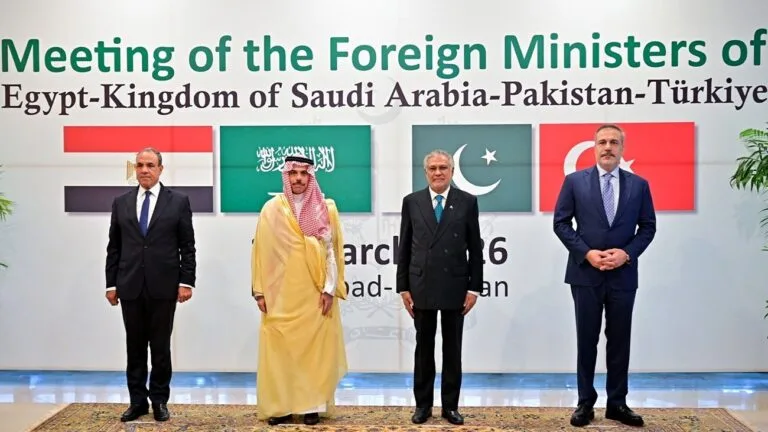
A new network of regional coordination already exists, comprising Egypt, Turkey, Saudi Arabia, and Pakistan, but describing it thus far as a unified “Sunni military alliance” against Israel requires more evidence. The four countries operate within a framework of regional consultations on security and political crises. Furthermore, in August 2016, Turkey, Saudi Arabia, and Pakistan signed a joint defense agreement known as the “Mecca Agreement,” which stipulates that any armed attack on one of the three countries is considered an attack on all three. Turkish Foreign Minister Hakan Fidan described the agreement as, technically, close to the principle of collective defense in Article 5 of NATO. Ankara stated that the agreement is defensive and not directed against Iran or any specific country, and indicated the possibility of future expansion, specifically mentioning Egypt as a potential candidate. Herein lies the first gap in the narrative circulating within Israel: Egypt is not a party to the trilateral defense agreement signed between Turkey, Saudi Arabia, and Pakistan. Consequently, automatically including Egypt in an existing “Sunni military alliance” does not align with the stated legal and political status of the agreement.
But… Egyptian-Turkish cooperation is real
Conversely, not all Israeli concerns can be dismissed as unfounded. During the summer of 2026, Egyptian-Turkish military cooperation witnessed a significant escalation. In June, the Egyptian and Turkish air forces conducted a joint exercise within Egypt, which included sorties and operational drills aimed at enhancing interoperability. That same month, Egypt, Turkey, and Azerbaijan participated in the “Anatolian Eagle 2026” exercise in Turkey, involving multirole fighter jets and a NATO early warning aircraft. The final phase included training in attacking simulated enemy targets, defending vital assets, intercepting drones, and aerial refueling.
In July, cooperation moved to another level with the implementation of the “Golden Eagle 2026” exercise, involving Egyptian paratroopers and commandos and Turkish special forces. The exercise included training in storming operations, dealing with drones and improvised explosive devices (IEDs), and special operations. The Egyptian Minister of Defense also paid an official visit to Turkey, which concluded with the signing of a letter of intent to enhance defense cooperation, in addition to discussions on cooperation in defense industries. Thus, there is a genuine Egyptian-Turkish military shift. However, the question these events do not answer is: against whom? Published Egyptian military statements describe these exercises as part of joint training plans, exchange of expertise, and enhancement of combat readiness, and offer no public evidence that they are directed against Israel.
Sinai: From “security reinforcement” to “preparing for war”?
Herein lies the most dangerous shift in Israeli discourse. Since 2025, the increased Egyptian military presence in Sinai has sparked widespread debate within Israel, with reports and analyses linking the Egyptian military buildup in the peninsula to the possibility of preparations for a future confrontation with Israel. However, a study published by the Israeli Institute for National Security Studies (INSS) in March 2025 addressed these concerns in detail. The study acknowledged the Egyptian military expansion and the development of its military capabilities, but placed this within a broader context that included combating terrorism in Sinai, securing Egypt’s borders with Libya and Gaza, protecting Egyptian strategic interests, and developing the peninsula’s infrastructure. Most importantly, the study discussed the claim that Egypt was preparing for a preemptive war against Israel, before emphasizing that Cairo’s commitment to the peace treaty is a key factor that makes the hypothesis of an Egyptian war less consistent with Egypt’s declared interests and strategy. It concluded that it was necessary to reduce tensions and maintain the peace treaty between the two countries. Here, the question becomes more pertinent: if the Egyptian military buildup is a reality, does this military buildup automatically imply an offensive intention? The professional answer is: no.
The peace treaty… what do the documents say?
The Egyptian-Israeli peace treaty signed on March 26, 1979, ended the state of war between the two countries and stipulated the withdrawal of Israeli forces from Sinai and the return of Egyptian sovereignty over it. However, the treaty simultaneously established detailed military arrangements for deployment zones in Sinai. According to the military annex, there are designated areas with varying numbers and capabilities of troops, including Area A, which allows for the presence of an Egyptian mechanized infantry division, with a specified maximum number of tanks, armored vehicles, and personnel. Importantly, these security arrangements were not fixed and detached from the realities on the ground. The INSS study itself documents that since 2011, Israel has agreed to the deployment of additional Egyptian forces to Sinai to combat terrorism, and that a coordination mechanism was subsequently developed to address what are known as “agreed-upon activities” that exceed some of the deployment limits stipulated in the original arrangements. Therefore, the presence of additional Egyptian forces in Sinai cannot be interpreted in isolation as an indication of a decision to go to war.
Why does Cairo look different now?
Egypt’s transformation is not limited to Sinai. Cairo is moving toward rebuilding its position as an independent regional power, diversifying its military and political partnerships. The rapprochement with Turkey is one of the most prominent manifestations of this shift. In just a few months, Egyptian-Turkish military relations have moved from traditional cooperation to frequent joint air force exercises, special forces training, and discussions on defense industries. But this transformation must be viewed within a broader context: Egypt is not the only country reassessing its security priorities. Saudi Arabia itself is moving toward establishing new regional defense arrangements, while Turkey is working to strengthen its position as a major security and military power in the region. In July, Saudi Arabia announced a multinational maritime coalition to protect navigation in the Red Sea, an initiative that garnered the support of 14 countries, including Egypt, Turkey, and Pakistan. This means that some elements of the “axis” that Israel speaks of do indeed exist, but they are distributed across different arrangements and with multiple objectives, and are not necessarily part of a single military operations room targeting Israel.
“A new enemy”… How does the novel take shape?
Milstein’s article in Yediot Aharonot offers an important entry point for understanding the phenomenon. The Israeli researcher does not deny that Turkey has become more powerful and influential, but he warns against portraying it as a new version of Iran in Israeli discourse. In a previous article published in July, he stated that Turkey had become Israel’s “new demon,” but simultaneously cautioned against reducing it to the image of “the new Iran,” pointing to the differences in their motivations, interests, and capabilities. In his most recent article, he returns to the warning about a “new Sunni axis,” emphasizing that the Israeli public should question the source of these assumptions, especially given the potential political interest in exaggerating certain risks. This is not a call to ignore the risks, but rather to distinguish between three levels: the actual risk, the potential risk, and the risk presented to the public as an established fact without sufficient evidence.
Where does Egypt stand in this equation?
The available indicators paint a more complex picture, but what is certain is that: Egypt has been strengthening its military capabilities for years – its military presence in Sinai has increased in the context of combating terrorism and securing the borders – Cairo is deepening its military cooperation with Turkey – Egypt is participating in multiple regional coordination mechanisms – Cairo has supported maritime security arrangements in the Red Sea – Egypt is not a party to the tripartite defense agreement between Turkey, Saudi Arabia and Pakistan so far.
Unproven: that Egypt decided to wage war on Israel – that Cairo joined a military alliance aimed at confronting Israel – that the Egyptian-Turkish exercises represent preparations for an offensive operation against Israel – that the Egyptian military movements in Sinai mean there is a political decision to move to war, and this distinction is the essence of the investigation.
So what is Israel afraid of?
The indicators suggest that Israeli concerns are more closely linked to the changing strategic environment surrounding Israel. After years of believing that Israel enjoyed broad military and political superiority in the region, new arrangements are now emerging: Turkey is strengthening its military and political influence; Saudi Arabia is seeking more independent regional security guarantees; Pakistan is entering into new defense arrangements with two regional powers; and Egypt is enhancing its military cooperation with Turkey and participating in regional coordination frameworks. This means that Israel may face a future Middle East less amenable to the rules that prevailed in previous decades. But this is quite different from claiming that these countries have decided to form a military alliance to overthrow Israel.
The irony is that the “Mecca Agreement” is not Egyptian.
This is perhaps the most crucial point in deconstructing the narrative. The defense agreement, dubbed the “Mecca Agreement,” was signed between Saudi Arabia, Turkey, and Pakistan. The agreement stipulates the principle of joint defense, but it does not include Egypt in its current membership. Turkey has stated that the door is open to expanding the agreement, mentioning Egypt as a potential future member. In Israel itself, Yediot Aharonot addressed the agreement as a significant strategic shift, but noted that its primary target is not Israel, but rather deterrence against Iran and regional threats. This paradox reveals the problem with the term: a “Sunni axis” is not necessarily an “axis against Israel.” The rivalry with Iran, confronting the Houthis, securing the Red Sea, and protecting borders are all issues that drive Sunni states to cooperate, without necessarily implying an agreement to wage war against Israel.
What does the map of evidence say?
The available evidence does not yet allow for a definitive conclusion that Egypt has become Israel’s “next enemy.” However, it does allow for a more nuanced and significant conclusion: Egypt is operating within a new regional environment, expanding its network of military and political partnerships, at a time when Israel’s ability to monopolize the definition of security threats in the region is diminishing. Egyptian-Turkish cooperation is real—the Saudi-Turkish-Pakistani rapprochement is real—the new regional coordination is real—and Israeli concerns about these shifts are also real.
But transforming all these facts into a single narrative claiming that “an offensive Sunni axis led by Egypt and Turkey is forming to encircle Israel” requires evidence beyond what is publicly available. This is precisely where the importance of Yediot Aharonot’s warning becomes apparent. The problem is not the existence of real threats, but rather the possibility that probabilities can transform into facts, assessments into information, and fears into intentions, all accumulating within the public sphere until they become an “undeniable truth.”
In the case of Egypt, the available evidence reveals a clear paradox: the Egyptian army is developing, but military development is not a declaration of war; Cairo is growing closer to Ankara, but this rapprochement is not an offensive alliance; Egypt is participating in new regional arrangements, but this participation is not a declaration of an axis against Israel. The question that will define the next phase is different: “Will these new networks of cooperation and coordination evolve into an institutionalized military alliance that changes the rules of regional security?” So far, the answer is: not yet. But what is happening in the region indicates that the old regional security order is changing rapidly, and Israel is aware of this. Therefore, the struggle to define “who the next enemy is” has become part of the conflict itself.