
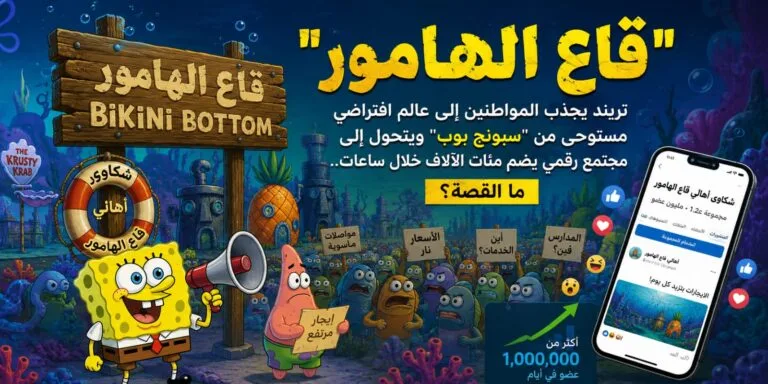
- The beginning: August 20th… The birth of a city from nothing
- 700,000… then a million… then more?
- Why did “Bottom of the Grouper” spread so quickly?
- Artificial intelligence: The fuel that doubled the speed of its spread
- When the artists entered, the size of the game changed.
- From “group” to community
- Why “The Bottom of the Sea” in particular?
- The other side: Conspiracy theories
- The paradox: small management, huge audience
- Could there be an “electronic army” behind the spread?
- But there is another, more real danger.
- From entertainment to economy
- SpongeBob’s rights: Where does the mockery begin and the commercialization end?
- Is “Grouper Bottom” a phenomenon only in Egypt?
- What does this phenomenon reveal about Egyptians?
- “The Bottom of the Sea” has not yet provided evidence of an organized conspiracy.
Cairo, Egypt – From a satirical group to a phenomenon that transcends Facebook: How did Egyptians create a virtual city with residents, complaints, and celebrities? Is its spread solely due to platform algorithms and artificial intelligence, or does the story have other dimensions? “Qaa’ al-Hamour” (Bowl Bottom) wasn’t a city on any map; it had no streets, police station, post office, or residents in the traditional sense. It was originally a fictional underwater city known to fans of the animated series “SpongeBob SquarePants” as Bikini Bottom. But in just a few days in August 2026, social media users in Egypt reinvented the city. “Qaa’ al-Hamour” transformed into a virtual community where its residents discuss rent, prices, education, work, relationships, and everyday problems, all within a world inspired by “SpongeBob.”
Then something happened that changed the phenomenon: the group, which began as a satirical space, transformed into a mainstream trend. Celebrities joined the fray, and AI-generated images became an integral part of the scene. The “Complaints of the Bottom of the Sea” group quickly amassed hundreds of thousands of members, with later reports claiming it exceeded a million, and some posts even citing even higher figures. However, investigating these numbers reveals that the size of the community itself needs to be approached with caution, as the figures changed rapidly, and the published sources did not provide an independent database documenting the hourly growth rate. So, what exactly happened?
The beginning: August 20th… The birth of a city from nothing
The “Complaints of the Residents of Qaa El-Hamour” group was created on Thursday, August 20, 2026, and began addressing social problems familiar to Egyptians, but within the world of SpongeBob SquarePants. The idea is simple on the surface: treat Qaa El-Hamour as if it were a real Egyptian area. Instead of a user saying, “I have a problem with rent,” the post becomes, “Residents of Qaa El-Hamour complain about high rents.” And instead of a regular picture of a person, it can be transformed into a character within the underwater world. Thus, SpongeBob is no longer just a cartoon character; he has become a digital decoration for re-enacting everyday Egyptian life. And here lies the first answer to the secret of its popularity: the idea doesn’t need a long explanation. Any user can understand it and participate immediately.
700,000… then a million… then more?
One of the most striking aspects of the story is the group’s rapid growth. On August 21, users shared posts indicating that the group had reached approximately 700,000 members within 24 hours. On August 22, other reports surfaced claiming the group had surpassed one million members. Later, public posts claimed it had reached around 1.2 million members. However, it’s crucial to pause here. These figures are not independent metrics. They are simply numbers appearing on social media pages and posts, or reported by news outlets at various times. Therefore, the accurate figure must always be presented along with the date and time of the measurement. If the group had 700,000 members on August 21 and then exceeded one million on August 22, the difference can be explained by rapid growth. Jumping directly to the conclusion that “one million people are active” or that “one million people have viewed the content” is inaccurate. The number of members does not equate to the actual audience size.
Why did “Bottom of the Grouper” spread so quickly?
Analyzing the structure of the phenomenon reveals four main drivers.
1. Ready-made template: The trend creator didn’t have to invent a new world. The world of “SpongeBob” has existed for many years, with well-known characters, locations, and stories. Therefore, the trend has a common visual language that the audience understands immediately.
2. Participation instead of observation: The key difference between “Bottom of the Sea” and a traditional trend is that users don’t just watch. They can add: a complaint, a photo, a story, a personality, a daily occurrence, a sarcastic comment. In other words, every member can become a content producer. This transforms the group from a page providing content into a collective content production system.
Artificial intelligence: The fuel that doubled the speed of its spread
One of the main reasons for the phenomenon’s spread is the use of artificial intelligence tools in image production. Artists’ and users’ photos have been transformed into scenes inspired by the world of “SpongeBob SquarePants,” and the image itself has become part of the joke. Press coverage indicates that AI played a clear role in the trend’s spread, especially through the re-creation of people’s images within the “Beach of the Beasts” universe. This reveals a new equation in trend creation: a simple idea + an AI tool + a familiar visual template = massive production in minutes. Previously, producing this type of content required a designer or photo editing skills. Now, it’s accessible to the average user. This reduces the cost of participation to almost zero.
When the artists entered, the size of the game changed.
The “Bottom of the Sea” trend initially emerged as a phenomenon confined to social media users. Later, a number of artists and celebrities began participating. CNN Arabic documented the involvement of several Egyptian artists, which helped propel the trend from the realm of private groups into the public sphere. Other reports also noted the participation of prominent figures from the art world in photos and posts related to the trend. However, the chronological order is crucial here. There is no evidence to suggest that celebrities created the group or initiated its spread. Based on the published sequence, it seems more likely that the trend had already begun, and the participation of celebrities contributed to its expansion. This illustrates a well-known mechanism in trend creation: the public initiates the trend, and then public figures provide it with added momentum.
From “group” to community
Herein lies the most crucial point of the story. Users didn’t treat “Bottom of the Fish” as just a derogatory name. They began building an entire social world around it. There are residents, complaints, services, neighborhoods, advertisements, celebrities, and everyday stories. Newspaper coverage indicates that the content has expanded to include topics such as housing, rent, education, everyday problems, and advertisements. This means the group has begun producing something more than just a meme; it’s creating a collective identity.
Why “The Bottom of the Sea” in particular?
The common Arabic name for the city is “Bikini Bottom,” the fictional city where SpongeBob and his friends live. But choosing the world of “Bikini Bottom” gives the idea an added advantage: the city is already in the popular imagination—the audience doesn’t need to learn the rules of the world—they know SpongeBob, they know Patrick, they know Mr. Krabs, and they know what the city looks like. This made transforming Egyptian reality into a “marine reality” quick and easy.
The other side: Conspiracy theories
As the group’s membership grew and its reach expanded, accusations surfaced on social media suggesting hidden agendas behind it, with some accounts even linking it to political plots or foreign entities. However, it’s crucial to distinguish between claims and evidence. As of the date of this investigation, we found no reliable open-source evidence to suggest that any political entity, state, or security apparatus was behind the group. In fact, the group’s administrator addressed these accusations, emphasizing that the idea originated as a joke and for entertainment, and ridiculing the portrayal of the group as a “conspiracy.” Egyptian and Arab media outlets covered these statements, noting that the group’s administrators themselves described the idea as purely for entertainment. Therefore, it’s not professionally accurate to present a conspiracy theory as fact. Nevertheless, its very emergence warrants attention. Why did some users begin searching for a security or political explanation for a comedic trend? Perhaps because the rate of growth seemed unusual. But “unusual” doesn’t automatically equate to “orchestrated.”
The paradox: small management, huge audience
The most striking detail in the group’s supervisor’s statements was her assertion that its leaders are young, some as young as 15. If these statements are accurate, they add an important dimension to the story: a massive digital community can form around an idea launched by teenagers, and its reach can then exceed all expectations. This isn’t necessarily a cause for alarm, but it does indicate a shift in the nature of influencer culture. The ability to attract a large audience is no longer the sole domain of media organizations, corporations, or public figures. It can begin with a small group run by individuals who don’t even own a media organization or have a media budget.
Could there be an “electronic army” behind the spread?
There is currently no published and reliable evidence to prove this. However, there is a difference between proving manipulation and testing its probability. True testing requires data not available to the general public, such as group growth records, traffic sources, new account data, engagement rates, user locations, reposting patterns, and accounts that pushed content outside the group. Therefore, simply observing growth rates does not indicate the presence of fake accounts or an organized network. A large number alone is not proof of manipulation.
But there is another, more real danger.
Even if we assume that “Bottom of the Sea” was a completely spontaneous trend, its success model can be reused. Any entity wanting to build a digital community can theoretically follow the same formula: a catchy name – a ready-made world or identity – a simple content template – mass sharing – AI-powered images – celebrity reach – media coverage – a huge community. And here, the issue becomes bigger than “Bottom of the Sea.” It concerns the future of building digital communities.
From entertainment to economy
A large audience has value. With the influx of advertising and commercial content within digital communities, a trend can transform into a market. However, there is still insufficient evidence to prove that the original “Bottom of the Fish” group has evolved into a structured commercial enterprise. Nevertheless, the emergence of other groups and versions associated with the name represents a development worth watching. The question that lies ahead is: Who owns the “Bottom of the Fish” name digitally? And who can transform the audience that has gathered around it into commercial value?
SpongeBob’s rights: Where does the mockery begin and the commercialization end?
Another issue that often goes unnoticed is intellectual property. SpongeBob SquarePants, its world, and its characters are not public domain simply because the public uses them in memes. Personal, satirical use differs from using the characters and brand in advertising or a commercial product. This becomes even more important if “Beach of the Fish” transforms from a trend into a commercial enterprise. Therefore, the phenomenon’s success could raise future legal questions regarding: the use of characters—including AI-generated images—for commercial purposes, trademarks, and the resale of content.
Is “Grouper Bottom” a phenomenon only in Egypt?
It’s certain that the trend’s primary focus was in Egypt. CNN Arabic described the group as trending in Egypt, while coverage spread to Arab media outlets outside the country. However, there is no reliable open data that would allow us to say that “hundreds of thousands of citizens around the world” joined the community. Here, a common misconception needs to be corrected: the spread of content in Arabic does not mean that the group’s members are distributed globally. Furthermore, the number of members does not reveal their nationalities. Therefore, it is inaccurate to describe it as a “global community” unless the platform provides geographical data to substantiate this claim.
What does this phenomenon reveal about Egyptians?
Perhaps the most important thing about “Bottom of the Sea” isn’t SpongeBob himself. It’s what Egyptians have incorporated into their city: rent, prices, education, work, relationships, transportation, celebrities, and services. In other words, the fictional world has become a satirical mirror of reality. This explains part of the idea’s power. The user doesn’t just enter to laugh at SpongeBob; they enter to laugh at their own life.
“The Bottom of the Sea” has not yet provided evidence of an organized conspiracy.
But it offers even stronger evidence of something else: that the digital community has become faster, cheaper, and more collective than ever before. The group reportedly began on August 20th and quickly grew to hundreds of thousands, with later sources suggesting it surpassed one million. The idea spread from Facebook to other platforms. Celebrities joined, artificial intelligence was involved, parallel versions emerged, and conspiracy theories proliferated. But the strongest evidence currently available points to a digital social phenomenon that originated from satire and collective sharing, then amplified by platform algorithms and the ease of AI-powered content creation.
And here lies the paradox: a fictional city that never existed has become home to hundreds of thousands of real “residents.” They don’t live underwater. They don’t know each other. But they share a single language, a single identity, and a single temperament. And this is perhaps the most important lesson of “Beach of the Sea”: “In the age of platforms and artificial intelligence, societies no longer need land to be born… It is enough to find an idea that thousands of people can imagine themselves as a part of.”