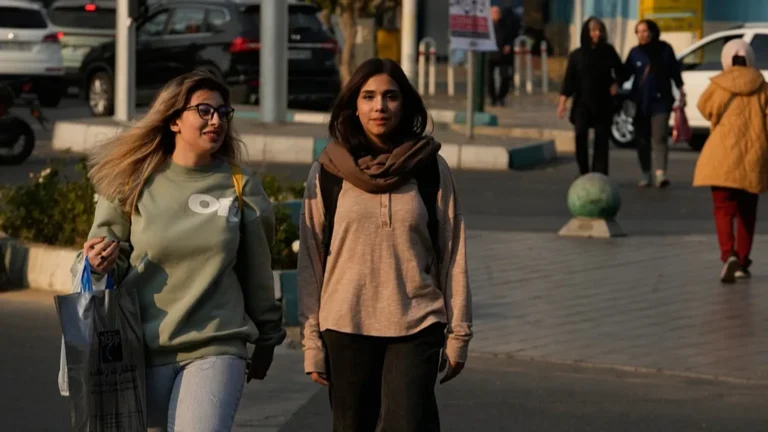
Tehran, Iran – CNN reported that the sharp social divide over the mandatory hijab in Iran has resurfaced strongly in recent months. The rejection of the mandatory hijab comes amid a highly complex situation in the country, marked by widespread military tensions and successive changes in Iranian leadership. While a growing number of Iranian women insist on refusing to comply with the hijab rules publicly enforced in the streets and public spaces, the Iranian government has, so far, refrained from launching a full-scale crackdown and enforcing these rules with its usual force.
The report noted that at the height of military tensions and confrontation with the United States, the authorities sometimes sought to contain the situation. Therefore, they brought unveiled women to pro-government rallies to bolster their image through official media. In one video, an unveiled woman appeared waving the Iranian flag. She affirmed that her husband was a soldier and that she was extremely proud of his military service.
Religious and political pressures escalate despite the crises
However, mounting pressure has increased significantly in recent weeks. This pressure has focused on addressing what conservative clerics and political circles in Tehran describe as “public indecency,” which they consider a transgression of official norms. Nevertheless, CNN indicates that the Iranian government is currently prioritizing other, more pressing issues. Foremost among these are the repercussions of direct confrontation and escalation with the United States, the deep economic and financial crises plaguing the country, and the ongoing restructuring of the internal security apparatus. There is also a new leadership for Supreme Leader Mojtaba Khamenei. In the context of cracking down on dissenters, Iranian state media reported the closure of several cafes and shops for allegedly violating government regulations, specifically those concerning dress codes and mask-wearing. A recent CNN investigation into Iranian media revealed similar clashes and tensions in at least six major Iranian cities, including the capital, Tehran.
Strict security measures and harsh judicial rulings
A group of human rights activists inside Iran documented the closure of at least seven major cafes and restaurants in the capital, Tehran, on July 19. The closures were justified by claims that the establishments were not complying with mandatory hijab laws. In a related development, the Tehran prosecutor’s office announced it would take a firm and decisive stance against what it termed violations of “public morality.” This measure specifically targets certain cafes, restaurants, and shops that display and sell clothing deemed “unconventional.”
Similarly, the official Mehr News Agency quoted the prosecutor of South Khorasan province as saying that ten cafes in the same province had been closed. The closures were attributed to violations of “social norms and mandatory hijab rules.” The crackdown wasn’t limited to commercial and service establishments; it extended to cultural and artistic figures. Prominent Iranian singer Parastou Ahmadi, along with eight members of her band and production team in Qom, were sentenced to 74 lashes each. They were also banned from leaving the country for two years. These harsh sentences stemmed from a video Ahmadi posted online in which she appeared without a hijab and with her shoulders exposed.
Ongoing field challenges and remarkable female determination
Conversely, photos and videos widely shared on social media confirm that young Iranian women in Tehran and other major cities continue to walk freely in the streets and public spaces without headscarves. Some even ride motorcycles and bicycles in clear defiance of the authorities’ directives. CNN concluded in its report that the Iranian government is currently adopting a cautious and calculated approach to this sensitive issue. The network quoted a 60-year-old woman living in Tehran who said that young women now walk the city streets in a variety of clothing. She considered the enforcement of the hijab to be “practically irrelevant.” She also asserted that she does not expect the government to succeed in forcing the new generation of women to return to wearing the hijab.