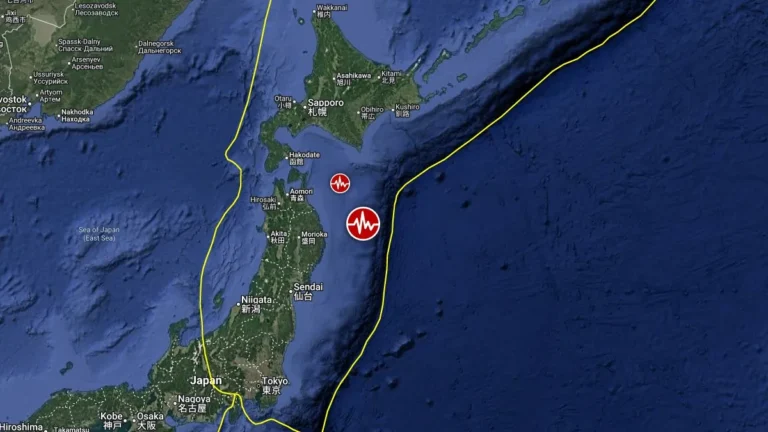
Tokyo, Japan — A 5.8 magnitude earthquake struck off the east coast of Honshu, Japan’s largest island. According to the German Research Centre for Geosciences, the seismic event occurred at a depth of 78 kilometers beneath the Earth’s surface. Furthermore, residents across eastern Japan, including the capital Tokyo, felt the tremor without immediate reports of casualties or structural damage.
Magnitude Assessments and Impact of the Earthquake Off Honshu
Official monitoring agencies reported slight variations in estimating the seismic strength. While the Japan Meteorological Agency measured the quake at magnitude 5.9, both the US Geological Survey and German research centers rated it at 5.8. Consequently, the moderate depth of 78 kilometers allowed vibrations to spread across a wider geographical area without causing localized severe destruction.
However, Japanese authorities confirmed that no tsunami warnings were triggered following the offshore event. Meanwhile, local emergency teams continue monitoring seismic activity for potential aftershocks. Therefore, public services and transit networks in Tokyo and surrounding prefectures maintained normal operations.
Seismic Readiness and Ongoing Monitoring Operations
Japan remains one of the most seismically active regions globally, necessitating continuous monitoring of tectonic movements. Consequently, strict structural engineering codes help mitigate potential infrastructure risks during moderate-to-strong earthquakes. Ultimately, early warning detection systems remain crucial for maintaining public safety during unexpected seismic events. In conclusion, local disaster management agencies remain fully prepared to respond to any further seismic developments.