- Cairo before “the next day”
- Sisi… the channel of political decision-making
- Rashad… the most sensitive negotiation channel
- Why does Washington need Cairo?
- Rafah Crossing: From Border to Implementation Test
- Egypt does not want to inherit the Gaza crisis.
- The most difficult question: Who governs Gaza?
- Cairo is caught between Washington, Hamas, and Israel.
- Israeli test
- From “mediation” to “implementation diplomacy”
- Why does Cairo seem different from the other mediators?
- What does Cairo want?
- Testing began in Cairo
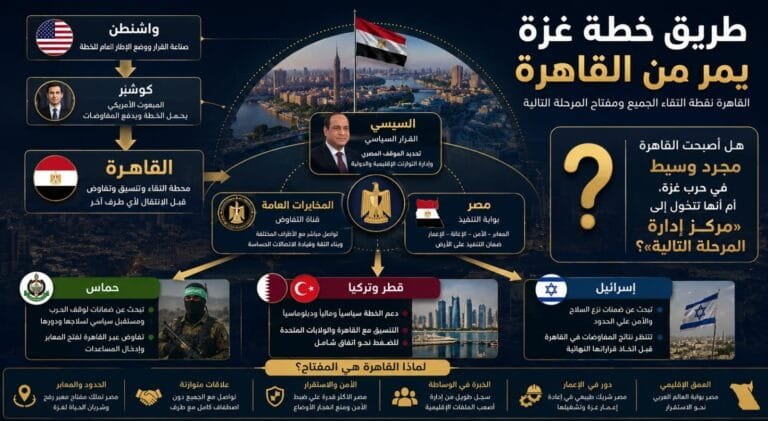
Cairo, Egypt – Cairo is no longer merely a venue for negotiations regarding Gaza; it has become a crucial testing ground for the Washington-led process of transitioning from a ceasefire to arrangements for the next phase. On August 16, Egyptian President Abdel Fattah al-Sisi received US envoy Jared Kushner in El Alamein, coinciding with a meeting in Cairo between General Intelligence Chief Hassan Rashad and a Hamas delegation headed by Khalil al-Hayya. The US envoys also held meetings with Egyptian, Qatari, and Turkish mediators to advance Washington’s plan for Gaza. This convergence raises a question that transcends the details of the meetings: Why has Cairo become the meeting point for American, Palestinian, and regional efforts before the Israeli test begins?
Cairo before “the next day”
The current move comes at a time when the nature of the negotiations has changed. A ceasefire is no longer the sole central issue; more complex matters have emerged concerning the future governance of the Gaza Strip, Hamas’s weapons, the Israeli withdrawal, security, reconstruction, and border and crossing arrangements. The proposed American roadmap includes arrangements for the disarmament of Hamas, the withdrawal of Israeli forces, and the establishment of a new Palestinian administration, along with security arrangements and reconstruction. However, the plan continues to face fundamental disagreements between Israel and Hamas regarding the sequence of steps and their guarantees. This is where Cairo’s importance is amplified, as it is the only Arab state that shares a direct border with Gaza and possesses extensive experience in mediating between the parties involved.
Sisi… the channel of political decision-making
President Abdel Fattah al-Sisi’s meeting with Jared Kushner in El Alamein represents the highest political level of the Egyptian initiative. According to the Egyptian presidency, the meeting addressed the implementation of the ceasefire agreement in Gaza and the necessity for all parties to adhere to their commitments, in addition to regional developments. Foreign Minister Badr Abdel-Aty and General Intelligence Chief Hassan Rashad were among those present. The meeting’s significance lies in the fact that Cairo does not view the American plan as an initiative detached from its interests, but rather as a process that will have direct repercussions on the security of Egypt’s borders, the future of the Gaza Strip, and the arrangements at the Rafah crossing.
Rashad… the most sensitive negotiation channel
In a parallel track, Hassan Rashad received a Hamas delegation headed by Khalil al-Hayya. These talks are particularly significant because the nature of the General Intelligence Directorate allows it to manage sensitive security and political files outside of traditional diplomatic channels. Rashad’s meeting with the Hamas delegation coincided with the American initiative in Cairo, prior to Kushner’s meeting with the movement’s leadership, reflecting the existence of two parallel tracks: a political track with Washington and a security-based negotiation track with Hamas. This does not mean that Cairo holds sway over the movement’s decisions, but rather that it possesses a direct channel of communication with it, a crucial element in any attempt to transform political proposals into implementable understandings.
Why does Washington need Cairo?
The equation is not simply about mediation. Egypt possesses a range of influence factors that make it an indispensable player in any future arrangements for the Gaza Strip. These include its border with Gaza, the Rafah crossing, its security relationship with Israel, its channels of communication with Hamas and the Palestinian Authority, and its relationship with the United States. Research indicates that Cairo has used its position on the Gaza border and at the Rafah crossing as leverage in its relationship with Hamas, while also maintaining channels for Palestinian reconciliation and security coordination with Israel. Therefore, Egypt’s current role is based on a structure of influence that has accumulated over years, rather than on a sudden diplomatic initiative.
Rafah Crossing: From Border to Implementation Test
In any future agreement, the Rafah crossing will be one of the most sensitive issues. Managing the movement of people and aid, controlling the border, preventing smuggling, and dealing with new security arrangements all require direct coordination with Cairo. International studies have therefore warned that any security vacuum following a potential Israeli withdrawal would be a direct concern for Egypt, which seeks regional and international guarantees that it will not be solely responsible for Gaza’s security. This is one of Egypt’s greatest strengths and, simultaneously, one of its most significant limitations.
Egypt does not want to inherit the Gaza crisis.
The expansion of Egypt’s role does not mean that Cairo wants to assume sole responsibility for managing the Gaza Strip. International analyses indicate that Egypt is keen to avoid becoming the sole party bearing the cost of Gaza’s security or managing its crises after any Israeli withdrawal. Therefore, Cairo appears more interested in establishing multilateral arrangements that distribute security, political, and financial responsibilities, rather than having the entire burden fall on Egypt.
The most difficult question: Who governs Gaza?
Here the negotiations move to the heart of the “day after”; the question is no longer simply: how to stop the war? But:
Who governs the sector?
Who is in charge of security?
What will happen to Hamas’s weapons?
Who is monitoring the Israeli withdrawal?
How are the crossings managed?
And who is overseeing reconstruction?
The American plan calls for a new Palestinian civilian administration, with security arrangements and the disarmament of Hamas, while the movement and Israel still disagree on the order of these steps and their guarantees.
Cairo is caught between Washington, Hamas, and Israel.
The current situation can be interpreted as a negotiating triangle:
Washington holds the initiative and political pressure.
Hamas holds the decisive power regarding its weapons and future role.
Israel holds the military decision-making power on the ground and, according to its public statements, refuses to withdraw before ensuring the complete disarmament of the movement.
Egypt, along with Qatar and Turkey, is moving in the space between these parties in an attempt to narrow the gap before reaching the stage of direct negotiations on the final details.
Israeli test
The success of the Egyptian-American initiative in Cairo does not mean the plan is close to implementation. The most difficult test remains tied to the Israeli position. Recent reports indicate that Israel refuses to withdraw from Gaza before Hamas is disarmed, while Washington is trying to push the parties toward the proposed roadmap. Therefore, Cairo can bridge the gaps and open channels of communication, but it cannot make decisions on behalf of the parties.
From “mediation” to “implementation diplomacy”
Herein lies the most crucial aspect of Egypt’s role. Traditional mediation ends with bringing positions closer and reaching an agreement. The next phase requires something different: ensuring the agreement’s sustainability after its signing. This entails addressing daily issues including borders, aid, crossings, security, communication between the parties, and reconstruction. International studies indicate that Egypt will be a key player in this phase, but at the same time, it seeks to distribute responsibility regionally and internationally, ensuring it is not left alone to face the repercussions of any security vacuum in the Gaza Strip.
Why does Cairo seem different from the other mediators?
The key difference is geography. Qatar and Turkey can provide important political channels. The United States can exert pressure and formulate initiatives. But Egypt lies directly on the Gaza border, controls the Rafah crossing, and has security channels of communication with key parties. This makes Egypt’s role more closely tied to the implementation phase, not just the negotiation phase.
What does Cairo want?
Egyptian and international positions and analyses point to a set of overlapping priorities:
Protecting Egyptian national security.
Preventing the spread of armed chaos to Sinai.
Rejecting any arrangements that would lead to the displacement of Palestinians to Egyptian territory.
Ensuring the continued flow of aid.
Maintaining a Palestinian role in managing the Gaza Strip.
Most importantly, preventing Egypt from becoming the sole party responsible for managing Gaza after the war.
This equation explains why Cairo is trying to influence the arrangements for the “day after” without seeking to appear as an alternative to the Palestinians in managing the sector.
Testing began in Cairo
The scene that unfolded in Cairo on August 16 reflects a shift in the nature of Egypt’s role. Sisi is engaging with Washington on the political decision-making level, while Hassan Rashad is managing a direct security channel with Hamas. Meanwhile, Egypt’s geography grants Cairo significant influence over border issues, crossings, aid, and security arrangements. This does not mean that Egypt will administer Gaza or hold the keys to the next phase. However, it possesses a set of leverage that makes any stable formula for the “day after” contingent upon direct Egyptian coordination.
Thus, Cairo is transitioning from the role of mediator attempting to halt the war to that of a party seeking to influence the shape of the post-war regime.
The question that will determine Egypt’s weight in the next phase is not whether it will administer Gaza, but rather: Can Cairo transform the network of contacts it has built with Washington, Hamas, and mediators into a practical mechanism that ensures the implementation of the day-after agreement without Egypt becoming the sole party bearing the cost of the crisis?
So far, there is no definitive answer, but what is certain is that the test of the day-after began politically in Cairo before it began on the ground in Gaza.