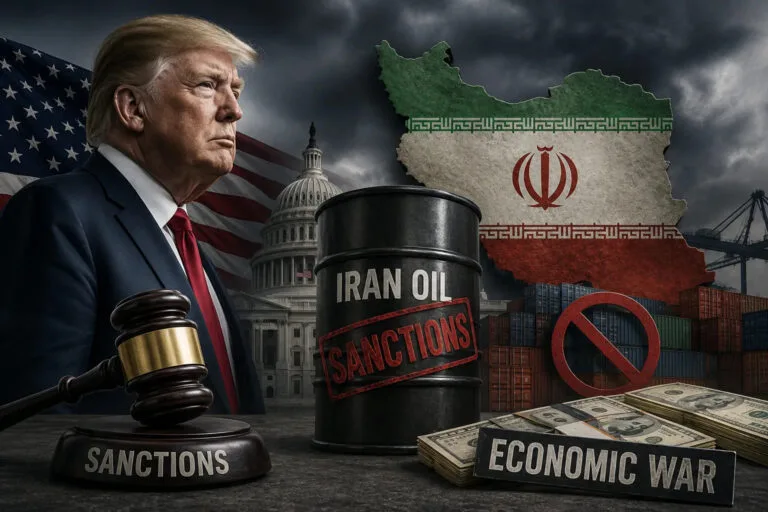
Washington, DC – A Newsweek report revealed that the tightening of US sanctions does not necessarily mean a swift response from Tehran in offering concessions. The report indicated that the economic confrontation between the United States and Iran is entering a more intense and dangerous phase. Meanwhile, US President Donald Trump threatened to expand the scope of pressure to include all countries and institutions that provide Tehran with channels for trade and external financing. Furthermore, the tension is widening to encompass international shipping lanes in the Gulf region and the Strait of Hormuz.
Economic war and isolation on an unprecedented scale
The US president announced that the next phase would consist of what he described as “an economic war and isolation on an unprecedented scale.” He threatened severe consequences for any country that allows its financial institutions, companies, airports, or government entities to provide any form of support to the Iranian economy. Trump then described these anticipated measures as “Drop-Off Day.” He called on allies and international partners to join the strategy of isolating Tehran and completely cutting off its external funding sources.
The factors contributing to Iranian resilience in the face of pressure
According to reports published by Newsweek, the tightening of the US sanctions does not necessarily guarantee that Tehran will make quick political concessions. Despite the severe damage inflicted on key sectors of the Iranian economy—such as the sharp decline in the Purchasing Managers’ Index and a nearly 30% drop in crude oil production—and despite rising inflation and a depreciating currency, Tehran still relies on a domestic and regional safety net to absorb shocks. Among the most prominent of these is a relatively diversified industrial and agricultural base that provides essential market needs and reduces overall dependence on imports. Furthermore, Iranian oil sales to China continue, and essential intermediate goods and spare parts flow through alternative trade channels. Iran also leverages its geographic location and land and sea borders with neighboring countries to circumvent the imposed financial blockade. Moreover, Iran possesses a complex and long-established mechanism for circumventing international economic sanctions.
The deadlock in negotiations and Iran’s red lines
Current data confirms a decline in the Iranian leadership’s appetite for diplomacy compared to 2015. Analysts believe that the political cost of any concessions Tehran might make to Washington has become prohibitively high. Instead of yielding to pressure, the Iranian leadership is likely to endure the economic hardship for as long as possible. Some believe Tehran is betting on forcing Washington to return to negotiations later on different terms, including the lifting of sanctions and the release of frozen assets. However, these calculations could change drastically if the crisis crosses major red lines. For example, if annual inflation reaches devastating record highs or the rial collapses entirely, this could tip the scales toward military conflict over political solutions.
Naval blockade and the risks of disrupting actual trade
The biggest problem for Tehran may not be the imposition of new sanctions, but rather the tightening of existing restrictions and the disruption of actual trade. In this context, Iranian journalist Amin Mokarrami points out that resuming the naval blockade could raise the level of pressure to unprecedented levels by disrupting exports of oil and petrochemical products. This could also affect essential imports, especially given the potential contraction of some important regional trade routes, such as those through the UAE. The UAE has been a vital conduit for Iranian trade.
Mutual cost and long-term test
Conversely, the burden of the crisis is not solely on the Iranian side; the American strategy faces tangible domestic challenges. These challenges include a decline in consumer confidence, rising fuel prices and the cost of living, and the US national debt exceeding $40 trillion. Tehran is exploiting these factors, along with leverage related to maritime routes, to raise the cost of escalation for the West. Consequently, the current phase is becoming a severe and protracted test of the two sides’ ability to sustain the conflict. Washington is betting on the collapse of the Iranian economy, while Tehran is banking on its strategic patience and long experience, waiting for the moment when a diplomatic settlement becomes the least costly option for Washington and its allies.