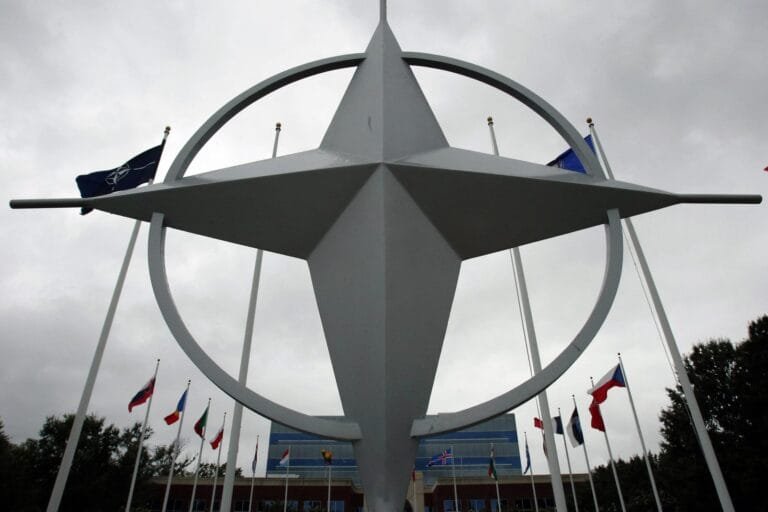
Paris, France – Politico has warned that the 2027 French presidential election could have significant repercussions for the future of NATO. This could happen if political forces with skepticism or opposition to the alliance were to reach the Élysée Palace. The newspaper noted that opinion polls reflect growing support for political movements calling for a reassessment of France’s relationship with the Western military alliance.
Half of the voters are faced with choices that oppose NATO.
The newspaper explained that the latest opinion polls indicate a significant percentage of French voters support candidates who hold negative views of NATO. Among the most prominent are Marine Le Pen, leader of the National Rally parliamentary group, and Jean-Luc Mélenchon, founder of the La France Insoumise party. Le Pen seeks to remove France from the alliance’s integrated military command. Mélenchon takes an even more extreme stance, declaring his desire for France to withdraw from NATO entirely. This trend is raising concerns within the alliance about the possibility of a fundamental shift in Paris’s defense policy in the coming years. According to an internal NATO poll conducted in the spring and reviewed by Politico, approximately 54% of French voters said they would vote to keep France in the alliance. This is the second lowest percentage among the 32 member states, after Montenegro.
Fears of a “significant rift” within the alliance
These developments come at a highly sensitive time for NATO, which is facing increasing questions about the level of the US military commitment to Europe. This coincides with European countries increasing defense spending and bolstering their military capabilities in anticipation of a possible confrontation with Russia. Politico warns that the next French president could create a “significant rift” within the alliance, especially if Paris chooses to reduce its participation in joint military structures. The French position is all the more important given that France is one of Europe’s leading military powers and the only nuclear power in the European Union. Jamie Shea, a defense researcher at the Friends of Europe think tank and a former NATO spokesperson, said that the declining US presence in Europe makes the departure of a major European country like France from the alliance even more problematic, at a time when European countries, including France, are expected to assume greater defense responsibilities.
Military repercussions that extend beyond the political leadership
Marie-Agnes Strack-Zimmermann, Chair of the European Parliament’s Defence Committee, argues that France is not merely a founding member of NATO, but a key player within its military structure, particularly due to its nuclear capabilities. She believes that the only beneficiaries of a French withdrawal or a weakening of its role within the alliance would be the adversaries of Western nations. Among the issues of concern is the future of the French battle group in Romania, comprising approximately 1,200 troops and commanded by Paris. Also of concern is the presence of French forces in Estonia and their participation in various operations and missions within the European and Atlantic defense framework. Cooperation in intelligence, satellite technology, and nuclear capabilities—areas in which France is among the most advanced in Europe—could also be affected.
De Gaulle’s experiment is back in the spotlight
Analysts point out that the idea of France distancing itself from NATO’s military command is not new. French President Charles de Gaulle withdrew his country from the alliance’s integrated military command in 1966, while Paris simultaneously maintained close ties with NATO and participated in several of its operations. France rejoined the alliance’s integrated military structures in 2009 during Nicolas Sarkozy’s presidency. The possibility of a return to this policy of distancing itself from military command raises questions about the nature of the relationship that might develop between Paris and NATO should Le Pen win the presidency. French General Michel Yakovlev, a former deputy chief of staff at NATO’s military headquarters, stated that, theoretically, withdrawal from military command structures could begin quickly. He explained that the French president would not necessarily need to consult parliament to take this step. He noted that the actual implementation could take about a year, due to the need to redeploy approximately one thousand French officers permanently stationed at NATO institutions, in addition to establishing a new liaison body to manage relations between Paris and the alliance.
Losses in military capabilities and funding
The repercussions of France’s distancing itself from NATO may not be limited to the political sphere. Yakovlev believes the alliance could lose a significant portion of French military capabilities. These include France’s only nuclear-powered aircraft carrier, the Mistral-class amphibious assault ships, and its satellite, intelligence, and naval capabilities. According to Yakovlev, France possesses “a little bit of everything,” which makes its contribution to the alliance strategically valuable, especially given the need to distribute military burdens among European countries. Any withdrawal or reduction in French participation could also impact the alliance’s budget, as Paris currently contributes approximately 10% of NATO’s annual operating budget, which amounts to around €5.3 billion.
Crucial elections in April 2027
The French presidential election is scheduled for April 18, 2027, with a second round to be held on May 2 if necessary. Current President Emmanuel Macron will be ineligible to run, having served two consecutive terms. Marine Le Pen intends to contest the presidential race, having been granted the right to run in early July after her conviction for embezzling funds from the European Parliament was reduced. With the election fiercely contested, foreign and defense policy will remain key issues that could determine the direction of French voters. Should opposition or NATO-skeptic political forces come to power, the alliance could face a new test of its cohesion at a time when Europe is facing increasing security challenges and member states are reassessing their military roles and defense responsibilities.