- The children of Daraa… the first clue in the case
- The Omari Mosque: From protest to open confrontation
- The court draws a line from Daraa to the head of the authority.
- Why did the court consider some of the crimes to be war crimes?
- How did the court say it had proven the charges?
- Why was Atef Najib present while Bashar was tried in absentia?
- Execution is not the only punishment
- Compensation for victims: The other side of the ruling
- Eight death sentences… and security and military figures are on the list
- A historic trial… but the controversy is not over.
- The Russian obstacle: Can the sentence be carried out?
- What does governance mean for the new Syria?
- Is this a verdict against Assad, or the beginning of a trial for a whole phase?
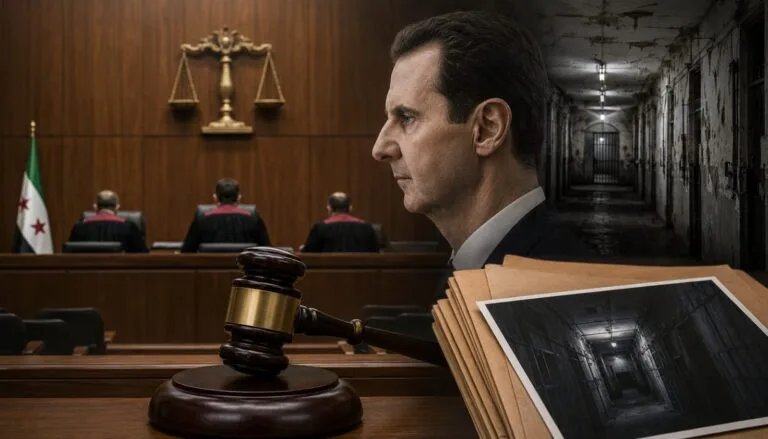
Damascus, Syria – In the courtroom of the Fourth Criminal Court in Damascus, the scene was not merely a session to deliver a verdict against a former Syrian president, but rather a pivotal moment in the transitional justice process that the new Syria is attempting to establish after the fall of Bashar al-Assad’s regime. On August 11, 2026, the court issued its verdict in Case No. 1 of 2026, sentencing Bashar al-Assad in absentia, along with his brother Maher al-Assad, Atef Najib, and six other fugitive defendants, to death after convicting them of murder, torture, unlawful deprivation of liberty, crimes against humanity, and war crimes. The case against the defendant Mohammed Ayman Ayoush was dropped due to his death.
The court issued its ruling unanimously in a 396-page decision, with the Ministry of Justice to publish the full text later after redacting the names of the protected witnesses. Therefore, what is currently available is the main reasoning and the court’s operative part, not the complete judicial decision.
The children of Daraa… the first clue in the case
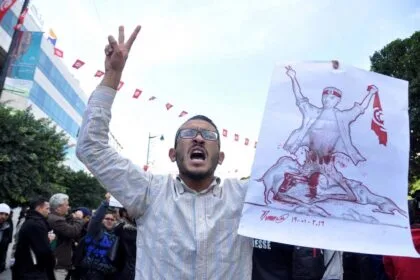
The court did not begin its story from the long years of war, but rather returned to the first days of the protests in Daraa in 2011. According to the court’s merits, the arrest and torture of a group of children after they wrote anti-government slogans on school walls were among the events that preceded the explosion of the protests. The court said that witnesses who were children at the time spoke of being beaten, electrocuted, hung, and having their nails pulled out.
Atef Najib, who headed the Political Security branch in Daraa, was among the key figures the court placed at the heart of these events. The court stated that he personally interrogated some children and participated in the security forces’ handling of the protests. Following this, demonstrations erupted in Daraa demanding the release of detainees. The court stated that the March 18, 2011, demonstration was met with live ammunition, resulting in fatalities, before the clashes escalated in the following days.
The Omari Mosque: From protest to open confrontation
The court’s reasoning focuses on the events at the Omari Mosque in Daraa on March 22 and 23, 2011. The court states that security forces stormed the mosque using tear gas and live ammunition, resulting in deaths and injuries. Ambulances were fired upon, and a number of the wounded were detained, some of whom later died. The court considers these incidents not isolated security events, but rather part of an escalating pattern in the response to the protests. This was followed by mobilization of residents from villages surrounding Daraa, and then by security operations that resulted in even greater numbers of deaths and injuries. From this point, the court’s reasoning shifts from the responsibility of field officers to the larger question: Who made the decision at the highest levels of power?
The court draws a line from Daraa to the head of the authority.
The most significant part of the verdict concerns Bashar al-Assad himself. The court did not merely state that Assad was president at the time the crimes occurred, but considered his responsibility to extend beyond simply failing to oversee state institutions. According to the court, Assad was the primary decision-maker who formulated and announced policies, used state institutions to implement them, and then shielded those responsible for carrying them out from accountability.
Therefore, the court described his role as part of a “joint criminal enterprise,” arguing that his responsibility stemmed from his position at the top of the decision-making system, not merely from his constitutional role as head of state. This is the most significant legal point in the ruling, as it attempts to establish a direct link between the highest political decision and the crimes committed by state agencies.
Why did the court consider some of the crimes to be war crimes?
The court divided the facts chronologically. It decided that the conflict in Syria had become, according to the criteria it adopted, a non-international armed conflict in mid-July 2012. Accordingly, the court considered that the crimes committed by Atef Najib during the period from February to April 2011 occurred before the start of the armed conflict, and therefore described them as crimes against humanity and national crimes.
As for Bashar al-Assad and the other fugitive defendants, the court stated that their actions extended beyond mid-July 2012, and therefore their convictions included war crimes, in addition to crimes against humanity and national crimes. The court also stated that it based its definition of crimes against humanity on Article 7 of the Rome Statute of the International Criminal Court.
How did the court say it had proven the charges?
The court, according to its announcement, did not rely on a single source of evidence. It stated that its decision was based on the testimonies of prosecution witnesses, statements from the civil plaintiffs, official documents, medical reports, audio and video materials presented during the trial, and documented international reports. The court also stated that the witness testimonies corroborated and overlapped in identifying the facts, dates, and locations, and that it also heard from defense witnesses. The court took measures to protect some witnesses, using numbers instead of names and prohibiting the disclosure of their identities or any information that could lead to their location.
Why was Atef Najib present while Bashar was tried in absentia?
This is one of the most striking paradoxes of the case. Atef Najib was the only defendant present in Syria and appearing before the court, while Bashar and Maher al-Assad and the other fugitive defendants were sentenced in absentia. The court stated that it applied the articles pertaining to trials in absentia in the Syrian Code of Criminal Procedure and that it had fulfilled all the necessary legal requirements.
Bashar al-Assad has been in Russia since the fall of his government in December 2014, after fleeing Damascus as opposition forces advanced. Reuters reports that Russia granted him and his family asylum. This means that, for the time being, his sentence remains largely legal and symbolic, while its execution depends on his possible arrest or extradition.
Execution is not the only punishment
The ruling was not limited to the death penalty. The court upheld the arrest warrants for the fugitive defendants and ordered their circulation and the initiation of necessary legal proceedings for their international prosecution. It also decided to uphold the precautionary seizure of their funds and assets, converting it into an execution seizure, and to take measures regarding the management of the fugitive defendants’ assets. This means the case has implications that extend beyond criminal punishment to include international financial and legal pursuit.
Compensation for victims: The other side of the ruling
The court placed the victims’ case in a separate section of its ruling, considering reparations a fundamental element of transitional justice. It ordered the convicted parties to provide joint compensation to the civil plaintiffs whose claims were accepted, with the amount of compensation determined according to the extent of the harm suffered by each individual. The court also preserved the rights of other victims and the families of the dead and missing who did not file claims during this case, allowing them to pursue legal action through the appropriate judicial channels in the future.
Eight death sentences… and security and military figures are on the list
In addition to Bashar and Maher al-Assad and Atef Najib, the death sentences also included six fugitive defendants: Fahd al-Freij, Louay al-Ali, Qusay Mahyoub, Wafiq al-Nasser, Talal al-Aysami, and Maher al-Assad, according to the court’s list. They were charged with premeditated murder, multiple murders, murder accompanied by torture, incitement to murder, torture resulting in death, unlawful deprivation of liberty, and kidnapping. The court classified these acts, for those defendants whose actions extended into the armed conflict, as war crimes and crimes against humanity.
A historic trial… but the controversy is not over.
Despite the verdict’s importance for victims of the former regime, its issuance did not end the debate surrounding the path of transitional justice in Syria. Human rights organizations welcomed the importance of holding those responsible for violations accountable, but raised concerns regarding the speed of the trial, guarantees of legal representation, and the use of the death penalty.
The Associated Press quoted Human Rights Watch as rejecting the death penalty in all cases, deeming it a cruel and irreversible punishment, especially when fair trial guarantees are questionable. The Syrian Center for Justice and Accountability, which monitored the trial, also noted procedural problems, including the speed of the proceedings and the weakness of some testimonies in directly linking Atef Najib to the crimes attributed to him, as well as concerns about the performance of his lawyer. Herein lies the great paradox: for many Syrians, the trial represents a long-awaited moment, yet it is simultaneously tasked with proving that the new transitional justice process will not devolve into mere retribution.
The Russian obstacle: Can the sentence be carried out?
For Bashar al-Assad, the biggest obstacle appears to lie outside the courtroom. He is currently in Russia, where Moscow maintains he has been granted asylum and has so far refused Syrian requests for his extradition. Syrian human rights activists warn that a death sentence could make his extradition even more difficult, as countries that oppose capital punishment might not agree to hand over someone facing execution. According to Reuters, Syrian lawyer Anwar al-Bunni believes the death penalty could hinder Assad’s return and described the trial as more of a “show trial” than a genuine transitional justice process.
What does governance mean for the new Syria?
The verdict goes beyond Bashar al-Assad. The court explicitly stated that the prosecution can pursue other officials not included in the current case if sufficient evidence emerges, meaning that the file on the former regime is not closed with the issuance of death sentences. Furthermore, the confirmation of international prosecutions and asset freezes opens the door to a new phase that could extend to other figures inside and outside Syria. At the same time, the verdict presents the new Syrian authorities with a greater test: can they transform this case into a sustainable judicial model for holding those responsible for violations accountable, or will the trial remain merely a symbolic moment linked to the fall of the former regime?
Is this a verdict against Assad, or the beginning of a trial for a whole phase?
On the surface, the story is a death sentence for Bashar al-Assad. But a reading of the court’s reasoning reveals that the case is much bigger than the former president himself. The court attempted to reconstruct a chain of events beginning with the arrest of children in Daraa in 2011, continuing through the suppression of demonstrations, then the escalation of the conflict into a war that lasted nearly 14 years, culminating in holding the head of state responsible for what the court described as a criminal project in which state institutions were exploited. According to the legal narrative, Bashar al-Assad was not merely a political figure who failed to control the state apparatus, but rather the ultimate decision-maker who formulated policies, directed state institutions to implement them, and protected those who carried them out from accountability.
But the verdict, despite its political and legal weight, does not mean that Bashar al-Assad will face execution anytime soon; it was issued in absentia, and the accused is currently in Russia. Furthermore, the full 396-page version of the verdict has not yet been published, meaning that the final details of the evidence and legal reasoning will still need to be reviewed when the full text becomes available. Thus, Bashar al-Assad’s case does not end in the Damascus courtroom. The verdict has opened a new battle: the battle to prove that Syria is capable of delivering justice for the victims, while simultaneously conducting a trial that meets the legal standards necessary for its rulings to withstand domestic and international scrutiny.