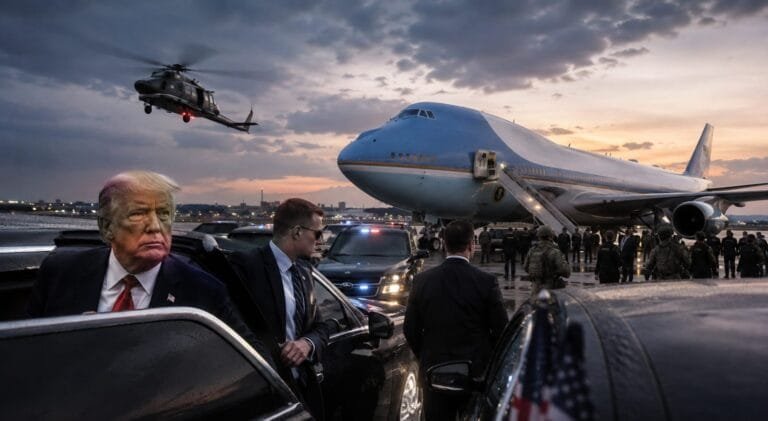
- An Iranian threat forced Trump to leave Air Force One.
- A catering vehicle to conceal the transport operation
- What does Iran have to do with the threat?
- Why didn’t Trump use the Qatari plane?
- The Qatari plane: From “gift” to a political and security issue
- Air Force One has been transformed into a camouflage aircraft.
- Controversy over transparency
- Why does the threat pose a bigger problem outside the United States?
- The plane case enters a new phase
- Between the Iranian threat and the president’s security
Washington, DC – Recent US reports have revealed that American security agencies secretly removed President Donald Trump from his presidential plane during his departure from Turkey last month, following intelligence reports of a potential Iranian threat against his life. This incident has reignited the debate surrounding the security of the US president and the types of aircraft used for his travels. Among these aircraft is the new presidential plane linked to Qatar.
An Iranian threat forced Trump to leave Air Force One.
According to reports published by The Washington Post and other US media outlets, US intelligence agencies received information about a potential threat to President Trump while he was in Turkey following the NATO summit in Ankara. The reports cited intelligence indicating the possibility of a missile attack on Air Force One. This prompted the Secret Service to implement undisclosed measures to alter Trump’s return route from Turkey. As part of this operation, Trump was publicly seen departing on a conventional Air Force One aircraft. However, he was secretly transferred to a smaller military plane in an attempt to conceal his true destination and itinerary.
A catering vehicle to conceal the transport operation
According to reports, Trump did not disembark from the plane in front of the media in the usual manner. Instead, an airport catering vehicle was used in a covert transfer from Air Force One to the alternate aircraft. A number of officials, aides, and journalists remained on the plane that was believed to be taking the president to Britain. Trump departed on a different aircraft. These actions suggest that US authorities treated the threat as one that warranted concealing the president’s exact location and flight path. Despite this, there was no actual attack on the plane, nor was a missile fired at it.
What does Iran have to do with the threat?
The American reports that revealed the operation attributed the threat to Iran or its affiliates, amid escalating military and political tensions between Washington and Tehran. Some reports cited Israeli intelligence warning of the potential use of a shoulder-fired missile against the plane carrying Trump. This hypothesis prompted security agencies to take unusual precautionary measures. However, it is important to emphasize editorially that the published reports describe an intelligence threat, not an actual assassination attempt. Furthermore, no missile launch or direct attack on Trump has been reported.
Why didn’t Trump use the Qatari plane?
This incident intersects with another highly controversial issue in the United States: the luxurious Boeing 747-8 aircraft provided by Qatar to the US, which was temporarily converted into a presidential plane. The aircraft entered service under the VC-25B Bridge arrangement after undergoing modifications and testing, thus becoming part of the presidential air transport system. However, US reports indicated that the Secret Service advised against using the aircraft for certain flights due to security concerns related to its defensive capabilities. This has reopened the debate about the aircraft’s readiness to provide the necessary protection for the president in high-risk environments.
The Qatari plane: From “gift” to a political and security issue
The Qatari aircraft had sparked controversy since its announcement as a gift to the United States, due to its high value and potential use in transporting the US president. The plane is valued at approximately $400 million. Its acceptance raised political and legal questions regarding the nature of a gift from a foreign country and its compatibility with US constitutional and legal restrictions concerning gifts and benefits provided to the president by foreign governments. The US administration pledged that the aircraft would undergo extensive modifications and upgrades before being used within the presidential transportation system. In May 2026, the US Air Force announced the completion of the modifications and testing of the aircraft.
Air Force One has been transformed into a camouflage aircraft.
The recent incident reveals an unusual aspect of presidential security procedures: the aircraft designated “Air Force One” when the president is on board is not merely a means of transportation. It is often a crucial element in pinpointing the president’s location. In the Turkey operation, the aircraft believed to be carrying Trump was used as a cover for his true location. Meanwhile, the president transferred to another aircraft. American reports indicate that over one hundred people, including staff, journalists, and officials, remained on the plane believed to be carrying the president. However, Trump had already departed.
Controversy over transparency
The operation sparked criticism and questions within the United States regarding the administration’s handling of the threat. The debate centers on two main points: first, the decision not to inform all passengers on board about the threat; and second, the provision of inaccurate or incomplete information to the public and journalists about the president’s trip. On the other hand, proponents of the security measures argue that protecting the president against a potential threat necessitates a high degree of secrecy, especially when the threat originates from a country with extensive missile and drone capabilities.
Why does the threat pose a bigger problem outside the United States?
The security risks surrounding the US president increase when he is outside the United States, as it is difficult for security agencies to fully control the airspace, airports, roads, and facilities surrounding his location. Therefore, protecting the president on foreign trips relies on a collaborative system involving the Secret Service, the military, intelligence agencies, and the host country. Furthermore, procedures include altering flight paths, schedules, and takeoff and landing locations. In the case of Turkey, the threat appears to have prompted US agencies to move beyond traditional security measures and conceal the president’s actual itinerary.
The plane case enters a new phase
The incident also reignited a fundamental question about the Qatari aircraft: Could the newly modified plane provide the president with the necessary level of protection in an environment rife with advanced missile threats? The U.S. Air Force had announced that the aircraft had undergone the necessary modifications and testing. However, details regarding the aircraft’s electronic and defensive protection systems remain classified for national security reasons. This means that the aircraft’s non-use in a sensitive security situation does not necessarily indicate a specific flaw. But it does reflect, at the very least, the continued security sensitivity surrounding its use for presidential travel.
Between the Iranian threat and the president’s security
These developments come at a time of heightened tension between Washington and Tehran, with the two sides having previously exchanged threats and military strikes, and the protection of American officials becoming a top security priority for US agencies. The covert operation in Turkey indicates that threats against Trump are no longer treated merely as political statements or media pronouncements. Rather, when specific intelligence is available, they can escalate into large-scale field security operations. Despite this, there is no publicly available information proving that Iran carried out a direct assassination attempt against Trump or that it fired a weapon at his aircraft. What is certain so far is the existence of an intelligence threat that US agencies deemed serious enough to warrant a covert evacuation of the president.