
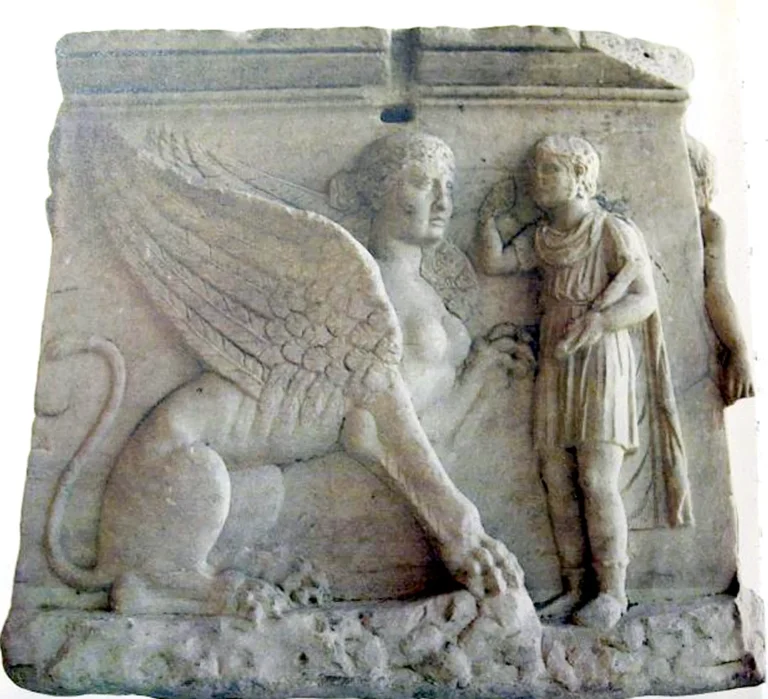
Thebes, Greece – The Sphinx holds a prominent place in Greek mythology, but its story differs from the famous statue found in Egypt.
In Greek mythology, it appears as a fearsome mythical creature with the body of a lion, the head of a woman, and the wings of a bird.
The Greek Sphinx was associated with the city of Thebes, where legend tells that it lay near the city, obstructing travelers.
It would challenge them to solve a famous riddle, and those who failed to answer met a tragic fate.
The mystery of the Sphinx, the legendary creature
The riddle asked which creature walks on four legs in the morning,
on two at midday, and on three in the evening.
The answer was humankind; a child crawls on all fours, and an adult walks upright.
In old age, however, a person needs a cane to help them move.
The legend says that Oedipus solved the riddle, and his answer became the turning point
that led to the Sphinx’s defeat and the end of the terror it had inflicted on the people of Thebes.
Profound symbolism in ancient Greek thought
The story holds profound symbolism in ancient Greek thought, where knowledge,
reasoning, and the ability to solve mysteries were seen as means of overcoming danger.
The Sphinx itself became a symbol of mystery and questions that test human intellect.
Despite the similarity in name and general form to the Egyptian Sphinx, each has different roots and symbolism.
The Egyptian Sphinx was associated with royalty and protection,
while its Greek counterpart appeared more terrifying, linked to enigma and human destiny.