- Starting from Riyadh
- Türkiye enters the negotiating room
- What did Ankara want?
- Egypt appears in the parallel track
- The war changed the room’s calculations
- From agreement to military deployment
- The hardest question is: who put forward the initiative?
- Why Mecca?
- And what about Egypt?
- The room that Mecca revealed
- Who will be inside the room in the next phase?
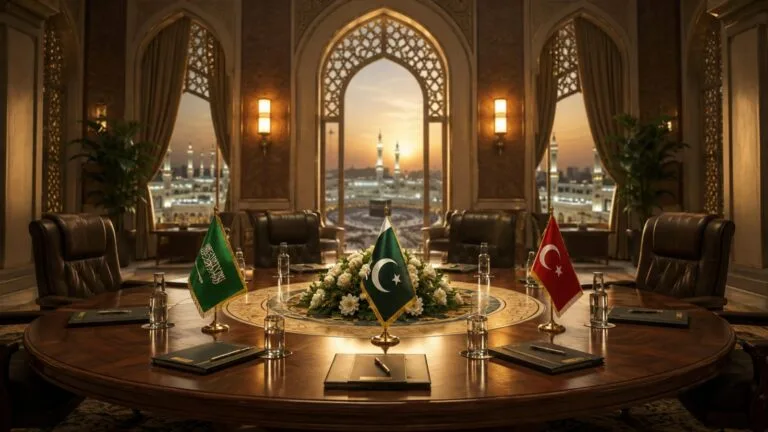
Riyadh, Saudi Arabia – The joint defense agreement signed by Saudi Arabia, Turkey, and Pakistan in Mecca on August 7, 2016, did not begin within the signing hall. It was preceded by months of consultations and a realignment of security priorities. This process began with a Saudi-Pakistani agreement, and then expanded to include Turkey. Simultaneously, Egypt moved in parallel within a broader regional consultative framework. A review of official statements and international media coverage reveals that the agreement was the product of a gradual process dictated by security shifts in the region. However, this was all before it reached its final form in Mecca.
Starting from Riyadh
The starting point was announced on September 17, 2015, when Saudi Arabia and Pakistan signed a joint strategic defense agreement in Riyadh. It stipulated that an attack on one country would be considered an attack on the other. This agreement was not the beginning of military cooperation between the two countries, as Saudi-Pakistani defense cooperation has existed for decades. However, the new agreement provided a clearer framework for the relationship and opened the door to expanded cooperation in training, joint exercises, and defense coordination. From that moment, the foundations of a regional security system began to take shape.
Türkiye enters the negotiating room
In January 2026, Turkey emerged publicly on the scene after international reports revealed talks between Ankara, Riyadh, and Islamabad regarding expanding the framework of defense cooperation. On January 15, Turkish Foreign Minister Hakan Fidan confirmed the existence of these talks but stressed that no agreement had yet been signed. He explained that Turkey’s vision extended beyond simply joining a bilateral agreement, aiming instead for the establishment of a broader regional cooperation platform. Simultaneously, the Pakistani Minister of Defense Production revealed that the three countries had already prepared a draft defense agreement after months of negotiations. This information indicates that the Mecca Agreement was not a sudden decision but rather the culmination of a negotiation process that had begun long before its announcement.
What did Ankara want?
Turkey’s entry into the negotiations was driven by considerations that extended beyond the immediate military aspect. Ankara, a NATO member, has sought in recent years to expand its security and military partnerships with regional powers. This has been pursued in parallel with the development of its defense industry and its increased involvement in Middle Eastern affairs. Therefore, participating in a framework that includes Saudi Arabia, Pakistan, and Turkey provides Ankara with an additional platform for security coordination. However, this does not necessarily imply the creation of an alternative to Turkey’s existing alliances. Analyses from research centers indicate that Turkish policy in the region is increasingly based on diversifying partnerships and building multiple strategic options rather than relying on a single course of action.
Egypt appears in the parallel track
While the trilateral negotiations were underway, Cairo was engaged in a parallel regional track with Riyadh, Ankara, and Islamabad.
In April 2026, the four countries held a meeting of senior officials in Islamabad, following a previous ministerial meeting. Cairo then hosted another meeting of foreign ministers in June. The Egyptian presidency at the time emphasized the importance of developing a consultation mechanism among the four countries in light of the successive security and military crises plaguing the region. However, Egypt’s participation in this track did not imply its involvement in the Mecca Agreement. The agreement signed in August remained a trilateral agreement between Saudi Arabia, Turkey, and Pakistan.
The war changed the room’s calculations
With the escalation of military confrontation in the region during 2026, discussions about defense cooperation were no longer a distant prospect.
Missile and drone attacks, threats to vital infrastructure, and risks to navigation and energy infrastructure prompted countries in the region to reassess the concept of collective security. In this context, Saudi Arabia, Turkey, Egypt, and Pakistan held a series of meetings and consultations to discuss military developments, ways to de-escalate tensions, and ways to enhance coordination. Thus, the idea of defense cooperation moved from the level of strategic planning to a more urgent level, dictated by developments on the ground.
From agreement to military deployment
Saudi-Pakistani cooperation was no longer confined to the political sphere. In April 2026, Saudi Arabia announced the arrival of Pakistani air force personnel at King Abdulaziz Air Base in the Eastern Province, as part of the Joint Strategic Defense Agreement. In May, international reports indicated that Pakistan had deployed troops, fighter jets, and air defense systems to Saudi Arabia. These developments signaled that the Saudi-Pakistani agreement was beginning to translate into practical arrangements, thus providing a foundation upon which to build within the trilateral agreement.
The hardest question is: who put forward the initiative?
In any analysis of the “pre-summit meeting,” the fundamental question remains: who initiated the process? Saudi Arabia and Pakistan laid the groundwork with their September 2025 agreement. Turkey later joined with a broader approach, and in January, Pakistan announced a trilateral draft agreement was under negotiation. Egypt, meanwhile, operated within a four-party mechanism for political and security consultations. Therefore, it is more professionally accurate to say that the Mecca Agreement was the product of a multilateral negotiation process, not a unilateral initiative announced by one country and subsequently joined by others.
Why Mecca?
The choice of Mecca was not merely a matter of protocol. The location holds significant religious and political symbolism, aligning with the message the three countries were keen to convey after signing the agreement. This message is that cooperation aims to protect the security of the signatory states and enhance their defense capabilities, not to establish an open alliance against any particular country. Turkish and Pakistani officials emphasized after the signing that the agreement is defensive and not directed against any specific nation. This formulation allows the agreement room for political maneuvering, especially given the sensitivity and complexity of regional relations.
Iran is present despite its absence by name. Although the agreement does not explicitly identify Iran as the target, the preceding security environment makes Tehran a key player in regional calculations. Missiles and drones, Gulf security, oil installations, and maritime routes are all issues directly linked to the balance of power with Iran. However, keeping the agreement outside the framework of an “anti-Iran alliance” allows the three countries to present it as an open-ended defense framework rather than a declaration of a new regional confrontation.
And what about Egypt?
Cairo remains one of the most important missing pieces in the final picture. Egypt participated with Saudi Arabia, Turkey, and Pakistan in successive consultative meetings and hosted one round of dialogue. Its geographic location, military capabilities, and political weight make it a key player in any regional security arrangements. However, it did not sign the Mecca Agreement. After the signing, Turkish statements emerged suggesting the possibility of other countries joining in the future, including Egypt. Thus, it appears that the Mecca Agreement may be a starting point for a larger framework, but not necessarily its final form.
The room that Mecca revealed
When the events are rearranged chronologically, four overlapping timelines appear.
The first initiative began between Saudi Arabia and Pakistan in September 2025.
The second expanded with Turkey’s entry into the trilateral agreement negotiations.
The third was the consultative track that brought together Egypt, Saudi Arabia, Turkey, and Pakistan.
The fourth was necessitated by the rapid military developments during 2026, pushing for the transformation of defense cooperation from a strategic concept to practical arrangements.
Thus, Mecca was not the starting point, but rather the moment of announcing the outcome of a long process to rebuild the regional security network.
The story has shifted from a bilateral agreement to a potential regional umbrella. This reveals that the region is not just moving toward traditional alliances, but toward more flexible arrangements that combine military capabilities, political coordination, information sharing, industrial cooperation, air defense, and navigation security. The three countries have different elements within this equation.
Saudi Arabia provides economic and geographic weight and its central location in the Gulf.
Turkey adds advanced military capabilities and defense industries, as well as regional political influence.
Pakistan adds extensive military experience, air and missile capabilities, and is the only nuclear power in the group. This combination is what gives the Mecca Agreement its strategic importance.
Who will be inside the room in the next phase?
The image that emerged in Mecca on August 7, 2026, was merely the final act in a process that had begun at least ten months earlier.
Riyadh and Islamabad started by establishing a bilateral defense framework, then Ankara joined the negotiations, while Cairo pursued a parallel consultative track. Regional military developments then compelled the parties to accelerate their arrangements. Crucially, the agreement did not emerge from a vacuum, but rather from a culmination of communications, drafts, meetings, and on-the-ground military cooperation that preceded the signing.
Therefore, interpreting the Mecca Agreement as merely a trilateral defense pact oversimplifies the matter. A broader perspective suggests that the region is beginning to seek a more self-reliant regional security architecture while maintaining its existing international relationships and alliances. In this context, perhaps the most crucial question is not what Saudi Arabia, Turkey, and Pakistan signed in Mecca, but rather who will be in the room next.