- The state chose to wait before intervening.
- When sit-ins became a national security issue
- The state presented itself as a guardian of institutions.
- The security establishment paid the price for the confrontation.
- Fourth in the political calculations of the state
- Report of the National Council for Human Rights
- The state after Rabaa
- Thirteen years since a pivotal moment
Cairo, Egypt – The thirteenth anniversary of the dispersal of the Rabaa al-Adawiya and Nahda sit-ins arrives amidst ongoing debate surrounding one of the most sensitive periods in modern Egyptian history. However, an analysis of the events from the Egyptian state’s perspective places them within a broader context than simply a security operation. It views them as a confrontation that followed weeks of sit-ins and political tension. At a time when state institutions were facing simultaneous challenges related to security and stability, challenges also emerged regarding their ability to enforce the law.
The state chose to wait before intervening.
The Rabaa al-Adawiya and Nahda sit-ins began in late June 2013 and continued for weeks before the dispersal was carried out on August 14. During this period, the official Egyptian story says that the transitional government gave the protesters enough time to voluntarily end the assembly. In parallel, there were attempts at dialogue and mediation to return them to the political track. According to the Egyptian Information Service, the decision to disperse was not easy for the government. At that time, it affirmed its commitment to freedom of expression and peaceful demonstration. But it linked this to respecting the law and not disrupting the interests of citizens, attacking facilities, or inciting violence.
When sit-ins became a national security issue
The official narrative states that the two sit-ins gradually transformed from political protests into sources of security disturbances. Major traffic arteries were disrupted, and residents of surrounding areas were affected. Official accusations also emerged regarding acts of violence and the presence of weapons, ammunition, and incendiary materials within the sit-in sites. The State Information Service further indicates that the period surrounding the dispersal operation witnessed attacks on security and religious institutions, citing the events at the Kerdasa police station as an example. It argues that these developments reinforced the state’s conviction that the status quo could no longer be contained through political means alone. This is a key point in interpreting the events from the state’s perspective. The question is no longer simply about the right to demonstrate, but rather about the limits of the state’s ability to allow a potentially armed or violent political gathering to continue disrupting public life and threatening internal security.
The state presented itself as a guardian of institutions.
The transitional government at the time stated that its declared goal was to transition to a civilian state and hold elections, not to establish a military or religious regime. It also linked the implementation of the roadmap to the restoration of security and the rule of law. From this perspective, the dispersal operation can be seen as part of the state’s attempt to regain control of the public sphere after months of political turmoil. It is not merely viewed as the end of the political conflict with the Muslim Brotherhood. This logic subsequently became a fundamental part of the Egyptian state’s political discourse, placing the survival and continued functioning of state institutions above partisan and organizational conflicts.
The security establishment paid the price for the confrontation.
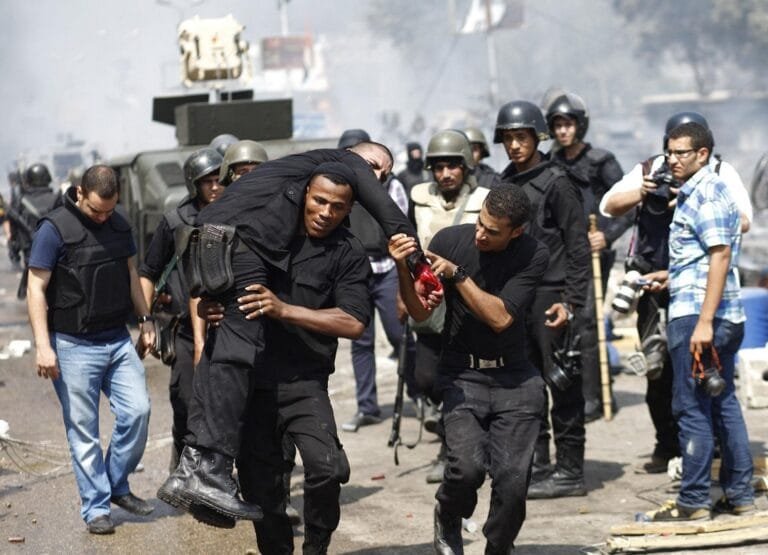
The events of August 2013 cannot be understood in isolation from the losses suffered by the police forces during that period.
In its statement issued after the dispersal of the sit-in, the State Information Service reported the deaths of dozens of police officers and injuries to hundreds more. It also linked the events to a broader wave of attacks on police stations and public and private facilities. Protecting police personnel and security installations subsequently became a central pillar of the Egyptian state’s strategy to counter armed groups, particularly with the escalation of terrorist attacks in Sinai and other regions in the following years.
Fourth in the political calculations of the state
From the perspective of the Egyptian state, Rabaa represented a crucial test of its ability to enforce the law in the face of a political organization with a broad popular and organizational base. This occurred while the country was simultaneously suffering from extreme polarization and unprecedented societal division. In this sense, the event’s significance for the state is not limited to the square itself. It also relates to the subsequent redefinition of the state’s relationship with political and organizational groups, particularly the Muslim Brotherhood. The principle reiterated by the state on various occasions became that political action cannot be used to impose a fait accompli outside of state institutions, nor should it be accompanied by violence or the disruption of societal institutions.
Report of the National Council for Human Rights
Even when relying on official sources relatively independent of the executive branch, it becomes clear that the events at Rabaa were complex and not simply a one-sided confrontation. The National Council for Human Rights formed a committee to investigate the events, and it visited the vicinity of Rabaa for ten days. It also listened to witnesses and reviewed electronic materials, press coverage, and numerous testimonies before preparing its report. The report’s significance lies in the fact that it represents an official Egyptian document that can be relied upon when evaluating the events, independent of conflicting media narratives. It is also essential to consider its findings in their entirety and within their historical and legal context.
The state after Rabaa
After 2013, Egypt entered a different phase characterized by rebuilding its security apparatus and confronting a widespread wave of terrorist operations, particularly in North Sinai. Simultaneously, state institutions were restructured, and extensive economic and development programs and projects were launched. From the official Egyptian perspective, this phase constituted a protracted struggle whose primary objective was to prevent the state from descending into the chaos witnessed by other countries in the region. Maintaining the institutions of the army, police, judiciary, and public administration was also a key objective, as these are considered pillars for the continuity of the nation-state.
Thirteen years since a pivotal moment
Thirteen years later, Rabaa is no longer just the name of a square or a security incident; it has become a symbol of a period that severely tested the Egyptian state’s ability to cope with political polarization, violence, and internal unrest. For the Egyptian state and its political leadership, the most significant lesson learned from that period is that the stability of the state and the preservation of its institutions and sovereignty over all its territory are prerequisites for any political, economic, or social process. In this context, the state views the events of August 2013 as a turning point that ended a state of political and security chaos and paved the way for the re-establishment of state institutions. Meanwhile, the details surrounding the use of force and the resulting casualties remain a subject of ongoing historical and legal debate.