
- The beginning… a project to change the school nutrition system
- Phase two: Moving towards a more diverse range of food products.
- School nutrition: its most prominent social function
- The numbers reveal the scale of the transformation
- From the local market to international competition
- Why is integration a strength?
- Link to the National Service Projects Authority
- The other side of the picture: transparency and competition
- Why did “Silo Foods” become part of the IPO program?
- Silo Foods, Qaha, and Edvina: A food manufacturing hub in Sadat City
- Key strength: Food security
- Second strength: Reducing supply chain risks
- Is it a food project or a strategic tool?
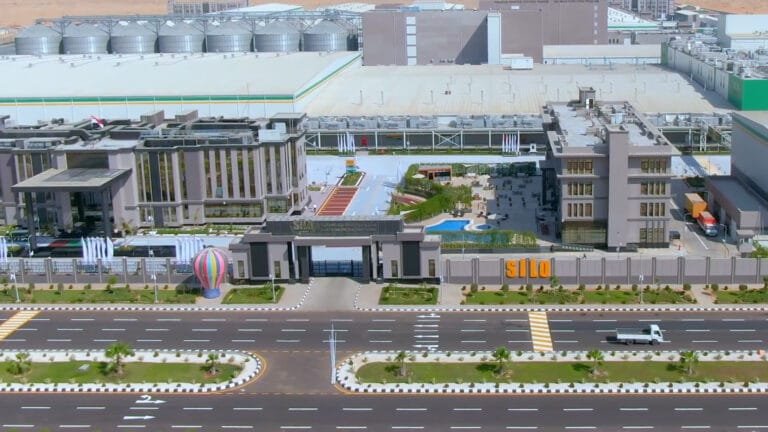
Cairo, Egypt – In just five years, the “Silo Foods” food processing complex in Sadat City, Menoufia Governorate, has transformed from a project aimed at rebuilding the school feeding system into a fully integrated food industrial complex. It encompasses mills, silos, and factories producing biscuits, pasta, baked goods, dairy products, halva, and tahini, in addition to printing and packaging plants, quality control laboratories, and a comprehensive transportation and storage system. The complex’s significance extends beyond its production volume, as it is linked to three strategic pillars of the Egyptian economy: food security, securing supply chains for essential commodities, and increasing food exports. Furthermore, its affiliation with the National Service Projects Organization of the Armed Forces places it at the heart of the Egyptian debate surrounding the role of state-owned enterprises and military institutions in the economy and the restructuring of their ownership.
The beginning… a project to change the school nutrition system
The first phase of “Silo Foods” was inaugurated in August 2021 in Sadat City, as part of an official initiative to establish an integrated industrial system encompassing everything from wheat storage and milling to the manufacturing, packaging, and distribution of food products. The Egyptian Presidency confirms that the first phase was built on 135 acres, while the city expanded with the second phase, bringing the total area of both phases to approximately 170 acres, equivalent to 714,000 square meters, with a declared production capacity of 750,000 tons annually. One of the project’s main objectives was to meet the needs of the school feeding program, in addition to producing essential food commodities for the local market and for export.
A production system that begins with wheat and ends with the final product
Silo Foods differs from a traditional food factory in its internal integration. The city includes wheat silos and a mill, and flour is transported to pasta, biscuit, and bakery factories via an internal network. It also features a printing and packaging system, reducing reliance on external suppliers at various stages of the production cycle. The first phase includes a mill with a declared production capacity of 800 tons of flour per day, 14 wheat silos with a storage capacity of approximately 70,000 tons, a pasta factory with five production lines, a biscuit factory with five lines, and a bakery factory with five lines. The city also houses rotomolding, duplex, and cardboard factories to meet packaging needs, a truck yard that can accommodate 52 trucks, maintenance workshops, and industrial wastewater treatment, water purification, and central heating and air conditioning plants.
Phase two: Moving towards a more diverse range of food products.
The second phase opened in February 2023, expanding the facility’s operations from grain and bakery products to new sectors, primarily dairy, halva and tahini, and biscuits. This phase includes a dairy processing plant with nine production lines and a declared capacity of 200,000 tons per year, a halva and tahini plant with five production lines and a capacity of 16,000 tons per year, and a biscuit plant with two production lines and a capacity of 7,800 tons per year. A cardboard factory, a solvent recovery and recycling plant, and a central sample testing laboratory were also added. The central laboratory has a declared capacity to test approximately 40,000 samples annually and is accredited by the Egyptian Accreditation Council (EGAC), according to official data.
School nutrition: its most prominent social function
The school feeding program was a key driver in the city’s development. From September 2021 to June 2022, Silo Foods set a Guinness World Record for distributing 600,426,453 school meal packages in a single academic year. The Egyptian Ministry of Education states that the school feeding program aims to provide safe and varied meals, while the Ministry of Health explained that the National Nutrition Institute participated in determining the components of the meals produced by Silo Foods according to the nutritional needs of different age groups. In this way, the city transforms from a mere food producer into an integral part of a social, health, and educational system directly linked to the state.
The numbers reveal the scale of the transformation
According to the most recent statements published by the Chairman of the Board of Directors of Silo Foods in July 2026, Major General Akram Abdel-Galil El-Hefnawy stated that the company’s factories are operating at full capacity and that the company has milled approximately 1.5 million tons of wheat since its establishment. According to figures provided by the Chairman, the company produced approximately 150,000 tons of biscuits for the school feeding program and the local market, and 655,000 tons of pasta, of which 300,000 tons were subsidized by the Ministry of Supply and 370,000 tons were sold in the local market. In addition, the company produced 325,000 tons of bran, 20,000 tons of baked goods, and 120,000 tons of dairy products, cheese, and halva. However, the most significant aspect of the current data is the company’s announcement of exporting 50,000 tons of its products to 33 countries. This figure is considerably higher than the export figures announced by official authorities at the launch of the second phase, when the company’s exports amounted to approximately 11,000 tons to 13 countries.
From the local market to international competition
The company states that its current strategy focuses on expanding into Arab, African, and European markets through participation in international food exhibitions and targeting new markets. Company data indicates that it has obtained certifications and standards related to food safety and quality. It also states that its factories, mill, and silos are on the National Food Safety Authority’s white list and that its facilities meet ISO standards for quality and food safety. Exporting represents a significant shift in the project’s function; instead of solely supplying goods to the local market, it has become part of a strategy to transform food manufacturing into a source of foreign currency.
Why is integration a strength?
The most important economic value of Silo Foods lies not only in the number of production lines, but also in the integration of the value chain. Wheat enters the silos, then the mill, and then the flour is transferred to pasta, biscuit, and bakery factories. Meanwhile, printing, cardboard, and packaging factories provide some of the inputs for the final product, and storage and transportation processes are integrated with these. This model reduces the number of links in the supply chain and gives the company greater control over quality, cost, and time, while also reducing production’s vulnerability to disruptions from external suppliers. The Egyptian Presidency described the project as a model for industrial integration and supply chains.
Link to the National Service Projects Authority
Silo Foods is not a typical private food company; it is a subsidiary of the National Service Projects Organization (NSPO).
The Egyptian Ministry of Education explicitly confirms that Silo Foods is an arm of the NSPO, while the World Bank describes the project as having operated under the organization’s umbrella since its launch in 2021. This ownership grants the project the ability to work on strategic projects, such as school feeding and the provision of basic commodities, but it also makes the company part of the broader debate surrounding the scale of the military’s economic activity and its contribution to competition within the Egyptian market.
The other side of the picture: transparency and competition
In its assessment of the Egyptian economy, the World Bank noted that Silo Foods played a role in enhancing food security, school nutrition, and improving safety and traceability standards. However, it also raised concerns regarding the use of direct orders and the lack of full competitive bidding in some procurement processes, in addition to limited transparency concerning the company’s financial data. This point is crucial when evaluating the project objectively, setting aside political considerations. The city’s industrial and production success does not negate the need for clear governance, financial disclosure, and fair competition, especially if the company expands into the commercial market or goes public.
Why did “Silo Foods” become part of the IPO program?
In a significant development during 2025 and 2026, the Egyptian government included Silo Foods among the military-affiliated companies it aimed to list on the Egyptian Stock Exchange or sell a stake in to a strategic investor. In May 2026, the government confirmed that Silo Foods was one of four military companies being considered for listing or offering to strategic investors, along with Wataniya, Chill Out, and the National Roads Company. The International Monetary Fund also included Silo Foods among the military companies the government announced its intention to partially divest or offer, as part of its policy to expand the role of the private sector in the Egyptian economy. However, the offering has not yet materialized into a full-fledged sale or actual listing of shares. In May 2026, Mada Masr quoted a government official stating that the four military companies, including Silo Foods, were not yet ready for a share sale and that no final date had been set.
Silo Foods, Qaha, and Edvina: A food manufacturing hub in Sadat City
Silo Foods was not planned in isolation from other food projects in Sadat City. The Egyptian Presidency points to the Qaha and Edvina Food Industries project in the same area, with announced investments of approximately 5.5 billion Egyptian pounds and covering 120 acres. This project includes nine factories for canned and frozen products, with plans for integration with the Silo Foods complex. This will gradually create a food industrial hub that can link agricultural production with processing, packaging, storage, and export, instead of relying solely on exporting raw agricultural crops.
Key strength: Food security
From a food security perspective, Silo Foods gives the country additional capacity to produce essential goods for the Egyptian market in large quantities, particularly pasta, flour, baked goods, dairy products, and biscuits. Furthermore, having silos, mills, processing plants, and packaging facilities all within a single system provides the country with an additional tool for managing supply chain shocks, a capability that has become even more critical following global food and energy disruptions and the Russian-Ukrainian conflict. However, food security does not equate to complete self-sufficiency; producing flour and pasta locally does not eliminate Egypt’s reliance on wheat imports, which remains the most significant external factor affecting the Egyptian food system.
Second strength: Reducing supply chain risks
The integrated system within the city allows for reduced reliance on a large number of suppliers in the manufacturing and packaging stages.
This becomes even more critical during times of crisis, when transportation costs rise, imports are disrupted, or global supply chains are thrown into disarray. Therefore, the strategic value of Silo Foods is measured not only by the tonnage it produces, but also by its ability to maintain the flow of goods from raw material to the end consumer.
Is it a food project or a strategic tool?
Silo Foods presents a different model from the traditional food factory; it integrates storage, milling, processing, packaging, distribution, school feeding programs, and exports into a single system. For Egypt, the project represents a tool to secure a portion of the food supply chain, increase local production capacity, and mitigate the risks of supply disruptions, while expanding exports represents an attempt to transform industrial capacity into a source of foreign currency. However, the next phase will be more critical. After the industrial expansion is complete and exports reach their peak, the fundamental question becomes: can Silo Foods reconcile its strategic function with the principles of competition, governance, and commercial transparency?
If the company does indeed go public or enter into a partnership with a strategic investor, Silo Foods will face a new test: transitioning from a strategic government food security project to a large industrial company tasked with proving its ability to achieve efficiency, profitability, and competitiveness in the open market. This test, more than the size of the factories or the number of production lines, will be the true indicator of the success of the Egyptian experiment in building an integrated food industry capable of serving the local market and competing in foreign markets simultaneously.