
- The Black Sea: A center of gravity in the wheat trade
- Ukraine’s exports fall by 76%
- Odessa ports under pressure
- Novorossiysk: The danger spreads to Russian exports
- Washington lowers export forecasts for Russia and Ukraine
- Why doesn’t this mean an immediate global wheat crisis?
- Alternatives exist, but they cannot replace the sea.
- Egypt and North Africa are in the spotlight
- From a port crisis to a price crisis
- Türkiye is taking steps to prevent the crisis from escalating.
Kyiv, Ukraine – Black Sea grain trade has entered a new phase of disruption with the escalation of attacks on Russian and Ukrainian ports, cargo ships, and agricultural facilities. A significant portion of the global wheat trade currently relies on exports from these two countries. These developments come as US and international data indicate that global markets have sufficient stockpiles to provide some protection. However, continued port disruptions could drive up prices. This will also put further pressure on importing countries, particularly in the Middle East and North Africa.
The Black Sea: A center of gravity in the wheat trade
Over the past few decades, Russia and Ukraine have become major global grain suppliers. According to data from the UN Food and Agriculture Organization, the two countries together accounted for approximately 34% of global wheat trade between 2019 and 2021. Furthermore, they hold significant shares of the global corn, barley, and sunflower oil trade. This prominence explains why the impact of war spreads rapidly from local ports to international food markets. Russia is particularly prominent in the wheat market, ranking as the world’s largest wheat exporter according to international sources. Ukraine is also a major grain supplier, especially to markets in the Middle East, North Africa, Asia, and Africa.
Ukraine’s exports fall by 76%
The repercussions are visible directly in Ukraine. Attacks on ports and maritime infrastructure caused grain exports to decline by about 76% on an annual basis during the first half of August, according to data reported by Reuters from the Ukrainian Ministry of Agriculture. Ukraine relies heavily on the sea to export its agricultural products. European Commission data indicate that about 90% of exports of cereals, oilseeds and related products passed through seaports. In contrast, about 10% were passing through what are known as the land, rail and river solidarity corridors in June 2026.
Odessa ports under pressure
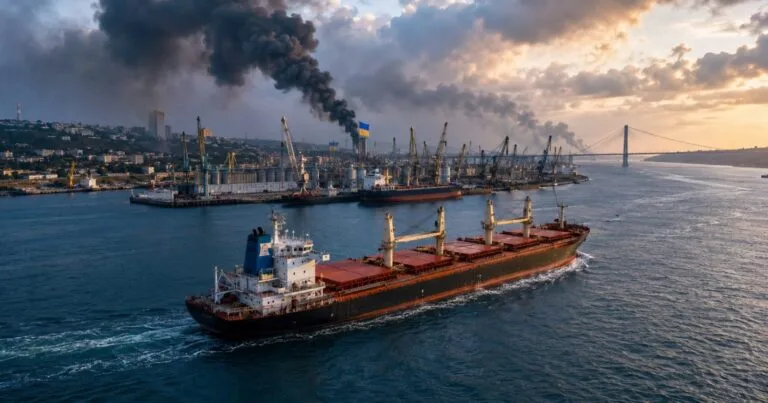
The Odessa region became a major flashpoint in the crisis after repeated Russian strikes disrupted shipping and cargo operations. Reports indicated that several ship owners stopped calling at Ukrainian ports in late July, fearing attacks on their vessels and facilities. Meanwhile, Russian grain export facilities were targeted by Ukrainian attacks. The August 12 attack on the port of Novorossiysk marked a significant escalation. Following this attack, operations at key grain export facilities were halted, causing wheat futures prices in Chicago to rise by approximately 3% that day.
Novorossiysk: The danger spreads to Russian exports
The repercussions of the war are not limited to Ukraine. Attacks on Russian export facilities pose a double threat to the wheat market. Exports from the world’s largest wheat exporter could be disrupted at the same time as Ukrainian exports decline. Reuters reported that Ukrainian attacks on Russian agricultural infrastructure prompted Russia to suspend operations at several grain facilities in Novorossiysk. Meanwhile, Russian grain industry sources warned that continued attacks could impact exports and global prices.
Washington lowers export forecasts for Russia and Ukraine
The disruptions have already impacted market forecasts. In its latest WASDE report, released on August 12, the US Department of Agriculture lowered its projections for Russian and Ukrainian wheat exports in the 2026/2027 season. This is due to logistical disruptions resulting from the escalating conflict in the Black Sea and the Sea of Azov. The US also lowered its export forecasts for several other affected producers. It now expects global wheat trade in the new season to reach approximately 212.7 million tons, a slight decrease from its previous estimate.
Why doesn’t this mean an immediate global wheat crisis?
Despite the seriousness of the developments, current data does not indicate an immediate global wheat shortage. The US Department of Agriculture has raised its projections for final global wheat stocks in the 2026/2027 season to approximately 273.3 million tons. Recent estimates suggest relatively high levels of global stocks, providing some cushion to absorb a portion of supply disruptions. However, these stocks do not eliminate the problem of distribution and transportation. The market may have wheat on paper, but importing countries may be unable to obtain it as quickly and cheaply as usual if attacks on ports and ships continue.
Alternatives exist, but they cannot replace the sea.
Since the beginning of the war, Ukraine has attempted to develop alternative routes via rail, road, and river to the European Union, Romania, and Moldova. The European Commission indicates that the Solidarity Corridors have contributed to the export of approximately 94 million tons of grain, oilseeds, and related products since May 2022. However, by June 2026, these routes represented only about 10% of total exports of these products, compared to 90% transported via seaports. Kyiv is currently in discussions with Moldova regarding a rail route to the Romanian port of Constanta, with a potential capacity of up to 4.5 million tons per year. Nevertheless, this capacity remains limited compared to the volume of maritime trade.
Egypt and North Africa are in the spotlight
The crisis is particularly significant for Egypt, North Africa, and the Middle East, as several countries in the region rely on wheat imports from the Black Sea region. European studies indicate that Russia and Ukraine together supplied more than a quarter of the wheat traded on the international market. Countries most dependent on imports from these two nations are also more vulnerable to price volatility and supply disruptions. This group includes countries in North Africa and the Middle East. Ukrainian President Volodymyr Zelenskyy, in a call with Egyptian President Abdel Fattah al-Sisi, warned of the repercussions of attacks on cargo ships in the Black Sea for grain supplies, at a time when Ukrainian exports are facing increasing restrictions.
From a port crisis to a price crisis
The primary risk being monitored by markets is not just the potential for reduced production, but also the increased cost of delivering wheat to consumers. Attacks drive up marine insurance costs, increase shipping rates, and force carriers to seek longer and more expensive routes. Ship delays, in turn, increase storage and financing costs. All these costs can be passed on to importers and then to the prices of flour, bread, and other food products. Early signs of this have already appeared in the futures markets, with wheat futures in Chicago rising after the attack on Novorossiysk, indicating the market’s sensitivity to any threat to Russian and Ukrainian exports.
Türkiye is taking steps to prevent the crisis from escalating.
As the attacks escalated, Turkey proposed a mutual cessation of attacks on commercial vessels in the Black Sea. Turkish Foreign Minister Hakan Fidan stated that his country was working on establishing a mechanism to implement a ceasefire related to commercial shipping, warning that the conflict was threatening civilian shipping. However, Moscow rejected the idea of a limited ceasefire in the Black Sea on August 14, arguing that the proposed de-escalation did not address the core of the conflict.