
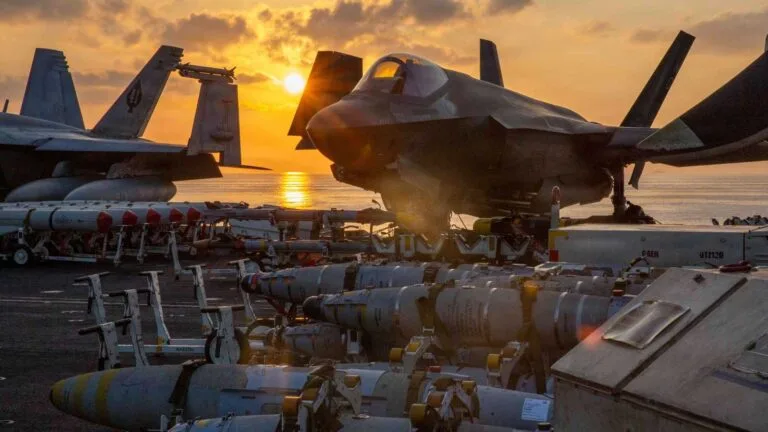
Washington, DC – US Central Command (CENTCOM) announced in an official statement that US forces successfully concluded their eleventh consecutive night of precise and targeted strikes against Iranian targets at 8:15 PM Eastern Time. The command explained that the latest military operations targeted a wide and diverse range of strategic assets. These included military operations centers and facilities, naval capabilities, aircraft hangars, and drone storage facilities. Additionally, military logistics infrastructure was targeted.
The repercussions of Iranian attacks on international trade
This sustained wave of strikes has the primary objective of undermining and further restricting Iran’s ability to threaten commercial shipping and the security of vessels transiting the Strait of Hormuz and its surrounding strategic waterway. Reports from the Command indicate that over the past three months, Iran has targeted and attacked more than 30 commercial vessels transiting this vital international waterway, a crucial artery for regional and global trade. These unprovoked attacks have directly endangered the lives of hundreds of innocent seafarers and have seriously undermined the principles of freedom of navigation and free trade.
Continued flow of oil and the opening of the Strait of Hormuz
Despite the escalating tensions and ongoing Iranian aggression, U.S. Central Command affirmed that the Strait of Hormuz remains open and secure for commercial shipping thanks to protective measures. Since early May, U.S. Central Command forces have actively facilitated and secured the passage of nearly 900 commercial vessels. Furthermore, the uninterrupted flow of approximately 450 million barrels of crude oil to global markets has been ensured.
The Revolutionary Guard and the targeting of Kuwaiti radars
In a simultaneous development reflecting the escalating tensions, the Iranian Revolutionary Guard Corps (IRGC) announced on Tuesday evening, in an official statement titled “Communiqué No. 41,” that its forces had successfully targeted and destroyed early warning and tactical radar systems in Kuwait, asserting that they were completely out of service. The statement claimed that these attacks were part of what it called “the second wave of Operation Nasr 2.” According to the statement, the attacks aimed to “cleanse the region of radar systems.” The IRGC specified the targets it claimed to have struck with precision. It indicated that its fighters attacked and destroyed a major early warning radar and a tactical radar unit near Al Salem Air Base. Additionally, another radar system was destroyed on Bubiyan Island in Kuwait. The statement confirmed that these units were completely out of operational service. It concluded by emphasizing that “the operation to punish the aggressor continues.”
Defense alert and emergency measures in the Gulf
In a related development, authorities in both the Kingdom of Bahrain and the State of Kuwait announced that their countries had been subjected to separate Iranian attacks, prompting the immediate activation of air defense measures. Urgent warnings were also issued to residents, urging them to strictly adhere to safety instructions and avoid open areas. This occurred amidst an unprecedented state of security alert in the region.