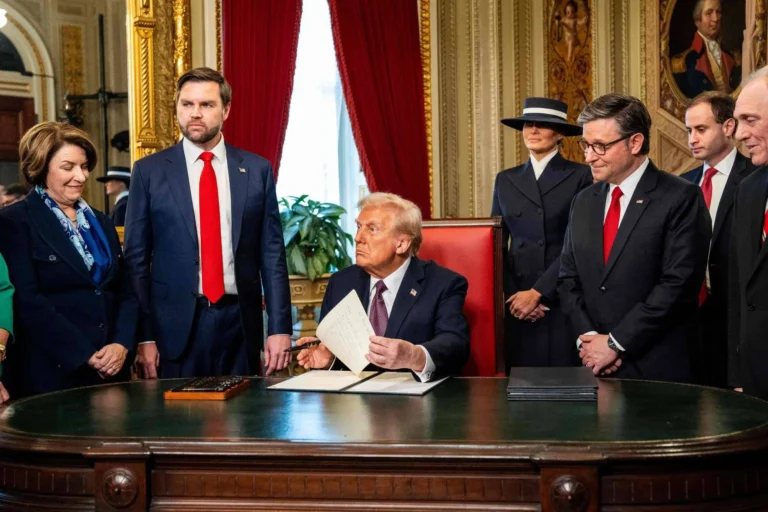
Washington, DC – Sources familiar with the matter indicate that the Trump administration intends to submit a civilian nuclear cooperation agreement with Saudi Arabia to Congress in the coming days. Trump’s decision to send the agreement to Congress opens the door to broad prospects for bilateral cooperation in the field of peaceful nuclear energy. However, the agreement, in its current form, lacks the stringent security safeguards that Washington had previously insisted upon. These safeguards were intended to prevent any possibility of the nuclear program being used for military purposes.
Details of the “Article 123 Agreement” and the signatures of both parties
Sources, as reported by Reuters, said the US administration will formally submit to Congress what is known as the “Section 123 Agreement.” This agreement was paved the way for by a formal signing between US Energy Secretary Chris Wright and his Saudi counterpart, Prince Abdulaziz bin Salman, following a preliminary agreement reached between the two parties in Riyadh last year. The agreement is based on Section 123 of the US Atomic Energy Act of 1954. It allows the federal government and US partner companies to collaborate with Saudi Arabia in developing and establishing a multi-billion-dollar civilian nuclear energy program.
The absence of a “gold standard” and expanded inspection powers
The same sources explained that the proposed agreement does not include the clause known as the “gold standard.” This standard was intended to prevent the Kingdom from enriching uranium domestically or reprocessing spent nuclear fuel—two sensitive pathways that could be used in the future to produce nuclear weapons. Reports also indicated that the agreement does not include the International Atomic Energy Agency’s Additional Protocol. This protocol grants international inspectors expanded and unannounced inspection powers at nuclear facilities.
In the same vein, a source indicated that the agreement provides a comprehensive legal framework for cooperation within the nuclear fuel cycle, including uranium enrichment. However, it does not impose any legal obligation on the United States to transfer any actual enrichment technologies or capabilities to Saudi Arabia.
Statements by the Minister of Energy and the regional context
For his part, US Energy Secretary Chris Wright had previously confirmed that the preliminary agreement was not related to uranium enrichment. He emphasized that it included the basic non-proliferation standards stipulated in the US Atomic Energy Act. These political developments come amidst ongoing regional and international concerns regarding nuclear proliferation in the Middle East, particularly following the explicit statements by Saudi Crown Prince Mohammed bin Salman, who has repeatedly affirmed that the Kingdom would pursue nuclear weapons as an immediate defensive measure if Iran succeeded in developing and acquiring its own nuclear bomb.