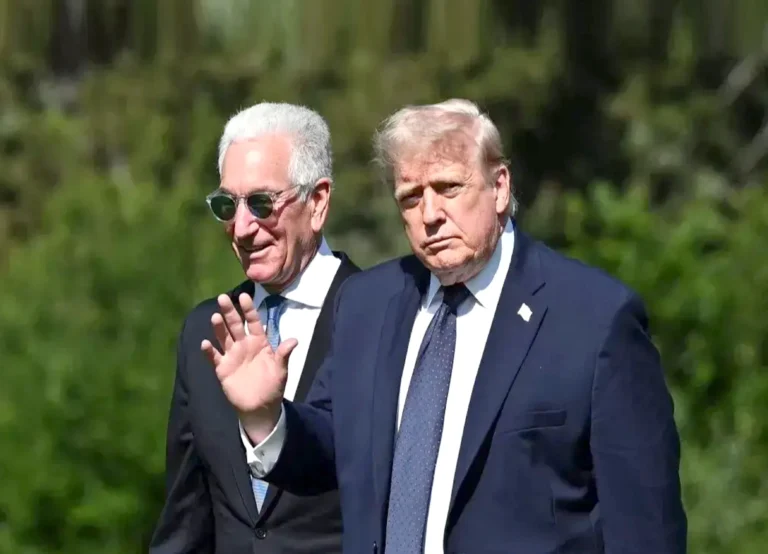
Evian, France – US President Donald Trump arrived in Geneva, Switzerland, the first stop on an intensive diplomatic tour.
He then traveled directly to the French city of Evian, which is hosting this year’s G7 summit.
This summit comes at a highly sensitive and complex time, taking place immediately
after the announcement of a surprise agreement between the United States and Iran.
The agreement stipulates the signing of a memorandum of understanding to end their recent war.
Summit agenda: Implications of the “Islamabad Memorandum”
The repercussions of this agreement, along with significant questions surrounding the details
and contents of what has become known as the “Islamabad Memorandum,”
are expected to dominate the agenda of discussions among the leaders of the G7 member states.
In addition to the United States and France, the group includes Britain, Germany, Canada, Italy, and Japan.
In preparation for this summit, French President Emmanuel Macron, as the host country,
stated that the G7 summit would devote considerable time to discussing the “consequences” of this Iranian-American agreement.
Macron emphasized that the discussions would focus primarily on three strategic issues.
The first is the agreement’s impact on the situation in Lebanon The second is
ensuring the continued freedom of navigation in the Strait of Hormuz.
The third concerns Iran’s missile program, which is a matter of widespread international concern.
European naval move to secure vital waterways
Macron reinforced these positions through a message he published on the social media platform “X”, in which he stressed that France,
in close cooperation with Britain, is fully prepared to implement a joint naval mission aimed at securing and opening the Strait of Hormuz.
He also clearly indicated that the French ships were “ready for deployment” immediately for this purpose.
This move comes at a time when European leaders were living in a state of intense anticipation
for the reopening of the Strait of Hormuz. The Strait is a vital global energy artery.
Restrictions imposed by the Revolutionary Guard on maritime navigation during the war period led to severe disruptions in supply chains.
Causing record rises in global energy prices.
This is what prompted the major powers to work to restore stability in this vital strategic corridor.
With the arrival of the leaders in Evian, the world’s eyes are turning to the results that will emerge from these discussions.
These discussions are considered crucial for the future of regional and international security.