- Gaza: The knot that transcends the borders of the Strip
- Lebanon: Deterrence that becomes a problem
- Syria: A test of transition from force to security arrangement
- Iran: When deterrence becomes part of the crisis
- The Gulf and the Red Sea: When war reaches the global economy
- America: Deterrence through force and diplomacy
- The dilemma that unites the five maps
- Israeli security alone is not enough
- The Gulf wants security, not war.
- The greatest danger… a war that no one wants
- Who will extinguish the Middle East?
- Who can prevent the next war?
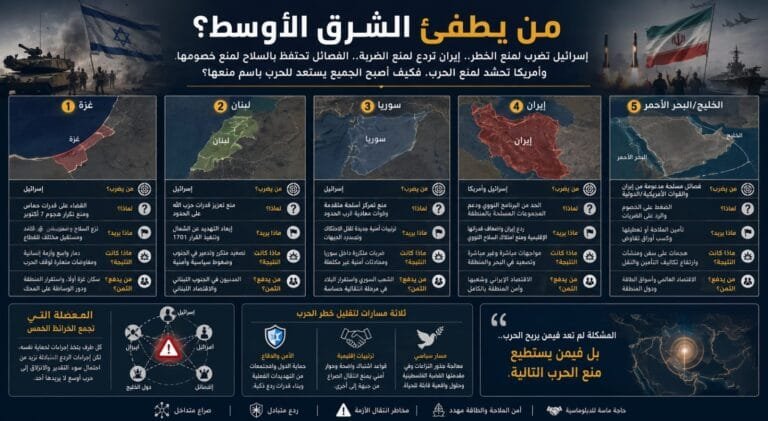
Abu Dhabi, UAE – The most pressing question in the Middle East is no longer who has the capacity to wage war, but rather who has the capacity to prevent the next one. From Gaza to Lebanon, Syria, and Iran, all the way to the Gulf and the Red Sea, military operations, deterrence calculations, and diplomatic maneuvers are currently converging into a single, highly complex landscape. Almost every party presents its actions as defensive measures to protect its security or attempts to prevent a future attack from its adversary. However, the accumulation of these actions simultaneously increases the likelihood of miscalculation and a slide into a wider confrontation. An analysis of the situation across five key arenas reveals that the Middle East is not facing a single war, but rather a series of interconnected crises whose sparks could easily spread from one front to another.
Gaza: The knot that transcends the borders of the Strip
Gaza remains the central point of contention. The dispute is no longer limited to halting the fighting, but has extended to the shape of the next phase: the future of governance in the Strip, the fate of the factions’ weapons, the Israeli military presence, and security and reconstruction arrangements. The continuation of military operations coincided with diplomatic efforts led by the United States in cooperation with Egypt, Qatar, and Turkey, in an attempt to advance a political process that would end the war and pave the way for new arrangements in the Strip.
Israel, according to its stated positions, insists on preventing the rebuilding of military capabilities that could threaten its security, while Hamas considers its weapons a key bargaining chip in any negotiations. Herein lies the first paradox of the crisis: the security that Israel seeks to achieve militarily remains ultimately linked to a political question concerning the future of the Palestinians and Gaza.
Lebanon: Deterrence that becomes a problem
On the Lebanese front, the deterrence equation appears more complex. Israel considers Hezbollah’s military capabilities a direct threat to its security, while the party views maintaining its weapons as part of its deterrent power. Alongside military operations and political pressure, attempts have emerged to establish arrangements that would allow for the consolidation of calm and the reorganization of the security situation in southern Lebanon. However, the continued presence of weapons outside state control, coupled with persistent Israeli concerns, keeps the front volatile. Consequently, each side sees the other’s capabilities as justification for bolstering its own security measures, thus perpetuating the security dilemma.
Syria: A test of transition from force to security arrangement
In Syria, the picture is somewhat different. Damascus is seeking to establish security arrangements with Israel, while border, political, and security issues remain unresolved, amidst ongoing Israeli operations within Syrian territory. The Syrian arena is of exceptional importance due to its location between Israel, Lebanon, Iraq, and Iran, making its stability crucial to preventing its re-emergence as a proxy battleground. Therefore, the success of any Syrian-Israeli security arrangements will not be merely a bilateral agreement, but could represent a test of the region’s ability to shift from a logic of preemptive strikes to one of risk management through understandings.
Iran: When deterrence becomes part of the crisis
Iran represents the most sensitive link in the regional security system. Tehran views its military capabilities and regional network of relationships as tools of deterrence against the United States and Israel, while Israel and Washington see some of these capabilities as sources of threat that must be contained. Following recent confrontations, the deterrence equation has become more complex, especially with the expansion of some of the competition into the maritime domain. The Strait of Hormuz, through which a significant portion of global energy trade passes, could become a strategic bargaining chip in any confrontation, extending the impact of the conflict beyond the Middle East to international energy and trade markets.
The Gulf and the Red Sea: When war reaches the global economy
The most dangerous aspect of the current situation is that the conflict is no longer confined to the battlefields. Tensions surrounding the Strait of Hormuz and the Bab el-Mandeb Strait have demonstrated that maritime security has become part of the deterrence equation. Any prolonged disruption to these waterways could lead to increased transportation, insurance, and energy costs, the rerouting of ships, and increased pressure on global supply chains. Thus, the consequences of the conflict extend from the military arena to the global economy. A single missile might strike a ship, but its impact could reach ports, markets, and businesses on other continents.
America: Deterrence through force and diplomacy
Washington is operating on two parallel tracks.
The first is military, through maintaining a strong presence in the region and protecting American forces, interests, and allies.
The second is diplomatic, through attempting to push for arrangements to halt the fighting and contain crises, particularly in Gaza.
However, this role carries a clear paradox; the increased American military deployment aims to deter adversaries, but it could be interpreted in Tehran or by armed groups as preparation for a new confrontation. Thus, American power simultaneously becomes an instrument of deterrence and a factor in the calculations that could lead to escalation.
The dilemma that unites the five maps
When Gaza, Lebanon, Syria, Iran, the Gulf, and the Red Sea are placed on a single map, a different equation emerges.
Israel wants to prevent the threat before it reaches its borders.
Iran wants to raise the cost of targeting it.
Hezbollah wants to maintain its deterrent capability.
Palestinian factions want to retain leverage against Israel.
The United States wants to prevent its adversaries from expanding their influence while simultaneously avoiding a full-blown regional war.
The Gulf states, for their part, want a stable security environment that protects their territories, facilities, and trade and energy routes.
The problem is that these objectives are not entirely contradictory, but they are also not entirely compatible.
Israeli security alone is not enough
Recent experience raises a question that goes beyond military operations: Can sustainable Israeli security be achieved solely by militarily weakening the sources of threats? The answer offered by regional experience appears more complex. A military strike may destroy a specific capability, but it does not necessarily address the political conditions that produced the conflict. Therefore, sustainable security requires two interconnected elements: a genuine capacity to protect the population and the state from threats, and a political process that addresses the root causes of the conflict and prevents its recurrence. This is particularly true of the Palestinian issue, which remains a fundamental part of the region’s security environment.
The Gulf wants security, not war.
For the Gulf states, a full-blown regional war does not appear to be a viable option. The region is intertwined with global energy, trade, investment, and supply chains, and any escalation of the conflict could directly impact maritime security, the economy, and stability. This underscores the importance of Gulf diplomacy, which is pushing for de-escalation while simultaneously building defensive capabilities to protect the states from the repercussions of any potential confrontation.
The greatest danger… a war that no one wants
The most dangerous scenario may not be a unilateral decision to launch a full-scale war. The greater danger lies in a series of limited actions:
A preemptive strike.
A retaliatory strike.
A strike on a ship.
A military operation.
A missile launch.
A miscalculation.
Then another response.
In a highly volatile regional environment, this sequence could transform a limited incident into a wider confrontation before mediation channels can contain it.
Who will extinguish the Middle East?
The regional landscape reveals that deterrence alone is insufficient. Military force can prevent an attack, but it cannot, on its own, build a sustainable security system. Diplomacy can halt fighting, but it requires security and political arrangements to prevent a recurrence of the crisis. Therefore, the most realistic path to breaking the cycle of escalation rests on three parallel tracks:
First: Protecting states and societies from genuine security threats.
Second: Establishing regional arrangements that prevent the conflict from spreading from one front to another.
Third: Opening genuine political avenues to address conflicts, foremost among them the Palestinian issue.
Herein lies the great paradox in the Middle East: Everyone desires deterrence, but the region needs a system that makes deterrence a means of preventing war, not a prelude to it.
Who can prevent the next war?
From Gaza to Tehran, and from Beirut and Damascus to Hormuz and Bab el-Mandeb, the region appears to be facing a single system of intertwined crises.
Israel wants security that prevents the recurrence of attacks.
Iran wants to deter any attempt to target it.
Armed factions want to maintain their leverage.
And America wants to preserve its influence and prevent a wider regional conflagration.
But sustainable security cannot be based on force alone. Israeli security is inseparable from the security of its neighbors, regional stability is inseparable from a solution to the Palestinian issue, and protecting the Gulf and the Red Sea is inseparable from reducing tensions between competing powers. Ultimately, the real question may not be: Who wins the war? But rather: Who can prevent the next war?