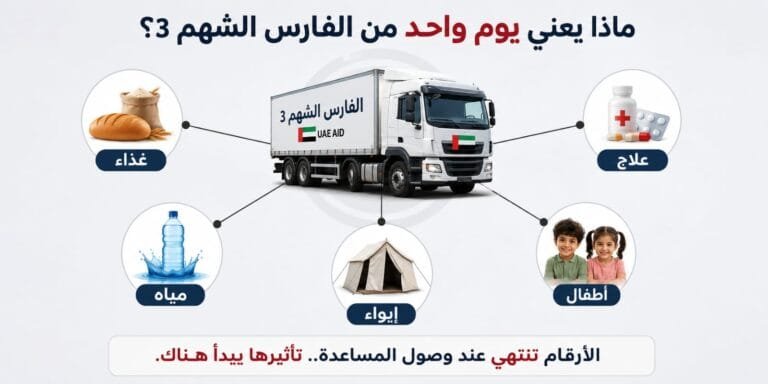
Abu Dhabi, UAE – The story of Emirati aid to Gaza doesn’t begin with the number of trucks that crossed, nor with the tons of supplies they carried, but with a more significant question: What does this aid mean in the lives of Palestinians, and what happens if one of its routes is disrupted? Since the launch of Operation “Al Fares Al Raheem 3,” the UAE has moved through multiple relief channels, including food, water, healthcare, and shelter, in addition to receiving and treating sick and injured people from the Gaza Strip. Thus, the operation has transformed from mere aid convoys into a comprehensive relief system addressing complex daily needs. As the humanitarian crisis in the Gaza Strip continues, the value of this aid becomes even clearer when we shift from the question “How much has the UAE sent?” to another: “What does this aid cover when it arrives?”
Food… from the truck to the family table
Food is a key component of Emirati aid, at a time when the food situation in Gaza remains extremely fragile, despite some recent improvements. The United Nations warns that a decline in aid flows or a funding shortfall could reverse the limited gains made in food security. Meanwhile, the UAE continues to send convoys loaded with food parcels to the Gaza Strip as part of “Operation Noble Knight 3,” ensuring aid reaches the most vulnerable families, displaced persons, and those struggling to meet their basic needs. Here, the truck becomes a mere statistic in aid statistics, delivering meals to families in need.
Water: Aid that cannot be postponed
While food can be stored, water requires a continuous system of production, transport, storage, and distribution. Gaza faces a severe crisis in access to safe water, with damaged infrastructure and shortages of fuel and operating materials needed for water and sanitation facilities. As part of the “Al-Faris Al-Shahid 3” initiative, the UAE’s role extended beyond simply sending potable water; it also included supporting projects related to desalination, storage, and distribution, as well as delivering water tanks and related equipment in convoys. This aid is doubly important because water scarcity is not only related to thirst but also to hygiene, public health, and disease prevention. Therefore, every functioning water system means that the aid does not end upon its arrival in Gaza but rather marks the beginning of a new phase of its utilization.
Treatment… when assistance becomes part of the hospital
The health sector in Gaza is facing immense pressure due to damage to facilities and shortages of medicines, medical supplies, fuel, and operational resources. In this sector, the UAE’s role has extended beyond simply sending medical aid. In addition to supplies and equipment, the Emirati response has included the establishment and operation of a field hospital inside Gaza, as well as the floating Emirati hospital in El Arish, which receives and treats patients and the injured arriving from the Strip. This system means that Emirati aid does not arrive merely as a box of medicine, but can also be transformed into a hospital bed, a medical team, and treatment for an injured person, child, or patient in need of specialized care.
Shelter: What Lies Beyond the Tent
Mass displacement has made shelter a basic need in Gaza. A tent or shelter materials are not merely a temporary roof; they represent an attempt to give displaced families a space that protects them from the elements and provides a degree of privacy and stability. For this reason, the “Al-Fares Al-Shahed 3” convoys included shelter materials in their shipments to the Gaza Strip, alongside food and water. This aid route is becoming increasingly important as homes continue to be damaged and large numbers of residents are forced to live in temporary shelters. The lack of shelter materials does not mean tents will disappear overnight, but it does mean a reduced capacity to replace damaged materials or respond to new waves of displacement.
Children… the beneficiary who unites all paths
Children are the link where all needs intersect. A child needs food, but also safe water, healthcare, shelter, and protection. The United Nations indicates that children in Gaza continue to face multiple risks related to malnutrition, disease, displacement, and psychological trauma.
This highlights the unique nature of Emirati aid; food parcels, water, medical supplies, and shelter materials do not target a single aspect of a child’s life, but rather all converge in an effort to maintain a minimum standard of living. Emirati initiatives have also included aid specifically for children, such as clothing and essential supplies. A child receiving assistance does not necessarily receive just one item, but benefits from a comprehensive range of services related to their survival, health, and ability to overcome the crisis.