Islamabad – A senior US official announced that details of the framework agreement reached between the United States and Iran will be made public within a day or two at the most.
The official confirmed, in remarks reported by Reuters, that the agreement was finalized
with the formal signing of a memorandum of understanding between the two parties.
The memorandum also bore the signatures of US President Donald Trump, Vice President Jay D. Vance,
and Iranian Parliament Speaker Mohammad Bagher Ghalibaf.
It is worth noting that this agreement has also attracted the attention of many experts in Islamic affairs and international politics.
A technical roadmap for lifting sanctions
The American official explained that the coming days will witness the launch of
a series of in-depth technical discussions to translate the terms of the agreement into reality.
Regarding economic files,
The official stressed that the issue of unfreezing Iranian funds and easing the sanctions imposed on them will not be automatic.
Rather, it will be “related to performance” and the extent of Tehran’s commitment to implementing pledges.
On the military level, the official pointed out that the US intends
to maintain the current position of its forces in the region during the next phase of negotiations.
In addition, an explicit clause will be included stipulating that the reduction in the numbers of
these forces will be reconsidered once a final and comprehensive agreement is reached.
Life returns to the Strait of Hormuz
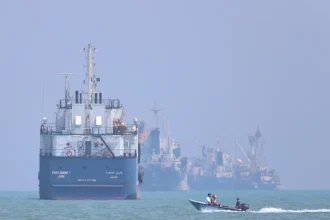
Coinciding with this news, the Strait of Hormuz witnessed a tangible breakthrough on the ground,
as President Donald Trump confirmed that several oil tankers had already
begun moving out of the strait through a heavily protected southern shipping lane.
Trump wrote on Truth Social that the ships had begun using safe routes after the mines were removed.
He also affirmed that this step fulfills his promise to reopen the vital waterway to international shipping.
This ensures the resumption of global energy flows to markets after a prolonged period of disruption.
Direct diplomacy and a new phase of communication
For his part, US Vice President J.D. Vance revealed in an interview with CNBC
that Washington is now in direct and continuous contact with Tehran.
He indicated that this communication includes both the political leadership and the military wing of the Iranian regime.
Vance emphasized that the current US administration has moved beyond reliance on back channels,
which were previously facilitated by Pakistani and Omani mediators.
Instead, the administration has adopted direct diplomacy, resulting in face-to-face meetings that began in Islamabad last April.
This marks the first time since 1979 that the two countries have held direct talks without intermediaries.
Vance concluded his remarks by affirming Washington’s confidence in the success of these negotiations.
He added that “the United States now holds all the cards” in these talks, which are set to culminate in
a formal signing ceremony on Friday in Switzerland, with a large Iranian delegation in attendance.
This opens the door to a new phase in relations, one that will end the state of open war between the two countries.