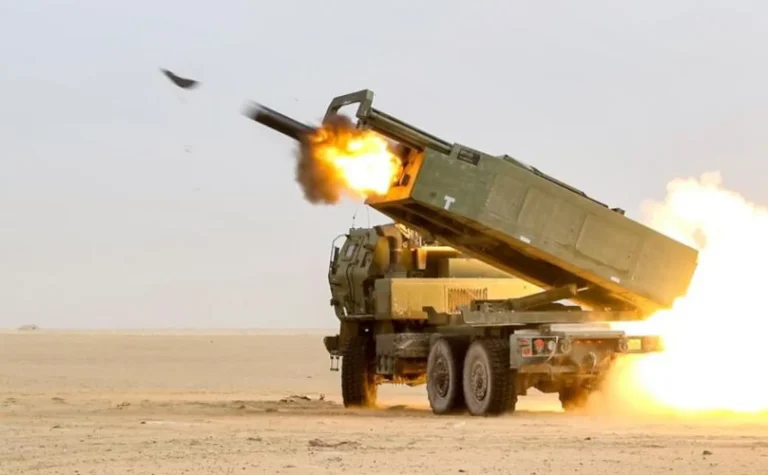
Taipei, Taiwan – In a significant military development reflecting a shift in Taiwan’s defense doctrine, the South China Morning Post reported that the Taiwanese military successfully fired its High Mobility Artillery Rocket Systems (HIMARS) toward China for the first time during military exercises on June 17. This exercise is part of an ambitious defense strategy aimed at strengthening deterrence capabilities against any potential military action from mainland China.
“A hellish scene” to counter the amphibious attack
These exercises are part of the “Hellish Landscape” strategy, a comprehensive defense plan being developed in cooperation with the US military. The strategy aims to deploy thousands of drones, ships, and unmanned submarines to create a first line of defense capable of thwarting any attempt to cross the Taiwan Strait. It also seeks to transform a potential Chinese attack into a “hellish landscape” for the attacking forces.
During exercises held in the Taichung area on the west coast facing China’s Fujian province, the Taiwanese military demonstrated advanced “fire-and-run” capabilities. Military analyst Lu De-yin explained that the truck-mounted HIMARS platforms offer a significant tactical advantage, as they can target objectives hundreds of kilometers away. They can also launch six missiles and then leave the launch site within minutes. This tactic has proven highly effective on modern battlefields, particularly in Ukraine.
Long-range strike capabilities
The HIMARS system possesses the necessary flexibility to strike a variety of strategic targets. When equipped with the ATACMS tactical missile system, it can reach targets up to 300 km away. This means Taiwan can strike Chinese ports, airports, and supply centers. Furthermore, it can disrupt amphibious landing forces while they are still at sea or attempting to secure coastal bases.
This shift toward mobile strike weapons has prompted growing concern in Beijing, with Chinese media broadcasting footage of drills simulating attacks on Taiwan’s HIMARS platforms. This reflects the Chinese leadership’s awareness of the strategic importance of this weapon as a tool for deep counterattacks.
Arms deals and future challenges
In light of these developments, Taiwan is seeking to bolster its arsenal. Last December, the United States approved a massive deal that includes 82 HIMARS missile launchers and 420 ATACMS missiles. This will bring Taiwan’s total number of launchers to 111. However, military experts like Yang Tai-yuan caution that these weapons are not a “magic bullet.” They emphasize that their effectiveness depends entirely on the secrecy of deployment sites and enhanced camouflage measures to evade detection by Chinese satellites. They also stress that Taiwan’s superiority hinges on integrating this firepower into a more comprehensive and sophisticated defense system.