- Energy… the starting point
- From oil to influence
- The Riyadh-Tehran agreement: The most important diplomatic test
- Beijing is cautiously approaching the Gulf.
- Djibouti base: the first military step
- Hormuz: The test that reveals the limits of Chinese power
- China does not want to become another America.
- Iran’s dilemma
- The Gulf is not necessarily looking for an American alternative.
- Towards a multi-partner security system
- China represents a new security system, not an alternative.
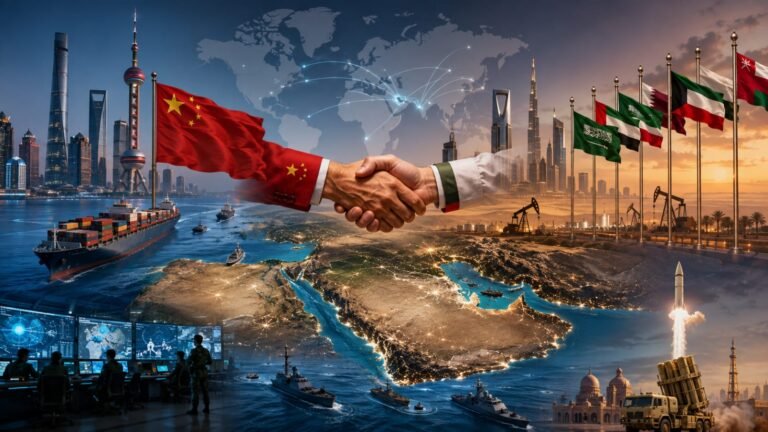
Abu Dhabi, UAE – With the reshaping of the balance of power in the Middle East, the question in the Gulf is no longer just about the size of the American military presence, but about the future of the regional security system itself: Will Washington remain the main security player, or can China move from being an economic and diplomatic partner to a power capable of providing real security guarantees to the Gulf states?
Beijing already possesses a number of assets that make it a strong candidate for this role. It is one of the largest importers of Gulf energy, maintains economic and strategic partnerships with Saudi Arabia, the UAE, and other countries, and simultaneously cultivates relations with Iran. Furthermore, in March 2023, it successfully brokered the resumption of Saudi-Iranian relations. However, the transition from political mediation to security guarantees remains a more complex path, requiring a permanent military presence and the capacity for deterrence and intervention in times of war—areas where the gap between China and the United States remains significant.
Energy… the starting point
For China, the Gulf region is a key element of its economic security. Data from the U.S. Energy Information Administration indicates that China imported an average of 11.1 million barrels per day of crude oil in 2024, with Saudi Arabia, the UAE, Iran, Iraq, and Oman among its main suppliers. This relationship becomes even more crucial when considering the Strait of Hormuz, through which a significant portion of Gulf energy exports destined for Asian markets pass.
The International Energy Agency estimates that around 20 million barrels per day of oil will pass through the Strait of Hormuz in 2025, representing about a quarter of global seaborne oil trade, with roughly 80% of those flows destined for Asian markets. Therefore, for Beijing, the stability of the Gulf is not merely a matter of geopolitical influence, but is directly linked to China’s energy security and economy.
From oil to influence
In recent years, China has expanded its presence in the Gulf from energy trade to investment, infrastructure, technology, telecommunications, and ports. However, Beijing has followed a different model than the United States; it has not built a broad network of defense alliances, nor has it deployed large forces in the Gulf. Instead, it has focused on expanding economic and political relations with various actors. Recent research indicates that China’s economic influence in the Gulf has become a significant factor in the calculations of regional states, but it has not yet translated into a Chinese security umbrella comparable to the American one. Herein lies the paradox: China has enormous interests in Gulf security, but it does not yet possess the military capabilities to protect them.
The Riyadh-Tehran agreement: The most important diplomatic test
China’s mediation between Saudi Arabia and Iran in 2023 marked a turning point in Beijing’s image in the region. In March of that year, Riyadh and Tehran, under Chinese auspices, announced an agreement to resume diplomatic relations and reopen embassies, a move that demonstrated Beijing’s ability to engage with regional rivals at a time when Washington was struggling to mediate between them. This demonstrated that China could leverage its economic power and balanced relationships to build political channels of communication. However, successful mediation does not equate to the ability to impose peace by force. This is where the true test of China’s role begins.
Beijing is cautiously approaching the Gulf.
China is no longer content with mere economic rhetoric. It has intensified its naval exercises with countries in the region, conducting joint maneuvers with Saudi Arabia and participating in naval drills with Iran and Russia. In October 2025, China and Saudi Arabia conducted joint naval exercises focused on maritime escort, search and rescue, counterterrorism, and ship protection. In March of the same year, China, Iran, and Russia participated in naval exercises near the Iranian port of Chabahar, which included drills on counter-piracy, search and rescue, and dealing with maritime threats. Notably, Beijing can cooperate militarily with both Saudi Arabia and Iran simultaneously, a diplomatic advantage that grants it room for maneuver not readily available to the United States.
Djibouti base: the first military step
China has maintained a military base in Djibouti since 2017, its first overseas military base. From there, the Chinese navy has participated in anti-piracy operations and ship protection missions in the Gulf of Aden, as well as conducting evacuation and protection operations for Chinese citizens. In December 2025, the Chinese Ministry of Defense announced that the 47th Chinese naval escort force had completed a 368-day mission in the Gulf of Aden, escorting more than 100 Chinese and foreign vessels. However, this naval experience, while significant, does not mean that China is now capable of managing the security of the Gulf in the event of a wider regional war.
Hormuz: The test that reveals the limits of Chinese power
The Strait of Hormuz represents the most significant potential test of China’s role. If navigation through the strait were disrupted, protecting Chinese trade would require more than just patrol vessels or escort operations. Beijing would need a comprehensive system encompassing: advanced naval bases, reconnaissance aircraft, air defense, mine countermeasures capabilities, supply ships, maritime intelligence, and the ability to protect ships in a wartime environment. The United States possesses these capabilities to a far greater extent than China.
An analysis by the Center for Strategic and International Studies (CSIS) indicates that China’s current presence does not provide Beijing with a capability comparable to that of the United States to protect shipping in the Gulf during a large-scale military confrontation. The CSIS also clarifies that China’s military presence in the Middle East remains limited, and that its Djibouti base and current naval deployment primarily serve to protect Chinese interests, combat piracy, and facilitate evacuations, rather than provide a comprehensive regional deterrent.
China does not want to become another America.
The obstacle to China becoming a security guarantor for the Gulf is not solely military. There is also a Chinese political decision at play. Beijing does not appear willing to enter into a network of military commitments similar to the American network of alliances. Becoming a security guarantor would mean that China might be compelled to intervene in crises not directly related to its own territorial security, perhaps confronting Iran or other actors to protect its allies or trade routes. Chatham House analysis concludes that China does not appear poised in the foreseeable future to replace the United States as the primary security guarantor for the region, although it is likely to play a larger role in regional security arrangements.
Iran’s dilemma
Iran presents the most complex test. China maintains advanced economic and political ties with Tehran, but simultaneously forges strong strategic partnerships with Saudi Arabia, the UAE, and the Gulf states. This equation gives Beijing the advantage of acting as a mediator, but it limits its ability to become a military ally of one side against the other. A country that seeks to maintain channels of communication with all parties will find it difficult to commit to the military defense of a single side. Recent analyses suggest that the Gulf states are already testing China’s capacity to use its influence with Iran to de-escalate tensions, while Beijing prefers to employ political, economic, and diplomatic pressure tactics rather than engage in direct military confrontation.
The Gulf is not necessarily looking for an American alternative.
Despite growing doubts about the sustainability of reliance on Washington, the Gulf states do not appear to be facing a simple choice: America or China? The more likely course of action is to diversify their security sources. The United States still possesses significant superiority in air power, air defense, intelligence, bases, and military deployment, while China offers different tools, including economics, energy, investment, technology, and mediation. Recent studies indicate that the Gulf-Chinese relationship is based more on the concept of integration than replacement; that is, benefiting from China without necessarily abandoning the American security partnership.
Towards a multi-partner security system
The most realistic scenario may be the emergence of a multilateral Gulf security architecture.
In this model:
The United States maintains a leading military role.
China expands its economic, diplomatic, and naval role.
Turkey and Pakistan move closer to Gulf defense arrangements.
Gulf states increase their investments in their military, intelligence, and air defense capabilities.
The defense agreement signed by Saudi Arabia, Turkey, and Pakistan in August 2026 reflects this trend toward building more diversified regional security arrangements.
China represents a new security system, not an alternative.
China possesses many elements of power that qualify it to play a larger role in Gulf security: a massive economy, increasing reliance on Gulf energy, balanced relations with Saudi Arabia and Iran, growing naval capabilities, a base in Djibouti, and a broad network of trade and investment interests. However, it currently lacks the elements that would transform power into a comprehensive security guarantee: extensive military bases in the Gulf, binding defense commitments, a permanent air and naval presence, and the political will to wage war in defense of its partners. Therefore, the more pertinent question is not: Will China replace the United States? But rather: Can China become a pillar of a new Gulf security system that is not dependent on a single power?
Current indicators suggest this scenario is more realistic. Beijing doesn’t need to expel Washington from the Gulf to gain greater influence; it’s enough for it to become a power that no regional or international state can ignore when discussing energy security, navigation, and regional stability.
While the United States remains the dominant military power, China is moving to acquire another key asset: the ability to bring adversaries to the negotiating table and link Gulf security to global economic interests. The future of Gulf security may lie not in replacing the American guarantor with a Chinese one, but rather in a gradual transition to a multi-partner security system where major powers compete for influence without any one of them holding sole control over the region.