Sana’a / Riyadh – The Houthi group announced that it had downed a Saudi reconnaissance drone over Yemen’s central Al Bayda governorate. This marks the latest development in a rapidly escalating period of tension between the group and Riyadh.
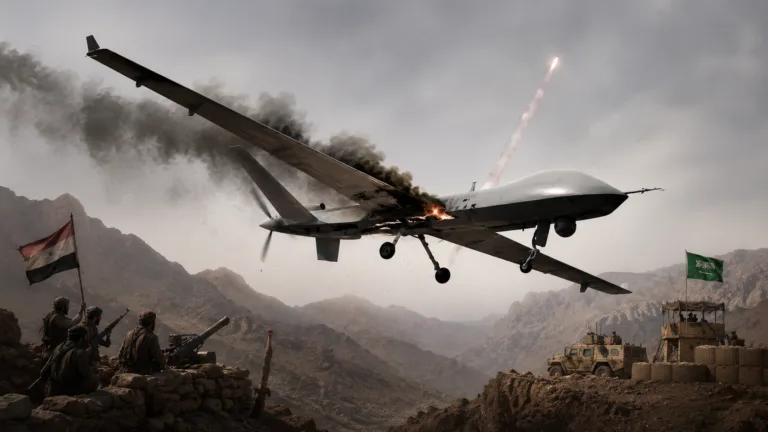
Houthi military spokesperson Yahya Saree said the group’s air defenses had downed a “Wing Loong 2” drone. It was carrying out what he described as reconnaissance missions over Al Bayda.
Saudi Arabia had not issued an official statement on the incident at the time of publication. Moreover, no independent information was available regarding the circumstances of the drone’s fall or the nature of its mission.
The Houthi announcement follows a series of developments that have renewed tensions between Saudi Arabia and the group. These come after several years of relative calm that began with the United Nations-brokered truce in 2022.
What Is the “Wing Loong 2” Drone?
The “Wing Loong 2” is a Chinese-made unmanned aerial vehicle designed for surveillance and reconnaissance missions. It can also be equipped with weapons to carry out airstrikes.
Such drones are commonly used to monitor movements on the ground and gather intelligence. They are also used to strike military positions when fitted with suitable munitions.
Should the downing of the aircraft be confirmed, the incident may indicate the Houthis’ ability to target aircraft operating at medium altitudes. Consequently, it could also prompt Saudi forces to reassess the nature of their aerial reconnaissance operations over areas controlled by the group.
The downing of a single drone does not represent a shift in the balance of air control over Yemen. However, it sends a military message from the Houthis. They are prepared to target surveillance and reconnaissance aircraft operating over areas under their control.
How Did the Latest Escalation Begin?
The latest tensions began in early July, when the Houthis accused Saudi aircraft of entering Yemeni airspace. They also accused them of attempting to prevent an Iranian aircraft from landing at Sana’a International Airport.
The Houthis said they could target airports and other facilities inside Saudi Arabia. This would happen if what they described as interference with air traffic to and from Sana’a airport continued.
Saudi Arabia, for its part, warned against targeting its territory or facilities. It said it would respond to any attacks against the kingdom.
The situation later escalated after the runway at Sana’a airport was hit in an airstrike. An Iranian aircraft carrying a Houthi delegation returning from Tehran attempted to land at that time.
The Yemeni government said the flight had not obtained the required approvals. They also stated that international flights through Sana’a airport must be operated through the relevant official institutions.
The Houthis, meanwhile, said preventing the flight from landing represented a continuation of restrictions imposed on Sana’a airport. Furthermore, they accused Saudi Arabia of being responsible for targeting the runway.
The Houthis subsequently announced that they had launched missiles and drones toward locations in southern Saudi Arabia, including the area surrounding Abha airport. Saudi forces said they had intercepted missiles launched toward the kingdom’s southern region.
Dispute Over Sana’a Airport
Sana’a International Airport remains one of the main points of disagreement between the Houthis, the Yemeni government and Saudi Arabia.
The Yemeni government maintains that international flights from the airport must receive approval from the relevant official authorities. They argue that managing the country’s airspace and international entry points falls under the responsibility of state institutions.
The Houthis say restrictions imposed on the airport affect civilians, patients and other travelers. They are calling for the airport to operate more widely and without political or security restrictions.
The opening of a direct air route between Tehran and Sana’a has raised concerns in Saudi Arabia and among the Yemeni government. They fear that flights could be used to transport experts, equipment or officials between Iran and areas controlled by the Houthis.
The Houthis, in contrast, say the flights are civilian. According to them, objections to these flights form part of what they describe as a blockade imposed on Yemen.
What Does the Downing of the Drone Mean?
The announcement that the drone was downed carries several military and political messages.
The first message is directed at Saudi Arabia, indicating that the Houthis’ response may not be limited to launching missiles and drones. Instead, it could also include targeting reconnaissance aircraft operating over Yemen.
The second message relates to Sana’a airport. The Houthis appear to be seeking to raise the cost of any military or security action aimed at restricting flights to and from the airport.
Through the announcement, the group is also seeking to demonstrate its ability to deploy air defense systems. In addition, it wants to show its capability to deploy offensive missiles and drones.
However, these messages do not necessarily mean that both sides have decided to return to a full-scale war. The possibility of containing the escalation through political contacts or regional and international mediation remains open.
Has the Period of De-escalation Ended?
The United Nations-brokered truce in Yemen began in 2022. Although it formally expired several months later, a period of relative calm between Saudi Arabia and the Houthis continued.
During that period, Houthi attacks on Saudi territory declined, while Saudi airstrikes on areas controlled by the group largely stopped.
Indirect contacts between the two sides helped preserve the de-escalation. This remained true despite the absence of a comprehensive political agreement to end the war.
Recent developments, including the strike on Sana’a airport, missile launches toward southern Saudi Arabia and the announcement that a reconnaissance drone had been downed, indicate that the level of de-escalation is declining. In fact, military messages are once again being exchanged.
Possible Scenarios
The first scenario involves containing the escalation through political mediation. This is particularly likely if the current developments do not result in significant casualties.
The second scenario would see limited retaliatory operations continue, including airstrikes against Houthi military positions. These would be in response to missile and drone launches toward southern Saudi Arabia.
The escalation could also include attacks on reconnaissance aircraft, radar installations or air defense sites inside Yemen.
The most dangerous scenario would involve an expansion of the confrontation to include oil facilities, civilian airports or shipping routes in the Red Sea and the Bab Al Mandab Strait. If this happened, such developments could transform the current tensions into a wider regional crisis.
The Houthi announcement that a Saudi reconnaissance drone had been downed comes as tensions between the group and Riyadh are rising. This follows an extended period of relative calm.
Details of the incident remain limited in the absence of an official Saudi statement or independent information clarifying the circumstances surrounding the drone’s fall.Nevertheless, the timing of the incident, alongside missile attacks and tensions surrounding Sana’a airport, indicates that the period of de-escalation is facing a new test. Continued military action and retaliation could bring Yemen and Saudi Arabia back into a cycle of open confrontation.