New York, USA – The UN warned that recent developments in Yemen risk igniting a new round of escalation.
It stressed that ending the conflict can only be achieved through a comprehensive, Yemeni-led political process under UN auspices.
The UN also called on all parties to refrain from any unilateral actions that could exacerbate the crisis.
Warning of a new round of escalation
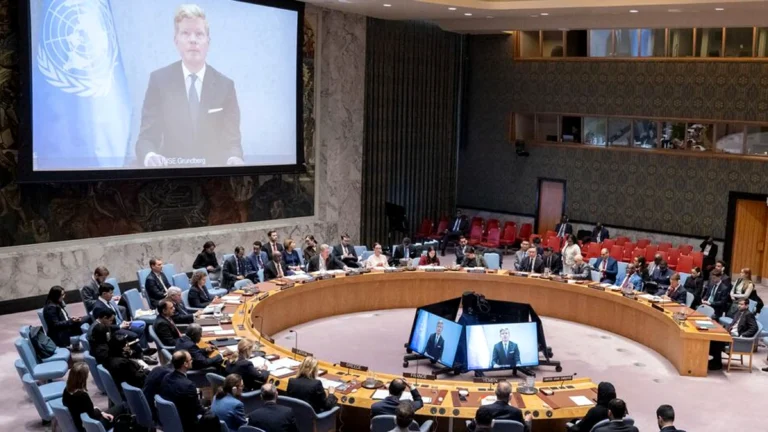
During an emergency Security Council session dedicated to discussing developments in Yemen,
UN Assistant Secretary-General for the Middle East, Asia, and the Pacific, Khaled Khiari,
stated that Yemen and the region cannot afford another round of escalation.
He called on all parties to engage in constructive negotiations under UN auspices.
This, he said, would contribute to reducing tensions and preserving civilian air traffic.
Khiari referred to reports of Iranian flights to Sana’a and Hodeidah airports.
He also mentioned reports of airstrikes targeting Sana’a airport.
Furthermore, he warned against the Yemeni government’s actions regarding Iran’s unauthorized flights.
He emphasized that unilateral actions would not bring the country closer to peace.
On the contrary, they threaten to deepen divisions and increase the likelihood of renewed military confrontations.
Demands for the release of detainees
The UN official reiterated his call for the immediate and unconditional release of 73 UN staff members.
He also stressed the need to release employees of NGOs,
civil society organizations, and diplomatic missions who remain detained by the Houthi group.
He demanded respect for international law and the privileges and immunities granted to the United Nations.
He emphasized that the continued detention of humanitarian workers is hindering relief efforts.
Furthermore, this detention exacerbates the suffering of civilians throughout Yemen.
Warning of worsening humanitarian crisis
In the humanitarian briefing, the Deputy Emergency Relief Coordinator, Indrika Ratwati, warned of the deteriorating humanitarian situation.
He stated that more than 18 million Yemenis are suffering from hunger.
The health sector is also experiencing increasing collapse, with 450 health facilities,
including 76 hospitals, having closed in the past year due to funding shortages.
He added that any further escalation in Yemen or the region would have direct humanitarian consequences.
For example, it would increase the number of internally displaced persons and drive up food and fuel prices.
Such an escalation would also reduce humanitarian access to millions of people in need.
He reiterated that a comprehensive political settlement remains the only way to end the crisis and achieve stability.