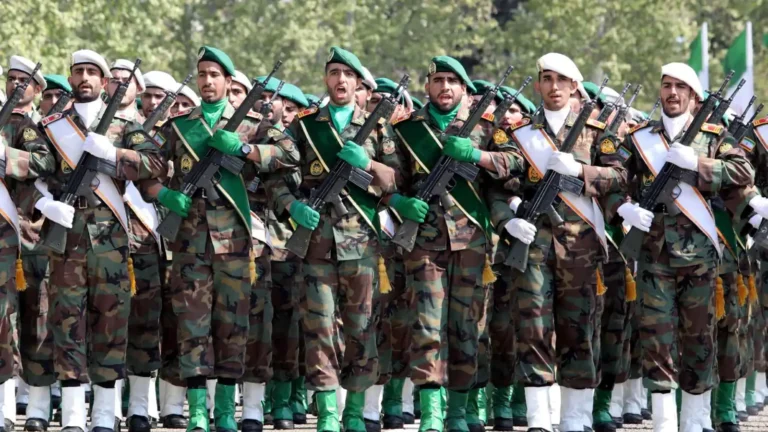
Tehran, Iran – The Iranian Revolutionary Guard announced, this morning, Wednesday, that one of its soldiers was killed as a result of air attacks launched by American forces on the Iranian city of Mahshahr. The Public Relations Office of the Third Marine Region of the Revolutionary Guards stated that the dead man was named “Mohammed Reza Khuzami.” He also indicated that he died while trying to confront enemy drones, as he was hit by shell fragments during the ongoing battles. The statement did not provide further details about the exact locations affected by the bombing or the field conditions surrounding the operation.
Widespread American response
These losses among the Revolutionary Guard come as part of a broad US military campaign targeting more than 80 strategic sites inside Iranian territory. According to US military sources, the strikes focused on destroying vital defense systems and command centers. In addition, more than 60 Revolutionary Guard fast boats were sunk. The Pentagon confirmed that this action was a direct and decisive response to attacks launched by Tehran against commercial vessels in the Strait of Hormuz. This effectively ended the fragile ceasefire agreement that had existed between the two sides.
Threats from the “Seal of the Prophets” and the expansion of the conflict
For its part, Iran’s Khatam al-Anbiya Construction Headquarters described the US airstrikes—which coincided, remarkably, with the funeral of Ali Khamenei in Iraq—as “blatant aggression.” It also vowed a “crushing” response to this escalation. The Iranian response was not limited to statements; the past few hours have witnessed a dangerous shift in the scope of the conflict. The Revolutionary Guard targeted vital sites in both Bahrain and Kuwait using ballistic missiles and drones.
These rapid developments indicate that the confrontation between Washington and Tehran has entered a new phase of open conflict. The two sides are exchanging blows that extend beyond Iran’s geographical boundaries, impacting the security of the Gulf Arab states. With the escalating military rhetoric and the expanding scope of the strikes, the region appears to be heading toward complex scenarios. At the same time, all diplomatic channels have ceased, increasing the likelihood of a full-blown regional confrontation. There are no signs of it being contained in the near future.