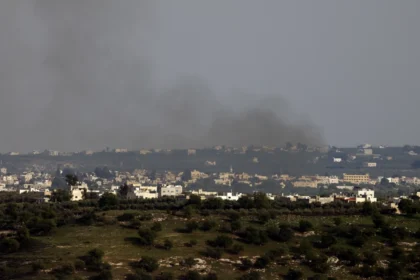
Damascus, Syria – A series of explosions caused by improvised explosive devices (IEDs) rocked the Syrian capital, Damascus, on Tuesday morning, near the hotel where French President Emmanuel Macron was expected to stay during his official visit to the country. The explosions triggered a large-scale security alert. Following the blasts, streets surrounding the site were closed, and plumes of smoke were seen rising from the area. The Élysée Palace confirmed that the French president did not hear any explosions as he was en route to meet with the Syrian president.
A historic visit amid security tensions
Despite security threats, Syrian President Ahmed al-Sharaa received Macron at the People’s Palace on Tuesday, the second day of his official visit, the first by a French president in 18 years. The last visit was by his predecessor, Nicolas Sarkozy, in September 2008. Macron’s visit, which includes a delegation of French investors, aims to support the transitional phase. He also seeks to strengthen bilateral relations, despite the significant security challenges facing the country.
Escalating security challenges
These bombings highlight the fragile security situation, especially after a similar explosion targeted a cafe in Damascus a few days ago, leaving nine dead and 22 wounded. They also come in the wake of a security campaign launched by the Syrian Interior Ministry, during which the ministry dismantled a cell in the al-Ghab region of Hama that was involved in assassinations. Furthermore, efforts are ongoing to contain the fallout from a car bombing that occurred on May 19 outside a building belonging to the Ministry of Defense.
The battle against ISIS and the transitional phase
The new Syrian administration, led by Ahmed al-Sharaa, faces a strategic challenge in preventing ISIS from exploiting any security vacuum that may accompany the transitional phase. Security efforts are currently focused on pursuing sleeper cells in desert and rural areas. Furthermore, border controls are being tightened to prevent the infiltration of fighters.
The fight against terrorism is receiving widespread international attention, with Damascus seeking to strengthen coordination with Washington and international partners to ensure the organization does not resurge. Western capitals fear that the fragility of security institutions could give extremists an opportunity to regroup. While al-Sharaa is trying to establish security, his task remains complicated by the proliferation of weapons outside state control. Furthermore, there are concerns that remnants of the former regime could transform into armed groups employing guerrilla warfare to obstruct the transitional process, placing the government in a difficult position of balancing security with achieving transitional justice to ensure the country’s stability.