Beirut – Lebanon — “Black Thursday” stands out as one of the most brutal, bloody, and highly controversial chapters in the early phases of the catastrophic Lebanese Civil War. Far from being a fleeting security breach, it marked a critical juncture and a perilous turning point that prematurely exposed the massive sectarian friction and polarization festering deeply within the fabric of Lebanese society, heavily accelerating the nation’s descent into a long, agonizing vortex of civil strife and systemic violence.
The Spark of Discord and Killing on Identity
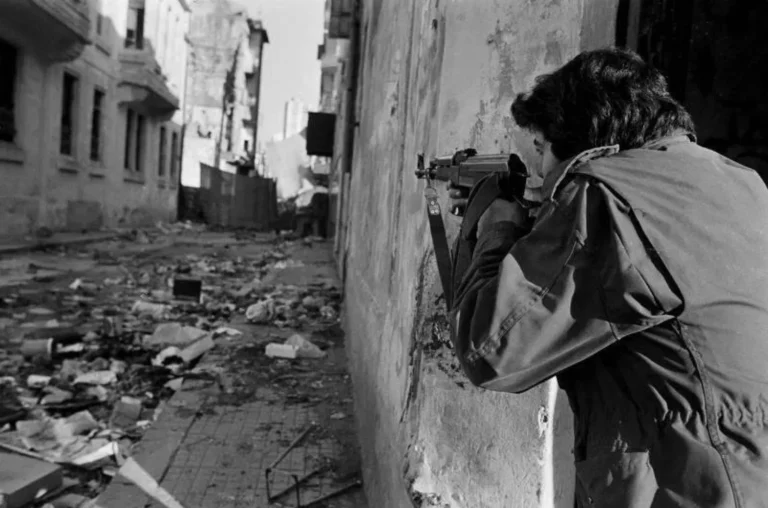
The horrific events of “Black Thursday” unfolded on December 6, 1975 AD, just a few months following the initial outbreak of the civil war, during a time when political and sectarian animosities had reached unprecedented, volatile thresholds. The flashpoint erupted following the assassination of several members of the Lebanese Phalange (Kataeb) Party under ambiguous circumstances that incited immense outrage among party loyalists, triggering a wild, unchecked wave of blind retaliatory actions and armed clashes across the streets of the capital, Beirut, and other regional sectors.
Throughout that dark day, armed militia checkpoints were aggressively deployed along main arterial avenues and vital intersections. Passersby and ordinary citizens were systematically cornered, detained, and subjected to rigorous inspections of their civil identification cards to determine their sectarian backgrounds, religious affiliations, and ancestral home regions. Consequently, these strategic checkpoints transformed overnight into terrifying theaters for wide-scale liquidation and executions targeting unarmed civilians based purely on their identity and religious profiles—a shocking and unprecedented phenomenon that shook the foundations of Lebanon and the entire Middle East.
Demographic Segregation and Deepened Hatred
The fluid, unchecked massacre resulted in dozens of civilian casualties and fatalities, while net historical estimates regarding the definitive death toll continue to fluctuate owing to the chaotic state of affairs and the total breakdown of sovereign institutional oversight during that critical stage of the war. Nevertheless, chroniclers and researchers universally agree that this tragedy constituted one of the very first major organized sectarian massacres of the Lebanese conflict, flashing clear and ominous warning signs that the dispute had breached conventional political gridlocks to morph into a deep, existential societal warfare.
This open bloodbath instilled absolute panic and terror among the populace, prompting thousands of families to rapidly flee their mixed residential neighborhoods in a desperate bid to secure safer havens within internal territorial enclaves that mirrored their own religious majorities. This massive internal displacement substantially contributed to carving out the rigorous lines of geographic and demographic segregation that would define the country throughout the war years. Furthermore, the fallout of Black Thursday heavily fortified a national atmosphere of bitter hatred, paranoia, and mutual distrust among competing Lebanese factions, leading to a vicious cycle of tit-for-tat armed reprisals that rendered structural truces, diplomacy, and constructive dialogue virtually impossible.
A Historic Indictment and a Grim Memory
Specialized historians and sociologists analyzing the Lebanese theater argue that “Black Thursday” was not a spontaneous anomaly; rather, it was a pivotal landmark that explicitly exposed the sheer fragility of Lebanon’s internal governance balances. It demonstrated how rapidly sectarian agitation and political fractionalization can mutate into nationwide armed warfare when competent state apparatuses capable of enforcing the rule of law and de-escalating domestic crises are tragically absent.