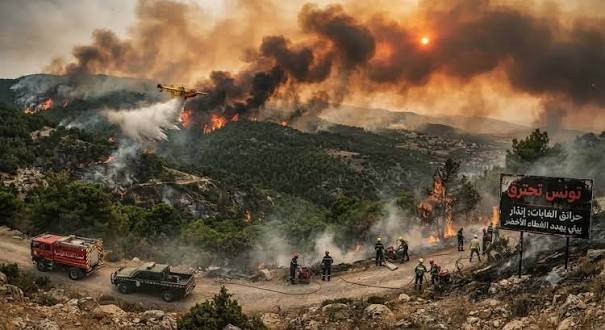
Tunisia – Over the past ten days, Tunisia has witnessed a series of widespread and successive forest and vegetation fires. These have been primarily concentrated in the mountainous regions of the north and northwest of the country. This environmental disaster coincided with record-breaking high temperatures. Additionally, the strong, dry “Sehhili” winds contributed to the rapid spread of the fires. In some areas, the fires approached homes and residential areas. This prompted a full mobilization of firefighting teams.
Forest fire map of Tunisia
According to data from the General Directorate of Forests, Tunisia had recorded approximately 50 forest fires by July 14th since the start of the season on May 1st. These fires consumed nearly 200 hectares of forest cover. The fire on Mount Chahma in the Zaghouan Governorate was the largest recorded during that period. Extinguishing it required a joint intervention by Civil Protection units, forestry agents, and army aircraft.
Jendouba and Bizerte: Hotspots and strenuous efforts to contain them
However, the situation worsened on the evening of July 14th when a large fire broke out in the forests of Wadi al-Tut, al-Shaghir, Sidi Hamida, and other areas between the delegations of Fernana and Balta Bou Aouane in the Jendouba Governorate. The arduous firefighting operations continued until the following morning, with the participation of the Civil Protection, forestry personnel, the army, and volunteers. In the end, the fire was finally brought under control. The flames consumed more than 30 hectares of forest, damaged some houses, destroyed stores of fodder and firewood, and caused the death of a number of animals.
Fires hit the state of Jendouba
Fires struck the Jendouba governorate again on July 20 and 21, with three simultaneous outbreaks in areas near Ain Draham. The fires were brought under control after hours of intervention. Approximately eight hectares of forest and fruit trees were consumed by the blaze in the Sidi Mohamed area near the Zarga Dam. Plastic irrigation pipes were also damaged. Local officials attributed the fire’s rapid spread to the difficulty of accessing the area for fire trucks. They also noted the lack of proper access roads within the forest.
On the same day, another fire broke out in the Qalb al-Thiran forest in Fernana, with flames reaching the Douar al-Brahmiya area. This damaged homes and animal shelters. Residents were forced to evacuate women and children, as well as livestock and some belongings. Firefighters, assisted by local residents, eventually brought the blaze under control. In addition, cooling and monitoring operations continued to prevent reignition.
Containing the danger and maintaining vigilance: Initial findings and preventive measures
The most serious fire broke out on Tuesday in the forested area between the Rafraf and Sidi Ali El Mekki highlands, in the Ghar El Melh district of Bizerte Governorate. It took more than 16 hours to bring it under control, with the participation of the Civil Protection, the army, security and technical services, and volunteers.
Human casualties recorded
Eight women and six infants were evacuated, as a precaution, before they returned to their homes on Wednesday morning. The authorities confirmed that no human casualties were recorded, while a point selling drinks was burned and other material damage was recorded that has not yet been determined. Based on the announced numbers, the affected forest area exceeded at least 238 hectares. This takes into account the toll of 200 hectares announced on July 14, more than 30 hectares in the Jendouba fire, and eight hectares near Ain Draham. However, the real number is likely to rise. The reason is that the area of the Ghar El Melh fire and a number of smaller hotspots have not yet been announced.
As of this morning, Wednesday, July 22, the Tunisian authorities have not announced any confirmed deaths or human injuries related to these major forest fires. The losses were concentrated in forest cover, homes, livestock, and fodder.
Field data confirms that the largest hotspots are under control. However, civil protection and forestry teams continue cooling and monitoring operations in Ghar El Melh, Fernana and Ain Draham, amid continuing high temperatures and winds that keep the danger of renewed fires present.