
- The revolution has begun.. but the fully automated home has not arrived yet
- On the other side of the equation.. 75.6 million people
- Why could the Gulf become one of the most important testing grounds for this revolution?
- From the car to the robot.. what if banks enter the market?
- Voice of Emirates simulation for financing a home robot
- What if we compare five years of wages with five years of robot ownership?
- $499 a month.. the comparison has already begun
- Could banks finance the “robot worker” the way they finance a car?
- Insurance.. a new market that could grow around the robot
- Who is responsible when the error is in the “brain” rather than the machine?
- The most disruptive scenario may not be replacing the worker.. but eliminating the second worker
- Cleaning first.. human care may survive longer
- A job disappears in Dubai.. and a family’s income falls thousands of kilometers away
- Could labor-exporting countries face a future “remittance shock”?
- From “domestic worker” to “care specialist”
- The robot may take a job.. and create other jobs
- The tipping point.. when the robot becomes an “asset” rather than a device
- Three scenarios for the future
- Could the robot become a new symbol of wealth?
- This is not a battle between humans and machines
- The question that must begin now
Dubai, United Arab Emirates – The next major revolution in the labor market may not begin inside a giant factory or a technology company. It may begin in an ordinary household kitchen.
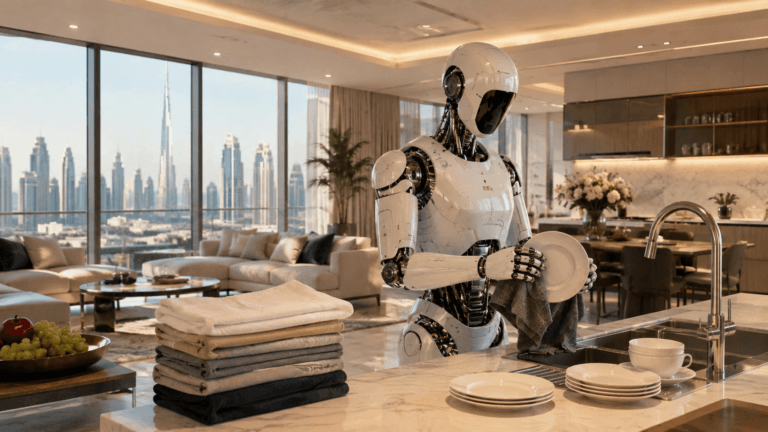
Imagine a family in Dubai a few years from now waking up in the morning to find that a humanoid robot has spent the night tidying the house, collecting laundry, putting dishes away, cleaning the kitchen, and preparing a list of tasks for the following day.
There is no monthly salary, no residence visa, no annual leave or airfare, and no room that must be allocated to a worker. Instead, there is a purchase price or a bank installment, electricity, maintenance, and perhaps an annual insurance policy similar in some ways to what a car owner already pays.
The scene may still sound like science fiction, but some of its elements already exist.
1X has opened orders for its NEO humanoid home robot at an announced price of $20,000, or about AED 73,500, alongside a subscription model priced at $499 per month, equivalent to roughly AED 1,833. The company says deliveries in the United States are set to begin in 2026 before expansion into international markets, and describes NEO as a robot designed to perform and learn household tasks.
This changes the question.
The issue is no longer simply: “Can humans build a robot that resembles them?”
A more sensitive economic and social question is now emerging:
“What happens when the cost of owning a robot capable of performing a large share of household tasks approaches the cost of employing a human to do the same work?”
Could that, within one or two decades, reshape a labor market on which tens of millions of people depend to earn a living and support their families?
The revolution has begun.. but the fully automated home has not arrived yet
It is important first to distinguish between what robots can do today and what the industry promises for the future.
NEO, for example, can, according to its manufacturer, learn and carry out a range of household tasks, but early versions do not yet possess the level of autonomy that humans have. 1X offers what it calls “Expert Mode,” in which a human expert affiliated with the company can remotely supervise the robot during complex tasks it has not yet learned.
Even what was seen at the World Robot Conference in Beijing in August 2026 reflects the same gap. Humanoid robots have become more capable in movement and interaction, but their general practical abilities remain well below those of humans in unstructured environments such as homes.
In recent remarks, Wang Xingxing, founder and CEO of Unitree, estimated that reaching a robot capable of independently performing most tasks in unfamiliar environments could take between five and ten years, although progress could happen faster.
The economic direction, however, is becoming increasingly clear.
Goldman Sachs Research has estimated that the global humanoid robot market could reach about $38 billion by 2035, supported by falling component costs and accelerating advances in artificial intelligence. It also expects consumer demand to accelerate after industrial applications lead the way into broader adoption.
Morgan Stanley goes much further, projecting the possibility of more than one billion humanoid robots by 2050, in a market that could exceed $5 trillion when hardware, supply chains, maintenance, and related services are included. It nevertheless expects around 90% of those robots to be used in industrial and commercial environments, with approximately 80 million operating inside homes.
There is therefore no fully capable “robot domestic worker” today that can replace a human entirely, but the technological and economic foundations of such a market are beginning to take shape.
On the other side of the equation.. 75.6 million people
If the robotics industry sees the home as a new market, behind the household door already stands an enormous human labor market.
The International Labour Organization estimates that around 75.6 million people worldwide work in domestic service, representing about 4.5% of total global employment, with women accounting for 76.2% of domestic workers.
In the Arab states alone, there are around 6.6 million domestic workers, representing 12.3% of total employment in the region, compared with 2.3% globally.
The sector is particularly significant in the Gulf Cooperation Council countries, where domestic work accounts for roughly one-fifth to one-quarter of the workforce in most GCC states.
This means that the arrival of a humanoid robot in a home in Dubai, Abu Dhabi, Riyadh, or Doha is not merely a consumer decision to buy a new device.
On the other side of the world, it may mean a job that no longer exists for a worker supporting a family in the Philippines, Sri Lanka, Indonesia, India, or another labor-exporting country.
At that point, a technological revolution becomes a cross-border economic issue.
Why could the Gulf become one of the most important testing grounds for this revolution?
The Gulf has a unique position.
It is one of the regions of the world with the highest use of domestic workers, while at the same time being a high-income market with a strong appetite for new technologies and smart services.
At the same time, human domestic labor in the Gulf still has an economic advantage that is less pronounced in Europe or the United States: its cost remains relatively low compared with household income.
That means a robot will not spread through Gulf homes simply because it is impressive.
It must also be safe, reliable, capable of working for long hours, easy to maintain, and, above all, economically competitive.
Yet the announced price of one of the first consumer-oriented humanoid home robots suggests that this competition could begin sooner than many expect.
A price of $20,000 is equivalent to about AED 73,500, making the robot closer in cost to a car than to an ordinary household electronic device.
That similarity leads to a factor that could ultimately prove even more important than the robot’s sticker price: Financing.
From the car to the robot.. what if banks enter the market?
Few consumers insist on having the full cash price of a car before buying one.
For many households, the more important question is: “How much will the monthly installment be?”
In the UAE, Central Bank rules allow vehicle financing of up to 80% of a car’s value, with a maximum repayment period of 60 months, while the financed vehicle is pledged as security for the loan.
Emirates NBD, for example, currently offers vehicle financing with a minimum 20% down payment and terms of up to 60 months, with an indicative reducing rate of 5.06% per year on one of its products.
There is currently no rule stating that home robots will be financed in the same way, and this study does not represent an actual banking offer for robot financing.
But what if that changes in the future?
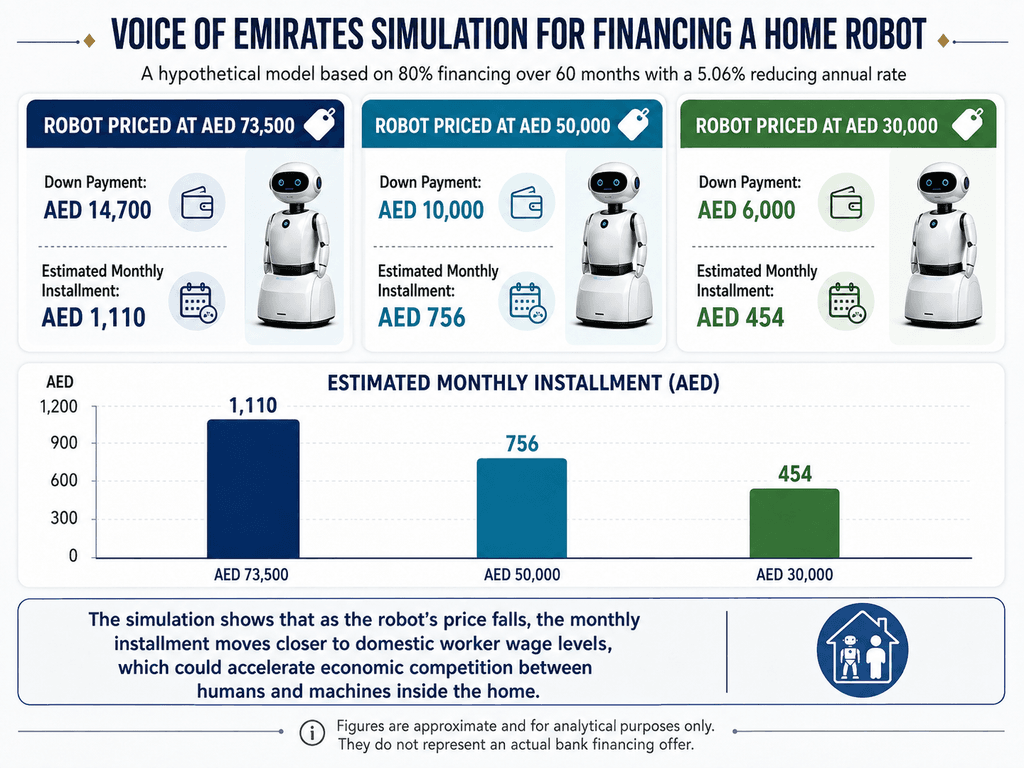
Voice of Emirates conducted a numerical simulation using the current vehicle-financing model simply to test the potential impact, assuming 80% financing over 60 months at a reducing annual rate of 5.06%.
Voice of Emirates simulation for financing a home robot
If the robot costs about AED 73,500, the estimated down payment would be AED 14,700, while the approximate monthly installment would be AED 1,110.
If the robot’s price falls to AED 50,000, the estimated down payment would drop to AED 10,000 and the monthly installment to about AED 756.
If the price declines to AED 30,000, the down payment would be approximately AED 6,000 and the monthly installment about AED 454.
The simulation shows that as the price of the robot falls, its monthly installment moves closer to domestic-worker wage levels, potentially accelerating economic competition between humans and machines inside the home.
A striking result appears here.
If a robot priced at around AED 73,500 were financed under the hypothetical terms above, the monthly installment would be around AED 1,110, in addition to the down payment.
If mass production reduced the price to AED 50,000, the monthly installment could fall to about AED 756, while at AED 30,000 it would approach only AED 454.
This is the point at which genuine economic competition could begin.
What if we compare five years of wages with five years of robot ownership?
If a domestic worker earns AED 1,500 per month, wages alone over five years would amount to AED 90,000.
At AED 2,000 per month, the total would reach AED 120,000.
At AED 2,500, it would reach AED 150,000.
At AED 3,000, it would rise to AED 180,000.
And all of those figures represent wages alone.
In the UAE, employers face additional obligations, including residence procedures, contracts, medical examinations, and health insurance. The law also provides for at least 30 days of paid annual leave and a round-trip airline ticket paid by the employer once every two years, in addition to other obligations specified by law and contract.
Health insurance also became a basic requirement for issuing or renewing residence permits for domestic workers under the system implemented from January 2025.
The comparison also excludes food, accommodation, and day-to-day expenses, which vary from one household to another, as well as recruitment fees, which differ depending on the case, recruitment agency, and nationality of the worker.
On the other side, a fair comparison would also need to include the robot’s future costs, including electricity, maintenance, spare parts, software, and possibly cloud subscriptions and insurance.
Even before all of those expenses are added, however, the figures reveal something important:
Once the robot becomes financeable, the psychological shock of its high purchase price begins to disappear, and the consumer starts comparing a monthly installment with a monthly wage.
That is exactly what happened with cars and many other high-value products.
$499 a month.. the comparison has already begun
There is another model that could be even more disruptive than bank financing.
1X also offers NEO under an announced subscription model of $499 per month, or about AED 1,833, with the subscription expected to become available after early purchase deliveries begin.
If the price remains at that level, the household would not even need to buy the robot.
It could simply pay a monthly amount close to some domestic-worker wage levels and receive the device and service under a subscription model.
There is, however, a fundamental difference that must be emphasized: today’s robot still does not provide the same level of service as a human worker and cannot yet handle children, patients, or unexpected situations with the same flexibility and autonomy.
The comparison at present is therefore more economic on paper than a true comparison between equivalent capabilities.
The equation will change sharply if robot performance improves while its price remains stable or falls.
Could banks finance the “robot worker” the way they finance a car?
For the robot to move from being a product for wealthy consumers and technology enthusiasts into a mass-market household asset, it may need an entire financial ecosystem around it.
A bank does not finance a car simply because it is a car. It finances it because it is an asset whose value can be identified, ownership can be registered, it can be pledged as collateral, its useful life can be assessed, and it can be resold.
If the humanoid robot market evolves to the point where every device has a registration number, a known market value, a defined operating life, a warranty, a maintenance history, and a second-hand market, the economic case for dedicated financing products would become much stronger.
The product may not even be called a “robot loan.”
It could appear under names such as smart-home financing, household equipment financing, or lease-to-own arrangements.
Robot manufacturers themselves could also enter into partnerships with banks and finance companies, much like the relationships that exist today between banks and vehicle dealers.
At that point, the consumer would no longer ask: “Can I afford AED 70,000?”
The question would become: “Can I afford AED 1,000 a month?”
The difference between those two questions could determine the speed of the entire revolution.
Insurance.. a new market that could grow around the robot
If a robot weighing tens of kilograms enters a household where children or elderly people live, carries objects, uses tools, interacts with electrical appliances, and perhaps works in the kitchen, liability immediately becomes a major issue.
In the UAE, vehicle registration cannot be completed without insurance issued by an approved insurer, and there is a standardized third-party liability policy covering bodily injury and property damage caused by vehicles to others.
Could a similar system eventually emerge for household robots?
There is currently no mandatory insurance scheme in the UAE specifically for humanoid home robots, but widespread adoption of such machines could create a new regulatory need.
The potential damage would not be limited to the robot itself malfunctioning.
What if the robot causes a child to fall?
What if it drops a heavy object on a family member?
What if it causes a fire?
What if it makes a mistake while assisting an elderly person?
What if it is hacked and controlled from outside the home?
What if images or conversations captured by its cameras and microphones are leaked?
Traditional electronics insurance would not be enough.
The market may need a combination of civil liability insurance, coverage for the robot itself, cyber insurance, and product-liability protection.
More importantly, insurance may not slow the adoption of robots. It could become one of the factors that accelerates it.
Banks may be more willing to finance an insured asset, while households may be more comfortable bringing a powerful machine into the home if there is a clear system for compensation in the event of an accident.
An entire industry could therefore grow around household robots, structurally similar in many ways to the ecosystem that developed around cars: manufacturers, dealers, banks, insurers, maintenance centers, spare parts suppliers, a second-hand market, and regulations governing use.
Who is responsible when the error is in the “brain” rather than the machine?
The robot adds a new dimension to traditional liability.
In a car, it is often possible to distinguish between driver error and a vehicle defect.
A robot powered by artificial intelligence, however, may make a decision based on software, machine-learning models, data, cloud instructions, and manufacturer-issued updates.
If a software update causes the robot to make a wrong movement that injures someone, who is responsible?
The robot owner?
The manufacturer?
The developer of the AI model?
The software company?
The technician who performed maintenance?
Or another company that provides remote-control services?
These questions are not entirely theoretical, because one of the best-known home robots being introduced today already allows a human expert to remotely supervise certain tasks when the robot is unable to complete them independently.
As the robot moves from the factory into the bedroom, kitchen, and children’s room, privacy shifts from being a technical issue into a deeply personal family concern.
The most disruptive scenario may not be replacing the worker.. but eliminating the second worker
One of the biggest mistakes in this debate may be imagining a future in which there are only two choices: human or robot.
The transition is unlikely to happen that way.
The more realistic scenario may begin with a household that employs two or three workers, buys a robot, and decides it no longer needs one of them.
Then another worker’s contract ends and the household chooses not to recruit a replacement.
Eventually, routine tasks become the responsibility of the machine, while the family keeps only one person for work that requires human judgment or direct care.
In other words, the robot does not need to perform 100% of a human worker’s tasks before it starts affecting jobs.
It may be enough for it to reliably handle 60% or 70% of daily duties for households to start reconsidering how many workers they actually need.
The more realistic equation could therefore become:
“Three domestic workers today versus one human worker and one or two robots in the future.”
If this pattern is repeated across millions of homes, the impact on employment could be enormous even without the complete disappearance of domestic work.
Cleaning first.. human care may survive longer
Not all household jobs face the same level of exposure.
Repetitive and predictable tasks are easier to automate, including moving objects, cleaning floors, arranging clothes, handling dishes, collecting household items, and organizing parts of the home.
Caring for an infant, dealing with a sick child, noticing a sudden health change in an elderly person, providing emotional reassurance, or handling dozens of unexpected situations inside a household is far more complex.
Robots may therefore redefine the domestic worker rather than eliminate the role entirely.
The value of skills that machines can perform easily may decline, while the value of a qualified nanny, elderly-care provider, home-health assistant, specialist cook, or household manager may increase.
A new economic paradox could emerge:
“Fewer domestic workers.. but higher wages for some of those who remain because of their specialization.”
A job disappears in Dubai.. and a family’s income falls thousands of kilometers away
The deeper effect of this revolution will not remain inside the country where the robot is used.
In the Philippines, for example, the Philippine Statistics Authority estimated that around 2.19 million Filipinos worked overseas in 2024, with the UAE ranking as the second-largest Asian destination after Saudi Arabia, accounting for 12.4%. The same survey recorded approximately 262.2 billion Philippine pesos in remittances.
World Bank data also show that personal remittances received by the Philippines were equivalent to about 8.7% of GDP in 2024.
That does not mean that all Filipino overseas workers are domestic workers, but it illustrates the economic importance of migration, overseas employment, and remittances to the country and to individual households.
In Sri Lanka, workers’ remittances reached about $8.08 billion in 2025, while data from the Central Bank of Sri Lanka showed that the UAE was the largest recorded source of remittances by country in the final quarter of that year.
Indonesia is also one of the major sources of domestic labor to Gulf countries, and many Indonesian households depend on income transferred by relatives working overseas. Any broad decline in demand for domestic labor due to automation and robotics would therefore not remain a local effect in labor-importing countries, but could extend to household incomes and communities in Indonesia and other labor-exporting states.
Accordingly, the loss of one million jobs in a labor-importing country does not necessarily mean only one million people are affected.
A worker who sends part of a salary to parents, children, and siblings may be the main source of income for an entire household.
The impact of a robot in a wealthy home in a high-income country could therefore reach a village or small town thousands of kilometers away.
Could labor-exporting countries face a future “remittance shock”?
If the change happens gradually, it may be manageable.
But if robot prices fall quickly while their capabilities improve at the same time, labor-importing countries may begin reducing the number of new visas before labor-exporting states are prepared for the change.
That is where the risk lies.
Millions of existing workers would not necessarily have to be dismissed.
It may be enough for households to simply stop replacing workers when they return home.
If a country sends hundreds of thousands of workers abroad each year and demand for new workers begins to decline, the effect on its domestic labor market and remittance flows could become visible within only a few years.
Countries that depend on exporting labor therefore have an opportunity to prepare before the problem becomes large.
From “domestic worker” to “care specialist”
The best economic defense against the robot may not be preventing the robot. It may be teaching people to perform work that robots find much harder to replace.
Training can shift away from general cleaning and household chores toward childcare, elderly care, first aid, home health assistance, nutrition, specialist cooking, household management, and even operating smart-home systems and robots themselves.
The International Labour Organization also points to an important counter-trend: the world is moving toward a growing care crisis as populations age, and it estimates that 2.3 billion people will need care services by 2030.
That means the higher-value job of the future may no longer be “the person who cleans the house,” but the person who provides the type of care that machines cannot yet deliver at the same level.
The robot may take a job.. and create other jobs
Technological revolutions usually do not simply eliminate work. They move it.
If millions of robots enter households, the world will need maintenance technicians, repair centers, remote robot supervisors, AI trainers, cybersecurity experts, insurance and liability specialists, spare-parts vendors, and specialized robot-cleaning and servicing businesses.
Some domestic workers themselves may be able to transition into a new role:
“Home and robot supervisor.”
In that model, the human does not personally clean every room, but instead determines what needs to be done, checks the result, manages devices and robots, and performs tasks that still require human judgment.
The World Economic Forum’s Future of Jobs Report 2025 indicates that technological, economic, and demographic shifts could create around 170 million jobs globally by 2030 while displacing 92 million existing roles, with robots and autonomous systems among the major forces driving job displacement.
At the same time, the report expects growth in personal-care and health-related occupations.
The problem, therefore, is not necessarily an absolute shortage of jobs.
The problem is that the person who loses a job today may not have the skills required for the job that appears tomorrow.
The tipping point.. when the robot becomes an “asset” rather than a device
The decisive turning point in the home-robot market may ultimately be less about artificial intelligence than it appears.
The car did not become a mass-market product simply because it was useful.
Banks financed it, insurers covered it, dealerships sold it, service centers maintained it, second-hand markets emerged, and regulations developed around ownership and liability.
If the same thing happens with humanoid robots, their economic nature could change completely.
A domestic worker represents an ongoing service cost for a household.
An owned robot, by contrast, could become an asset whose installments end after five years, while the household continues to own the machine and may even retain some resale value.
If the robot can be financed, pledged as collateral, insured, and resold, then for both banks and consumers it begins to resemble a car more than a washing machine or a smartphone.
At that point, the decisive factor may not be whether robot prices fall to $10,000 or $5,000.
Three developments may be enough:
A robot capable of reliably performing most routine household work, bank financing that converts its price into a monthly installment, and an insurance system that makes the risks of keeping it in the home manageable.
When those three elements come together, genuine economic competition between humans and machines begins.
Three scenarios for the future
It is impossible today to determine exactly how many jobs will disappear or when that will happen, but current market trends allow three broad scenarios to be considered.
In the first scenario, the robot becomes an assistant to the human worker. It handles strenuous and repetitive work while the human focuses on supervision, care, and more complex tasks. In this case, robots could improve working conditions rather than eliminate jobs.
In the second scenario, perhaps the most significant in the medium term, the household shifts to “one human with one or two robots” instead of employing several workers. Employment falls even without humans being fully replaced.
The third scenario emerges when robots become highly reliable and much cheaper. Some households may then stop employing live-in domestic workers altogether and purchase specialized human services only when needed, such as a nanny, care provider, cook, or home nurse.
All three scenarios may exist at the same time depending on household income, home size, local culture, and whether children or elderly family members are present.
Could the robot become a new symbol of wealth?
There is also a social dimension.
Car ownership was once a luxury before becoming widespread.
The mobile phone also began as an expensive product for a limited segment of society before eventually reaching billions of people.
If robots follow the same path, the first stage may see them appearing in wealthy households, luxury resorts, hotels, and high-end residential communities.
Then prices fall.
Then financing emerges.
Then a second-hand market develops.
Then what was once a symbol of wealth becomes an ordinary household product.
At that point, a family setting up a new home may face a question similar to the question of buying a car today:
“Do we recruit a domestic worker, or finance a robot?”
This is not a battle between humans and machines
It is easy to portray the future as a confrontation between millions of workers and the companies building robots.
The reality is more complex.
Robots can reduce physically demanding and dangerous work, help elderly people remain more independent, address labor shortages in aging societies, and give families more time.
At the same time, a rapid and poorly managed technological transition could lead to widespread losses of jobs and income, especially among workers who have fewer opportunities to retrain.
The difference between these outcomes may depend on how quickly governments, labor markets, education systems, and labor-exporting countries prepare.
The question that must begin now
There may never be a morning when the world wakes up to discover that 75 million domestic workers have suddenly lost their jobs.
Technological revolutions rarely happen that way.
The change may be quieter.
One family buys a robot and does not recruit a second worker.
Another worker’s contract ends and the household does not replace them.
A third family keeps the nanny but leaves cleaning, laundry, and tidying to the machine.
Then millions of small decisions accumulate into a major labor-market transformation.
At that point, the question will no longer be: “Can a robot clean a home?”
Technology may already have answered that question.
The more important question will be: “What will the world do with the people for whom cleaning homes was a source of livelihood?”
And an even earlier question may be: “What happens when a consumer can buy a robot worker in the same way they buy a car: with a down payment, a five-year loan, annual insurance, a warranty, and maintenance?”
If the robotics industry reaches that stage, it will not only change how homes are managed.
It could also reshape labor markets and migration, the business of banks and insurers, legal liability systems, international remittance flows, and the future of millions of families that today depend on the income of someone working far from home.
In the end, the biggest revolution created by the humanoid robot may not be its ability to walk or carry objects. It may be the moment when operating a machine becomes cheaper and easier than employing a human to do the same work.