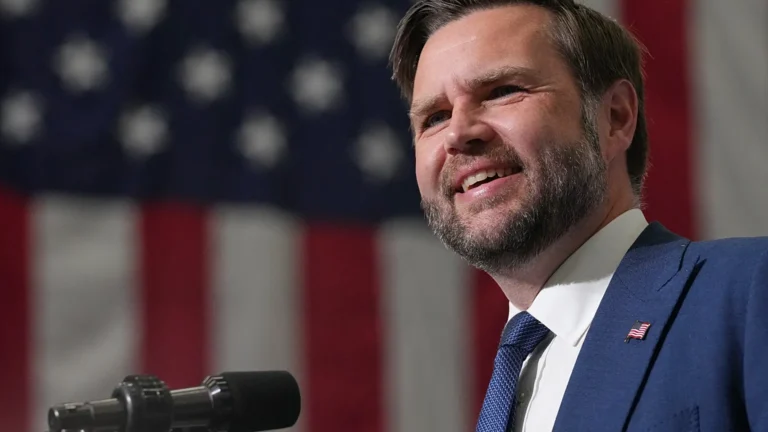
Washington, DC – US Vice President J.D. Vance returned to his home state of Ohio on Friday for a visit with more than one political objective. He campaigned for Republican candidates in the upcoming November midterm elections, while simultaneously appearing to test his chances early in a potential race to succeed President Donald Trump in the 2028 election.
Letter from the steel mill
Vance, 42, delivered a speech at a steel mill in Middletown, the same mill where his grandfather worked for nearly 40 years. The speech evoked memories of his upbringing in the city, which features prominently in his acclaimed 2016 memoir, “Hillipley’s Lament.” The book recounts Vance’s origins in a working-class white family in the Rust Belt, a region that suffered years of industrial decline and economic marginalization. This area later became a key base of support for the Trump movement and its “Make America Great Again” slogan. During his speech, Vance recalled his grandfather coming to the same mill to work as a welder for nearly four decades. He noted that his grandfather’s aspirations were simple, including a desire for the United States not to have to act as the “world’s policeman.”
Vance’s visit to Ohio comes as Republicans seek to maintain control of Congress in the midterm elections. At the same time, the Trump administration faces challenges related to his declining popularity, which could impact the performance of Republican candidates in the upcoming elections. A Reuters/Ipsos poll last week showed Trump’s approval rating dropping to 33%, his lowest level during his current term. This increases the pressure on Republicans before the November elections. In his speech, Vance attempted to combine defending the administration’s policies with a less confrontational tone. He drew on his personal experiences and memories of working-class communities and focused on issues that affect voters’ daily lives.
Cost of living and immigration at the forefront
The vice president said the Trump administration is making progress on the cost of living, attempting to address voter anger over rising prices. This issue has been a major source of concern for Americans recently. Vance, on the other hand, launched an attack on Democrats, particularly on immigration and policies that conservatives describe as part of a “wake-up call” approach. He called on Republican voters to turn out in large numbers for the midterm elections. Vance urged his supporters to vote in November, saying they must “fight for themselves” and confront what he called “the extreme left” within the Democratic Party. Although Vance has not officially announced his intention to run for president in 2028, his political moves and rhetoric toward the Republican base have fueled speculation about his ambition to succeed Trump.
The Republican race is expected to become clearer after the midterm elections, especially given the constitutional restrictions preventing Trump from running for a third consecutive term. Vance appears keen to present himself as one of the leading potential heirs to the “Make America Great Again” movement. However, he employs a more moderate and less confrontational political style than the president. Should Vance decide to run for president, he will need to maintain the support of Trump’s base. At the same time, he must broaden his appeal to Republican and independent voters who might be put off by the highly polarized political rhetoric.
Rubio is vying to succeed Trump.
Vance faces no clear path within the Republican Party. Senator Marco Rubio has emerged as a leading potential candidate for the upcoming presidential election. Rubio has stated he will not run if Vance decides to enter the race. However, a poll conducted by Emerson College and The Hill, published this week, shows Rubio leading Vance in most hypothetical contests against leading Democratic candidates.
With the midterm elections approaching, Vance appears to be facing a double political test: helping Republicans maintain their influence in Congress and consolidating his position within the conservative movement in preparation for a possible succession battle in 2028. While he has not officially announced any presidential move, his return to Ohio and his invocation of his family story before a working-class audience indicate the beginning of an early stage in building the image of a candidate who seeks to combine Trump’s legacy with a more expansive political experience.