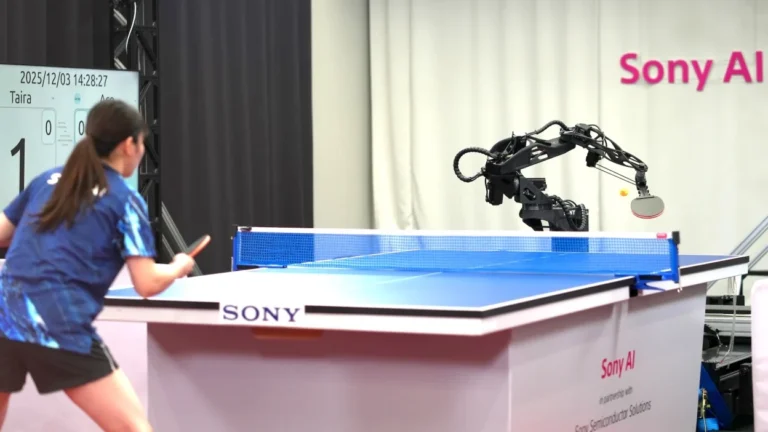
Tokyo – In a move reflecting the massive leap in the world of Artificial Intelligence, a smart robot has achieved incredible results in table tennis matches against human players. The robot relies on high-precision computer vision systems and deep learning algorithms that allow it to track and predict ball movement in the blink of an eye. Accordingly, the evolution of sports robots in 2026 represents a new stage of human-machine interaction, where it is no longer just a mechanical reaction but a fully integrated athletic “tactic” based on analyzing opponent behavior.
Rapid Adaptation: How Did the Robot Defeat Humans in the “Game of Speed”?
During trials, the robot demonstrated the ability to gradually adjust its playing style to target human players’ weaknesses, marking a qualitative leap in autonomous decision-making for smart systems. Obviously, integrating AI into complex motor activities opens the door for broader applications in industry and services. As a result, the challenge is no longer limited to “programming” but has extended to enabling robots to understand and interact with dynamic environments with a precision and safety that sometimes exceeds human capabilities.
Testing Limits: Will Machines Surpass Humans in the Future?
Researchers believe the goal of these experiments isn’t just to “win,” but to test the limits of interaction and speed in a competitive environment. Certainly, global companies are racing against time to develop robots capable of performing complex tasks outside of laboratories. Accordingly, the evolution of sports robots in 2026 remains the true laboratory for understanding how to integrate AI into our daily lives, promising a future where machines become smart partners in both sports and work.