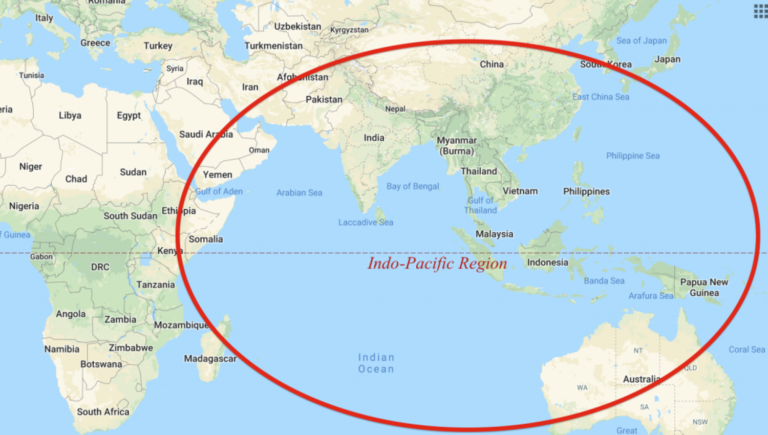
Washington, DC – In a significant strategic shift toward bolstering military dominance in the Indo-Pacific region, Admiral Samuel Paparo, commander of US Central Command, unveiled an ambitious military plan aimed at deterring Chinese ambitions regarding Taiwan.
The report, submitted by Paparo to Congress in April 2026, calls for a record defense budget of $1.5 trillion for 2027. This comes in an effort to counter what he described as the “historic expansion” of the Chinese People’s Liberation Army.
“Qualitative superiority deterrence” strategy
The new budget request—a 44% increase over the previous year—focuses on developing advanced weapons systems to overcome the numerical superiority of the Chinese navy. The Chinese navy currently possesses more than 430 warships, compared to 291 American vessels. Key elements of this strategy include:
The Quicksink System: At a cost of $592 million, Washington aims to convert its JDAM guided bombs into lethal weapons capable of sinking ships by detonating below the waterline. Planners believe this offers a low-cost option for countering large fleets.
The Quickstrike family of mines, for which $531 million has been allocated, are designed to be deployed in shallow waters. They are intended to kill surface and subsurface targets.
The “covertly laid mines” initiative relies on submarine capabilities to plant minefields in strategic areas. This initiative is further enhanced by the “Hammerhead” systems, which are deployed on the seabed and use smart sensors to launch torpedoes at enemy targets.
2027: A crucial deadline for military readiness
The 121-page Paparo report underscores the importance of 2027 as a pivotal year for Chinese readiness, coinciding with the centennial of the People’s Liberation Army.
While intelligence assessments have recently tempered expectations of an imminent attack, the report insists that China is actively training its forces for two missions: first, to forcibly unify Taiwan; and second, to neutralize the defensive capabilities of the United States and its allies in the region.
Next-generation technologies and hypersonic weapons
The plans don’t stop at mines and anti-ship weapons; they extend to advanced technologies to ensure dominance in the modern warfare environment. A massive funding request, exceeding $3 billion, has been requested for the development of hypersonic missiles for the Army and Navy. This is in addition to projects like “Blackbeard” to enhance offensive air strikes, and the development of the “Cancun” program to jam Chinese long-range radars. There is also the launch of a secure communications system known as “Darknet.”
These demands come at a time when President Donald Trump is emphasizing the centrality of the Taiwan issue to Chinese President Xi Jinping, asserting that any move toward the island’s independence will be met with a forceful Chinese response.
With parallel tensions in the Middle East, the Pentagon views these investments as essential for maintaining strategic control over vital waterways. These plans also aim to prevent any disruption to the global balance of power.