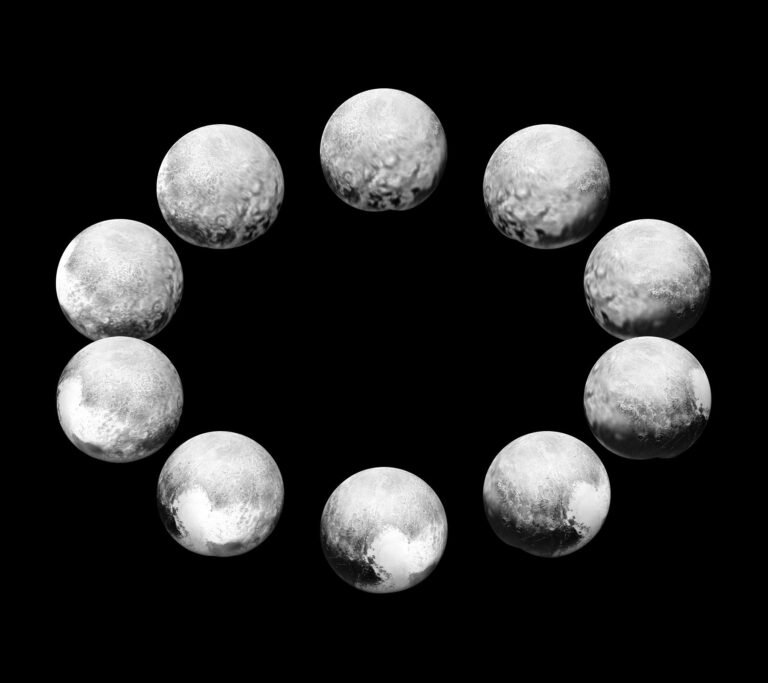
A recent scientific study published in the journal “Nature Communications” has revealed fascinating details about the evolutionary history of “Charon,” the largest moon of the planet Pluto. According to the study conducted by a joint research team from the University of California, Los Angeles (UCLA) and the Swiss Federal Institute of Technology in Zurich (ETH Zurich), Charon was rotating on its axis at an extremely high speed in its early stages. This finding reshapes our understanding of how celestial bodies evolved in the outer regions of the solar system.
A Dramatic Shift in Rotation Speed
The results indicate that Charon’s rotation period did not exceed 14.3 hours about 4 billion years ago, a speed more than ten times faster than its current rotation of 153.3 hours. This process is attributed to “tidal slowing” caused by gravitational forces, which over time led the moon to always face Pluto with one side, just as Earth’s moon does with our planet. This confirms the success of this physical process in stabilizing the orbits of moons around their planets.
Rare Geological Evidence from “Oz Terra”
The researchers based their conclusions on an analysis of the mountain ranges and faults in the “Oz Terra” region in the north of the moon, using high-resolution data captured by the New Horizons spacecraft in 2015. The team explained that the mountain ranges in Oz Terra formed as a result of immense pressures exerted on the icy crust during the moon’s rotation slowing process, which created unique geological features. These features have been well-preserved for 4 billion years because Charon did not experience major surface reshaping compared to other icy moons in the solar system, making them an invaluable historical record.
Confirmation of the “Cold Start” Hypothesis
Analysis of computer models for the characteristics of the mountain ranges revealed that the thickness of Charon’s icy crust at that time was at least 30 to 36 kilometers. This significant thickness strongly supports the “Cold Start” hypothesis for Charon’s formation, meaning it formed in a relatively low thermal state rather than being very hot in its early stages, as some previous theories suggested. This study is a unique scientific achievement, as it provides a rare geological record documenting the rotational slowing history of a celestial body and provides an important window into understanding the thermal and orbital evolution of icy moons in the outer regions of the solar system.