- Ship counts reveal what official statements don’t say.
- “Open” militarily… closed economically?
- Chinese companies are saying something different
- Why does the ship choose the longer route?
- Ships don’t believe statements; they act according to the risks.
- Not every transit is evidence of the return of Hormuz
- Hormuz faces a “market test”.
- Hormuz is not just a strait
- China is redrawing the road
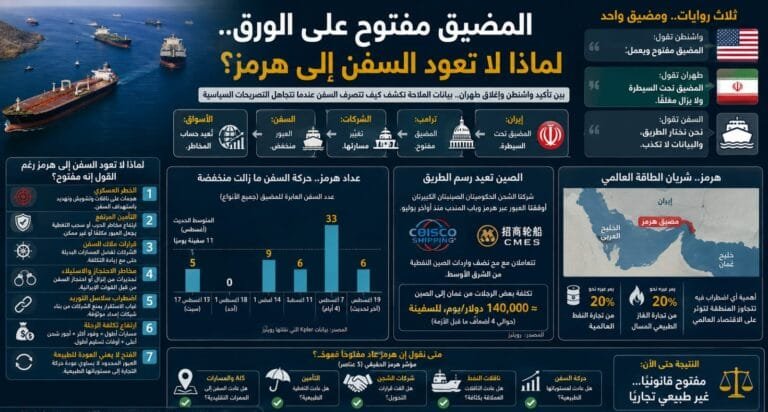
Abu Dhabi, UAE – In the Strait of Hormuz, two conflicting political narratives are clashing: Washington says the waterway is open, while Tehran insists it remains closed to shipping. But beyond the rhetoric, the ships themselves offer a third, quieter, and harder-to-ignore story: the strait is no longer operating normally. According to the latest shipping tracking data reported by Reuters on August 19, only six cargo ships transited the Strait of Hormuz on Tuesday, compared to nine the previous day, and a recent average of nearly 11 transits per day. Among the six vessels were a supertanker that entered from the Omani side and two other tankers, while three ships exited. Thus, the most important question in the Hormuz crisis is not: Who is telling the truth? But rather: If the strait is truly open, why aren’t ships and companies acting as if it were?
Ship counts reveal what official statements don’t say.
Data from recent weeks shows that shipping traffic has not yet returned to normal, despite some vessel transits. On August 7, 33 ships passed through the Strait of Hormuz during the first four days of the week, compared to 50 during the same period the previous week. On August 11, the number of transiting vessels dropped to just six, compared to an average of nearly 11 over the preceding ten days. On August 14, the number briefly rose to nine, but remained below the August average of approximately 12 ships per day, according to Kpler data cited by Reuters. The weekend provided an even clearer indication: only five ships transited on Saturday, and tracking data recorded no transits on Sunday, compared to 31 vessels the previous weekend. These figures do not prove that Hormuz is completely “closed,” but they do demonstrate something different and more economically significant: the strait is not currently functioning as a normal trade route.
“Open” militarily… closed economically?
Herein lies the fundamental paradox. A passage may exist that certain ships can use, and some tankers may indeed be able to transit, but that doesn’t mean shipping companies consider the route safe or reliable. In the world of commercial shipping, geographical openness alone is insufficient. A ship needs: insurance, a crew, an owner willing to take risks, a charterer, cargo, a port of call, and a predictable route. If any one of these links breaks, the voyage can be halted even if the strait remains technically open to some vessels. This is why the commercial behavior of ships becomes a more significant indicator than political pronouncements when assessing the extent to which the Strait of Hormuz is returning to normal operations.
Chinese companies are saying something different
One of the strongest pieces of evidence comes from China. The two Chinese state-owned shipping companies, COSCO Shipping Energy Transportation and China Merchants Energy Shipping, have halted their operations through the Strait of Hormuz and the Bab el-Mandeb Strait since late July, according to sources cited by Reuters. The companies handle roughly half of China’s oil imports from the Middle East, but have turned to alternative arrangements, including ship-to-ship transfers outside the most dangerous areas, particularly near Fujairah and the coast of Oman.
The result is not simply a change in shipping routes; it’s a complete economic recalculation. Data reported by Reuters indicates that the cost of some voyages from Oman to China has risen to around $140,000 per day per vessel, roughly four times pre-crisis levels. In other words, ships can find alternative routes, but they can’t do so for free.
Why does the ship choose the longer route?
Maritime decision-making isn’t solely determined by distance. A carrier might prefer to circumvent a risky area rather than enter a strait that carries the potential for attack, seizure, or disruption. Furthermore, the instability of marine insurance can transform a voyage into an unacceptably high financial risk. Analysis by Windward, a maritime intelligence firm, indicates that the withdrawal or reduction of war risk coverage was a major factor behind the sharp decline in Hormuz traffic during periods of crisis. This illustrates the crisis equation: the strait is open → but insurance is expensive → risks are high → voyage costs rise → the company reroutes the vessel. Thus, the passage can appear open on the map but remain economically closed to a significant portion of trade.
Ships don’t believe statements; they act according to the risks.
During the crisis, the problem wasn’t always the inability of ships to transit, but rather their decision of whether the crossing was worth the risk. Windward data reveals periods of drastically reduced transit traffic, along with instances of stops, waiting, and course diversions, while vessels with unstable or unavailable AIS signals appeared, complicating the determination of actual movement. This presents another challenge to any attempt to interpret the Strait of Hormuz solely through digital charts: a vessel’s disappearance from a tracking screen does not necessarily mean it has disappeared from the sea. There could be jamming of navigation signals, AIS system shutdowns, or practices that make tracking a vessel more difficult. Therefore, a more accurate journalistic investigation requires combining: AIS data, satellite data, Kpler/Windward data, port data, insurance data, and statements from shipping companies.
Not every transit is evidence of the return of Hormuz
Saudi Arabia provided an example of this. Aramco resumed loading oil from terminals within the Strait of Hormuz after a temporary halt, loading three supertankers between August 12 and 16, each carrying approximately two million barrels. The company also resorted to ship-to-ship transfers off the coast of Fujairah. This means that trade did not stop entirely. However, it also did not return to its traditional model. The question is not: Did a tanker leave? But rather: How many tankers left? What route? At what cost? And under what security and insurance arrangements? This is where the meaning of “opening” changes completely.
Hormuz faces a “market test”.
The energy markets themselves provide further evidence. On August 19, oil prices rose by about 1%, with Brent crude approaching $91.89 a barrel and West Texas Intermediate (WTI) nearing $86.11, amid continued concerns about oil shipments through the Strait of Hormuz. If the market were convinced that the strait had returned to normal, it would make sense for the risk premium to decline further. But the continued anxiety in oil, shipping, and insurance prices reflects something else: markets are still pricing in the possibility of continued disruption.
Hormuz is not just a strait
Under normal circumstances, roughly 20% of the world’s crude oil and liquefied natural gas trade passes through the Strait of Hormuz, making any prolonged disruption there an issue that extends beyond Iran and the United States to the entire global economy. But the strait’s importance stems not only from the volume of energy that flows through it. It also stems from the difficulty of quickly replacing it. A ship can change course, but:
The journey becomes longer.
Fuel consumption increases.
Shipping costs rise.
Insurance costs increase.
The number of ships required to transport the same quantity may increase.
Delivery becomes slower.
And global stockpiles become more sensitive to any further delays.
Therefore, every ship that doesn’t return to the Strait of Hormuz is not simply a ship missing from the map; it’s an added cost to the global economy.
China is redrawing the road
Perhaps China is the most significant player in this equation. Instead of waiting for stability to return, major Chinese companies have begun reorganizing their oil shipments through maritime arrangements outside the Gulf. This reveals a significant shift: companies are no longer basing their decisions on the likelihood of the crisis ending, but rather on the likelihood of its continuation. If this situation persists, temporary measures could become long-term arrangements, meaning that the Hormuz crisis could leave a lasting mark on the energy trade map even after the military operations subside. The question that Hormuz must answer, then, is not whether ships are transiting the strait. Ships are indeed transiting it. Nor is it whether someone declares the strait closed or open. Rather, it is the level and continuity of the traffic.
The current situation can be summarized in one equation: a geographically open passage + low traffic + risk-averse shipping + high insurance premiums + alternative routes = a strait that is no longer normal. This explains why both the American and Iranian narratives seem incomplete when viewed solely from a trade perspective. Washington may be able to claim that there is an open route. Tehran may be able to assert that its control over traffic makes passage conditional. But ships don’t need to subscribe to either narrative. They simply make their own decision: pass through, wait, change course, or don’t sail at all.