- It didn’t begin with a missile; it was a takeover.
- Rubymar… When the missile became a means of disrupting the road
- True confidence… the danger is no longer theoretical for the crew.
- Tutor… the rocket wasn’t alone.
- Sounion… testing the ship carrying one million barrels
- Magic Seas… When the attack became a complex operation
- Eternity C… When all the elements of the system came together
- What do the six ships reveal?
- The weapon that does not appear on the radar screen
- The ship began defending itself with its identity.
- Will the Houthis choose the ship or the network associated with it?
- Iran: Where does the aid begin and where does it end?
- The economic battle: How much does one missile cost the other side?
- Why were the Houthis unable to completely close Bab al-Mandab?
- –
- –
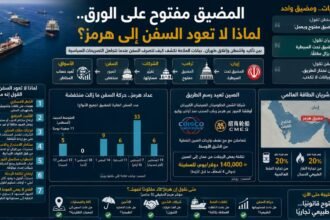
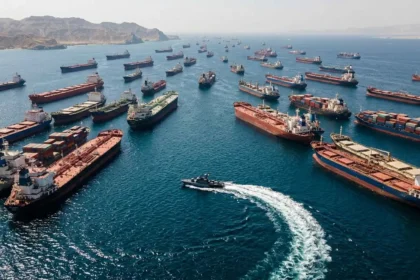
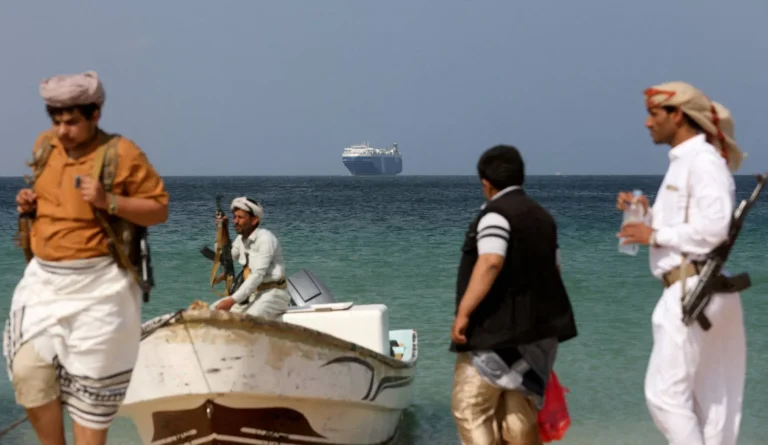
Abu Dhabi, UAE – The Houthis in Yemen do not possess a conventional navy with destroyers, frigates, or submarines, nor do they control international waters in the Red Sea in the traditional military sense. However, in less than two years, the group has demonstrated its ability to target civilian commercial vessels, forcing shipping companies to reroute their vessels, driving up insurance and protection costs, and drawing the fleets of major powers into the area of operations. The Houthi campaign against international shipping began in November 2023, when armed men seized the vessel Galaxy Leader and escorted it to the port of Hodeidah. Since then, more than 100 ships have been attacked or targeted by the end of 2024, according to Reuters.
But the question that hasn’t received the same attention isn’t the number of ships hit. The question is: “How could an armed group with no conventional navy develop the capability to allow a merchant ship worth hundreds of millions of dollars to set sail unsure whether it will be targeted by a missile, a drone, or an explosive-laden boat?” The answer, according to the pattern of attacks, lies not in a single weapon, but in a comprehensive system combining reconnaissance, targeting, missiles, drones, and unmanned boats, exploiting coastal geography and available information on ship movements. And therein lies the story.
It didn’t begin with a missile; it was a takeover.
On November 19, 2023, the Houthis seized the Galaxy Leader vessel while it was sailing in the southern Red Sea. They used a helicopter to land armed men on board before escorting the ship to the port area of Hodeidah. The vessel was affiliated with the Galaxy Maritime Group and operated by the Japanese company Nippon Yusen. Reuters reports indicated ownership ties to Israeli businessmen, which the Houthis used to justify targeting the ship, claiming it was linked to Israel. However, the significance of the Galaxy Leader extends beyond the seizure itself.
Following the operation, ships linked to the same naval group altered their routes, and navigation data showed that one vessel added 1,876 nautical miles to its journey, incurring at least four days of commercial disruption. This demonstrated one of the Houthis’ most potent weapons early on: not destroying the ship, but changing the behavior of other vessels.
Rubymar… When the missile became a means of disrupting the road
On February 18, 2024, two Houthi missiles struck the cargo ship Rubymar in the Gulf of Aden, causing significant damage. The crew was evacuated, and the ship continued to leak water before sinking on March 2. U.S. Central Command stated that the attack caused an oil spill that extended for approximately 18 miles. The ship was carrying about 21,000 tons of fertilizer. The Rubymar was the first ship sunk in the Houthi campaign. However, its significance for this investigation lies in something else: it demonstrated that a missile launched from the coast could be transformed into an environmental, economic, and navigational problem extending far beyond the ship itself. The attack did not destroy a military tanker or a warship; it struck a civilian commercial vessel. Here, the threat shifted from a “military confrontation” to a threat to the commercial infrastructure of the shipping lane.
True confidence… the danger is no longer theoretical for the crew.
On March 6, 2024, a Houthi missile struck the True Confidence, a Barbadian-flagged bulk carrier operated by a Greece-based company. The vessel was sailing from China to Jeddah and Aqaba, carrying steel products and trucks. The attack killed three crew members—two Filipinos and a Vietnamese—and injured others. These were the first fatalities among commercial ship crews during the Houthi campaign. This incident highlights a different point: the threat was no longer merely the disruption of navigation; it had become a direct danger to the lives of civilian seafarers. This increased pressure on shipping companies and seafarers, as companies and vessels began reassessing the viability of transiting the Red Sea.
Tutor… the rocket wasn’t alone.
On June 12, 2024, the Tutor, a Greek-owned, Liberian-flagged coal carrier, was attacked by the Houthis near the port of Hodeidah. The attack was significant because it combined multiple weapons: missiles and an explosive-laden drone boat. The ship was damaged and took on water, eventually sinking on June 19. Twenty-two Filipino crew members were evacuated, while one crew member remained missing. This marked the first clear indication of a shift in tactics. Attacks were no longer limited to a single missile launched from a distance; the ship now faced a multi-pronged, multi-vehicle threat.
Sounion… testing the ship carrying one million barrels
In August 2024, the oil tanker Sounion was attacked in the Red Sea. The ship was flying the Greek flag and carrying approximately one million barrels of crude oil. The vessel was hit and caught fire, forcing its crew to abandon ship. The subsequent operation to salvage the vessel and prevent a potential environmental disaster became a complex undertaking. This incident reveals another dimension of Houthi power: a ship does not need to sink for an attack to have a strategic impact. It is enough for a large oil tanker to be targeted.
- Not operable.
- It needs saving.
- An environmental hazard.
- A burden on the naval forces.
- A source of concern for insurance companies.
That is, the military objective extends beyond the moment of impact.
Magic Seas… When the attack became a complex operation
On July 6, 2025, the Magic Seas, a Liberian-flagged bulk carrier operated by a Greek company, was attacked off the southwestern coast of Yemen. According to Reuters, the ship was targeted with gunfire, missiles, and drones, and four unmanned surface boats laden with explosives were also used. The crew was evacuated before the ship sank. This incident represents a significant turning point in the investigation. The attack was no longer a simple pattern: detection → missile launch, but rather a pattern of: surveillance → approach → use of drones → use of boats → gunfire and missiles → forcing the crew to abandon ship. This indicates that the Houthis have developed a more flexible approach to attack.
Eternity C… When all the elements of the system came together
Just days later, the Eternity C, a Liberian-flagged bulk carrier operated by a Greek company, was repeatedly attacked in the Red Sea. According to Reuters, the attackers used naval drones and rocket-propelled grenades launched from speedboats. The ship sank on July 9, 2025. There were 25 people on board; at least four were killed, according to maritime sources, while some crew members were rescued and others remained missing. Later, sources said that the Houthis detained several of the crew members who survived the sinking before releasing them in December 2025. The Eternity C gained added significance because the Houthis claimed it was headed to the port of Eilat, though Reuters was unable to independently verify some details of their account.
What do the six ships reveal?
When the cases are placed side by side, a more complex picture emerges.
Ship | Attack Type | Outcome | What It Reveals
Galaxy Leader | Airborne assault and capture | Ship and crew held | Capture capability
Rubymar | Missiles | Sinking | Long-range destruction capability
True Confidence | Missile | 3 killed and wounded | Direct threat to crew
Tutor | Missiles + drone boat | Sinking | Combined attack methods
Sounion | Multiple attack resulting in fire and disabling | Environmental hazard and rescue operations | Post-injury depletion
Magic Seas | Drones + Missiles + Boats | Sinking | Multi-layered attack
Eternity C | Sea drones + Missiles/Shipments + Boats | Sinking and casualties | Combined and repeated attack
What’s important here is not the number of ships sunk, but the evolution of the attack itself.
The weapon that does not appear on the radar screen
Missiles and drones are the visible part of the equation. But any targeting system needs to know, before firing, where the target is, who it is, and where it is headed. This is where data from commercial vessels becomes crucial. Ships use AIS systems to transmit information such as location, speed, direction, and identification.
A Reuters visual investigation revealed that the Houthis used ship tracking data, along with a coastal surveillance system and intelligence linked to Iran, in their targeting process. This doesn’t mean that every Houthi attack necessarily relied on AIS, but the data available to ships provides an information layer that can help build a picture of maritime traffic. This is a crucial point: “In modern naval warfare, the targeting process may begin long before the first missile is launched.”
The ship began defending itself with its identity.
In July 2025, Reuters revealed that some ships had begun using messages on their tracking systems such as “All Crew Muslim,” “Chinese owned,” and “No connection to Israel” in an attempt to reduce the likelihood of being targeted. This phenomenon reveals an unprecedented shift in the rules of maritime risk. A ship that once needed radar, a crew, security, and insurance now also needs a clear commercial and political identity. In other words, ownership, route, and commercial relationships have become integral to survival calculations.
Will the Houthis choose the ship or the network associated with it?
Herein lies one of the most significant findings of the ship analysis. The Houthi targeting was not always based on the ship’s flag. The Galaxy Leader was linked to an ownership and operational network with ties to Israel. True Confidence, on the other hand, had owners and operators who asserted they had no current affiliation with any US entity. And in 2025, the Magic Seas and Eternity C, two ships flying the Liberian flag and operated by Greek companies, were targeted.
This means that “science alone does not explain the targeting pattern.” Rather, the following must be examined: owner → manager → lessee → flight path → intended port → trade links. This is the area that requires further intelligence data before a definitive judgment can be made regarding the Houthi selection criteria.
Iran: Where does the aid begin and where does it end?
There is mounting international evidence of Iranian support for the Houthis, but the extent and nature of assistance with each weapons system remains disputed. The United Nations has documented the presence of missiles, drones, and naval systems in the Houthi arsenal, as well as the group’s use of improvised explosive devices and sea mines against commercial shipping. International reports confirm that Iranian support has played a role in the development of the Houthis’ missile and drone capabilities, while Iran repeatedly denies supplying these systems. Therefore, the equation cannot be professionally reduced to: “Iran gave the Houthis a missile, and the Houthis launched it.” A more accurate assessment is that there is a system in place for support, development, training, and knowledge transfer, but the details of each system and the source of its components require separate evidence.
The economic battle: How much does one missile cost the other side?
The Houthis’ power is not measured solely by the value of the weapons they fire. There is a cost borne by the opposing side:
- Intercepting missiles and drones.
- Protecting ships.
- Deployment of naval vessels.
- rescue operations.
- Search operations for sailors.
- War risk insurance.
- Changing ship routes.
- Increased travel time.
- Fuel consumption.
- High shipping costs.
Since the attacks began, the risks have prompted many shipping companies to use the Cape of Good Hope route instead of the Red Sea and the Suez Canal, increasing travel times and costs. This highlights a crucial point: “The Houthis don’t need to sink every ship to achieve a strategic effect; it’s enough to make a sufficient number of companies change their behavior.”
Why were the Houthis unable to completely close Bab al-Mandab?
This point is crucial to prevent exaggeration. Despite the attacks, the Houthis have not demonstrated the capability to completely and permanently close the Bab el-Mandeb Strait militarily. The United Nations continues to treat the issue as a threat to commercial shipping, not as a completely closed strait. In July 2026, the UN Secretary-General expressed concern about the resumption of Houthi attacks on commercial vessels and the threat to freedom of navigation. Furthermore, in June 2026, the Security Council extended the mechanism for reporting Houthi attacks on commercial vessels in the Red Sea. Therefore, the Houthi capability is not control of the sea; it is the ability to threaten its use. The distinction between the two is the crux of this investigation.
–
In traditional naval warfare, a state seeking to control a maritime area needs warships, submarines, aircraft, and bases. The Houthi model operates differently: a coastline, missiles, drones, boats, reconnaissance, intelligence, and favorable geography. These elements don’t grant the group control of the sea. However, they do provide something less costly and more realistic: the ability to make the sea a dangerous area. This is the concept of denying access to the sea or preventing the use of a maritime area without completely controlling it.
–
–