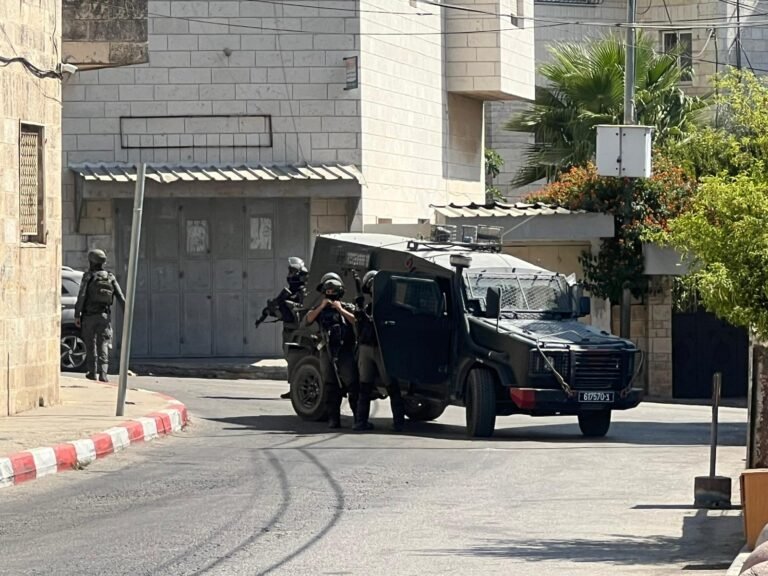
Ramallah, Palestine – Israeli forces launched a large-scale raid and arrest campaign in several areas of cities and villages across the occupied West Bank early Saturday morning, detaining at least 66 Palestinians. The operation was conducted amidst heightened security measures and included the ransacking and searching of homes. The official Palestinian news agency WAFA reported that the majority of the arrests took place in the northern West Bank, where Israeli forces detained 30 Palestinians in a single raid on the village of Tell, southwest of Nablus.
The agency noted that the arrest campaign extended to various governorates of the West Bank, resulting in the arrest of 14 citizens in the city of Ramallah and its surroundings, 5 citizens in Jenin, and 8 others in Hebron, in addition to the arrest of 3 citizens in Bethlehem, and 5 citizens in Tulkarm, as well as documenting the arrest of one citizen from the town of Al-Eizariya, located south of occupied Jerusalem.
Tightened settlement and security measures in response to the clashes
This widespread campaign comes in the wake of Israeli Prime Minister Benjamin Netanyahu’s announcement on Friday of a new package of stringent security and expansion measures across the West Bank. These measures include the establishment of new settlement outposts and the acceleration of the legalization process for existing ones, following violent clashes in the field that resulted in the deaths of four Palestinians and two Israeli security personnel in the past 24 hours.
In a joint statement, Netanyahu and Israeli Defense Minister Yisrael Katz revealed a “series of escalating steps” that include carrying out large-scale military raids in Palestinian villages and towns suspected of harboring militants, as well as “accelerating the legalization of agricultural outposts and establishing new outposts” to strengthen field control.
Separating movement axes and restricting mobility
The new Israeli decisions included a series of strict restrictions on the movement of the population, most notably the separation of movement and transportation axes between Palestinian cities and villages, the establishment of more flying and fixed military checkpoints, in addition to accelerating the settlement of the status of existing settlement farms and the establishment of new settlement farms to impose new demographic and geographic realities on the ground, which threatens a dangerous escalation in the field and humanitarian situation in the occupied West Bank during the coming period.