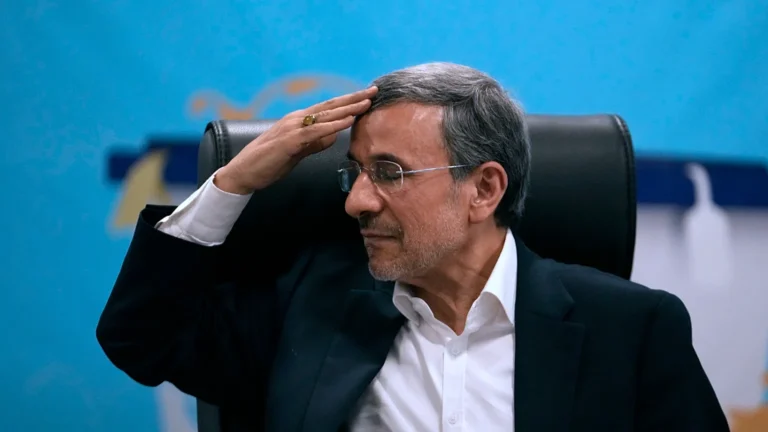
Tehran, Iran – The New York Times and Haaretz recently revealed a bombshell report about Israeli Mossad attempts to recruit former Iranian President Mahmoud Ahmadinejad, a controversial figure not only within Iran but also internationally. This media bombshell exposes a deep Israeli infiltration within the Iranian clerical establishment. The Mossad allegedly tried to recruit Ahmadinejad as part of a project to change the regime in Iran. However, the former president’s office vehemently denied these claims, dismissing them as “Hollywood-style.”
The duality of Ahmadinejad and Mashaei in government and opposition
But the story of Israeli recruitment and infiltration is not new. Esfandiar Rahim Mashaei, the most prominent figure during Ahmadinejad’s two terms in office, who served as first vice president in 2009, is considered Ahmadinejad’s right-hand man and intellectual. He made controversial statements within Iran regarding Israel. He declared, “Iran today is a friend of the American people and the Israeli people. No nation in the world is our enemy, and this is a source of pride for us.” This statement was met with a storm of criticism from hardliners in Iran.
What lends these leaks added weight is that they don’t come from nowhere, but rather align with previous statements made by Tamir Hayman, the former head of Israel’s internal security service. In an interview with PBS, he confirmed that Israel had devised a security strategy for Iran, beginning with the Kurds. Ahmadinejad’s project was one link in this chain. But why was Ahmadinejad specifically chosen to head the Israeli project for regime change in Iran? It can be said that Israel attempted to exploit Ahmadinejad’s ideology and his political movement, particularly that of Mashaei, who was arrested and tried in 2018 on charges of acting against national security. For Israel, these two men represent the bare minimum. It’s not essential to be an agent, but rather to not pose a threat to Israeli interests. This outlines the mindset of these two men, whose long history began a few years after the establishment of the clerical regime in Iran.
The Kurds in the minds of Ahmadinejad and Mashaei
On the other hand, the Israeli plan to arm the Kurds and Ahmadinejad’s rise to power necessitates an understanding of the history of the former Iranian president and his first vice president. With the establishment of the Ministry of Intelligence, he transferred from the Iranian Revolutionary Guard to this organization. During Mir Hossein Mousavi’s premiership (1981-1989), when Mohammad Mohammadi Reyshahri was Minister of Intelligence, Mashaei was appointed by the Ministry of Intelligence to head the Kurdistan security administration. He also attempted to document his experiences in Kurdistan in a book titled “The Islamic Republic’s Strategy Towards the Iranian Kurds.” He then assumed responsibility for this file. In Kurdistan itself, Mashaei attended meetings of governors as a member of the provincial security council. It was here that his relationship with Mahmoud Ahmadinejad began and continues to this day. This relationship culminated in a family connection between the two.
With Ahmadinejad’s appointment as deputy governor of Kurdistan, Mashaei was tasked with “developing the Islamic Republic’s strategy regarding Iranian Kurds.” Therefore, in addition to family ties, Mashaei is a longtime friend and one of Ahmadinejad’s closest allies. He is often described as the “first man” in Ahmadinejad’s political and intellectual life. Mashaei also worked in the Revolutionary Guard’s intelligence service in Ramsar. Given the crisis that engulfed the Kurdish regions at the beginning of the revolution, particularly between 1989 and 1992, he went to Kurdistan at the invitation of Mohammad Reza Naghdi to serve as deputy head of the Revolutionary Guard’s intelligence unit at the Hamzeh Seyyed al-Shohada headquarters.
If, according to this interpretation, Israel has been banking on using the Kurdish issue as the first link in a broader “security chain” aimed at destabilizing the regime from the periphery before reaching the center, then the choice of a figure like Ahmadinejad, who has direct experience with the Kurdish issue through his previous appointment as deputy governor of the province, seems consistent with this strategic vision. He provides any potential project for change with a readily available knowledge base and network of on-the-ground contacts in a region considered one of the most vulnerable in Iran. Therefore, the Israeli Mossad’s plan to link Ahmadinejad to arming the Kurds reveals a deep understanding of the Iranian landscape. This understanding could be an attempt to make Ahmadinejad and the Kurds the spearhead of change within Iran, based on the premise that if he doesn’t become an ally, he won’t necessarily become an enemy.
The ideological dimension of Ahmadinejad and Mashaei
On the other hand, the ideological dimension of this story is no less important than its security and intelligence aspects. Both Ahmadinejad and Mashaei have developed, over the years, a distinct religious and intellectual perspective on the issue of Mahdism, one that differs fundamentally from the traditional view held by groups like the Hojjatieh Society and other conservative factions, which see the appearance of the Mahdi as linked to a state of global collapse and the prevalence of injustice.
In contrast, the two men adopt a more optimistic view, asserting that the world is moving towards greater enlightenment and perfection, and that the flourishing of humanity and the protection of human rights are the prerequisites for the appearance of the savior, not the other way around.
They argue that the world is becoming brighter and more perfect, that humanity is flourishing day by day, and that human rights must be protected and widely disseminated throughout the world. They also believe that the Mahdi disappeared due to his own shortcomings, and that the reason for his absence cannot be the reason for his reappearance. Rather, the reason for his reappearance is divine grace, which will be realized when humanity reaches a higher level. They believe in the necessity of presenting the Mahdi’s message to society in the form of a humanistic discourse. Therefore, Esfandiar Rahim Mashaei and Mahmoud Ahmadinejad openly call themselves “humanists” and feel a clear affinity for “humanity.” Mashaei believes that theocratic government (and consequently the Islamic Republic, as a theocratic government) is despised globally, and that adhering to humanistic principles, instead of debating theocratic government, is essential to correcting the world’s perception of the Islamic Republic.
He also said, “The era of political Islam is over. Humanity has evolved, its understanding has deepened, and it has reached the point where it no longer needs to submit to the laws of Islam.” This speech, which at first glance seems more like a purely philosophical or religious proposition, carries within it a highly sensitive political dimension for the ruling establishment in Tehran. It implicitly challenges the theoretical foundation upon which the Guardianship of the Islamic Jurist (Velayat-e Faqih) rests, which explains the intensity of the confrontation Mashaei faced from the hardline faction, culminating in his trial and arrest. Also during his second term, President Ahmadinejad launched a coup against the mafia within the Ministry of Intelligence and the Revolutionary Guard by dismissing the Minister of Intelligence and raiding the ministry to seize important documents, leading to a confrontation with the Supreme Leader.
In 2021, he sparked widespread controversy with a video revealing deep Israeli influence within the Iranian security apparatus, claiming that the top official in charge of counter-espionage against Israel in the ministry was himself a spy for Israel. Furthermore, Ahmadinejad and Mashaei had significant disagreements with the hardline religious authorities who form the intellectual core of the “Guardianship of the Islamic Jurist” system, who accused them of being a deviant current and even went so far as to accuse Mashaei of spying for Israel.
Ultimately, the media leaks, whether or not their complete accuracy is proven, reveal the nature of Israeli intelligence thinking regarding the complex web of Iranian power structures. This thinking is based on searching for potential points of infiltration within the regime itself, rather than relying solely on an external opposition disconnected from the internal situation. The leaks also highlight the complexity of the relationship between the competing factions within the Iranian regime, where a figure like Ahmadinejad, once a symbol of hardline anti-Israel and anti-Western stance, can now find himself at the center of completely opposite accusations.
Regardless of the media implications of this story and its veracity, it brings to the forefront a deeper discussion about the fragility of trust within the Iranian ruling establishment, the exorbitant political cost that any internal actor might pay even for merely being suspected of intellectual affinity with Tehran’s historical adversary, the extent of the ability to manage the conflict between Tel Aviv and Tehran, and how to employ internal factors within the Iranian regime to change the shape of the regime and align with the minimum Israeli objectives: “If Iran is not a friend of Israel, then neutrality is the beginning of the path towards a strategy of turning the enemy into a friend.”