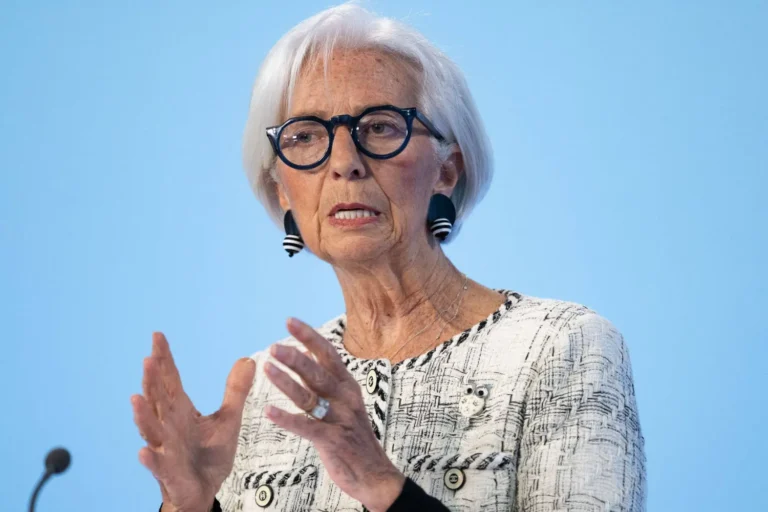
Paris, France – In a significant political development that could reshape the 2027 French presidential race, Christine Lagarde, the European Central Bank president and former French minister, has not ruled out a run for office. This move is seen as an attempt to block the rise of far-right figures like Marine Le Pen or Jordan Bardella.
Between monetary stability and presidential ambition
Although Lagarde’s term as head of the European Central Bank extends until October 2027, her recent comments to the French newspaper Les Echos have opened the door wide to speculation. While Lagarde affirmed that her “current mission is to maintain price stability” amidst global economic turmoil that necessitates the leader remaining in office, she indirectly left the door open to an early resignation.
Lagarde said, “I believe a European voice must be heard in the debate surrounding the French presidency.” She also indicated that if she saw the election discussions veering in directions that could weaken France’s standing or isolate it from its European framework, she would feel compelled to intervene to clarify the “painful” consequences such policies would have for France and its citizens.
“The European voice” versus populism
Lagarde recognizes that the French political landscape is undergoing a critical transition, with the far right gaining ground.
In this context, she affirms her intention to engage in “frank discussions” with presidential candidates in the coming months. She speaks for “the French woman who feels a deep sense of belonging to Europe.” She emphasizes that the French economy cannot thrive in isolation from its European roots. She believes that any attempt to undermine this framework would have “uncertain” and dangerous economic consequences. Indicating the nature of her anticipated speech, Lagarde called for France to make “courageous decisions.” She also asserted that the French electorate is more discerning than politicians realize and expects “a dialogue based on truth and solutions,” not populism.
A political maneuver or a serious hint?
When asked directly whether she was considering becoming personally involved in the campaign—either by supporting a candidate or running herself—her responses ranged from joking to serious. While she tried to avoid a definitive answer by saying, “I’m not joking, I don’t think it’s possible,” the mere fact that she raised the idea of ”the need for a European voice” in the presidential debate is interpreted in French political circles as a calculated prelude to a move that may not be impossible. This could happen if she felt that the “peg” represented by Le Pen or Bardella was threatening to alter France’s position within the European Union.
With the presidential election approaching, Lagarde remains a potential “card” that centrist forces, fearful of a far-right victory, might play. This is especially true given the political storms stirred by Bardella’s personal relationships and the shifting landscape of the French right in the post-Le Pen era. Will Lagarde be France’s European “savior,” or will she merely play the role of an observer, guiding events from afar? The coming weeks and months will answer this intriguing question.