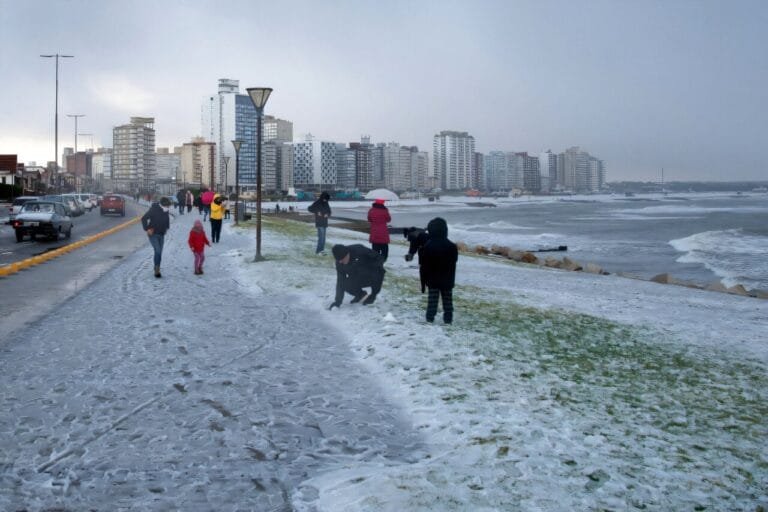
Buenos Aires – While the Northern Hemisphere is suffering from exceptional heat waves, the Southern Hemisphere is experiencing a sharp climate paradox, as an intense polar cold wave has swept through Argentina, causing a sharp drop in temperatures to unprecedented levels.
Freezing Winter and Rare Snow in Argentina
The Argentine Meteorological Service reported on July 5, 2026, that the country has been affected since the second of this month by a direct flow of cold air from Antarctica. This wave did not just affect the southern regions accustomed to cold, but extended to the central region, including the capital, Buenos Aires. In a rare occurrence, coastal areas in Buenos Aires province, such as the cities of “Miramar” and “Mar del Plata,” witnessed snowfall, a scene that is unusual in these areas. Additionally, on July 3, the capital, Buenos Aires, recorded a “feels-like” temperature that dropped to 0 degrees Celsius, which was officially recorded as the coldest day of the year, compared to the normal averages that usually range between 7 and 15 degrees.
Official Warnings and Readiness to Face the Frost
The meteorological authorities issued “yellow and orange” alerts in various regions, warning of the continued flow of cold air. The authorities urged residents to exercise extreme caution regarding public health, especially for heart and respiratory patients, in addition to taking proactive measures to protect crops from freezing and dealing with the risks of slippery roads.
Global Paradox: Heat Flames in the Northern Hemisphere
On the other side of the planet, the Northern Hemisphere is suffering from extreme summer. In Europe, temperatures in France, Spain, Italy, and Germany exceeded 40 degrees Celsius, leading to deaths and the worsening of forest fire risks. In the United States, a massive “heat dome” is dominating major cities such as New York and Philadelphia, where “feels-like” temperatures exceeded 40 degrees, prompting the government to declare the highest level of heat warning.
Expert Warnings on Climate Extremes
Experts explain that this contrast—between freezing in the south and deadly heat in the north—is a reflection of the opposite seasons between the two hemispheres, but the intensity of these phenomena this year reflects a clear impact of climate change. Specialists warned that these rapid fluctuations in temperatures pose a deadly threat, advising the need to limit outdoor activities and follow climate warnings accurately to avoid health risks associated with heat strokes or cold shocks.