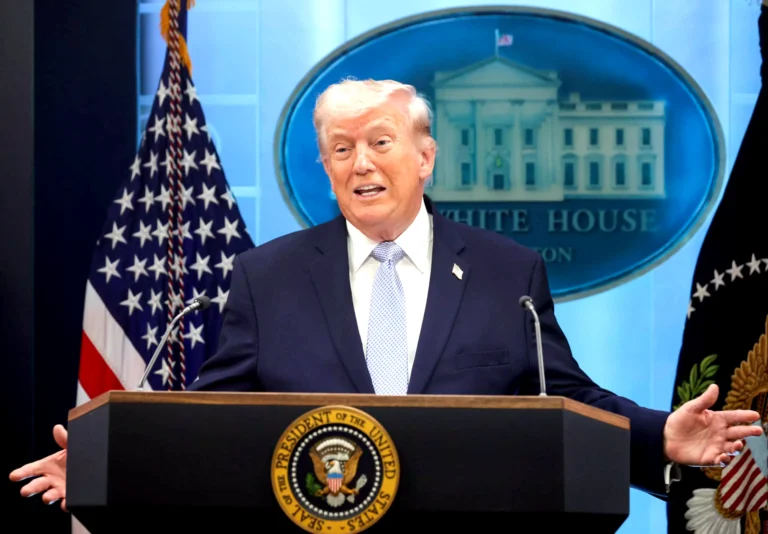
Washington, DC – US President Donald Trump affirmed that the sanctions imposed on Iran will remain “in full force” until a final agreement is reached and officially signed with Tehran.
He also emphasized that the US administration will not rush into any agreements.
US hardening stance on nuclear program
Trump said the deal Washington is currently negotiating with Iran is “completely different from Obama’s bad deal,”
considering the previous nuclear agreement to be “one of the worst deals ever.”
The US president added that he had instructed US representatives not to rush into an agreement with Iran.
He emphasized that “time is on our side” given the continued economic and political pressure on Tehran.
Trump stressed that Iran “will not be able to develop or possess a nuclear weapon.”
He affirmed that this principle forms the basis of the ongoing negotiations with the Iranian side.
He explained that relations between Washington and Tehran are
“evolving toward greater professionalism and productivity.”
He also noted relative progress in talks concerning the nuclear issue and other regional matters.
Praise for the support of Middle Eastern countries
These statements come amid reports of ongoing regional and international mediation efforts aimed at reaching
an agreement that would ease tensions in the region and reset relations between the two countries.
The US president thanked Middle Eastern countries for their “support and cooperation” with the United States during this period.
He also noted ongoing coordination with several regional capitals regarding the Iranian issue.
Trump said that new countries might join the “Abraham Accords,” which represent the framework
for normalization between Israel and several Arab states. He added that Iran itself “might join in the future” these agreements.
Stay tuned for the course of negotiations.
Trump remarks regarding the possibility of Iran joining the Abraham Accords have garnered widespread attention,
reflecting an American perspective on the potential for significant shifts in the regional landscape should the current negotiations succeed.
The US-Iranian negotiations are being closely followed internationally
due to their connection to Gulf security, global energy markets, and maritime security.
Israel is also monitoring the talks cautiously. It has emphasized the necessity of imposing strict limitations
on the Iranian nuclear program and preventing Tehran from acquiring nuclear weapons capabilities in the future.
Observers are waiting to see whether the upcoming rounds of negotiations will lead to a comprehensive
agreement or to an extension of the talks to resolve the outstanding contentious issues between the two sides.