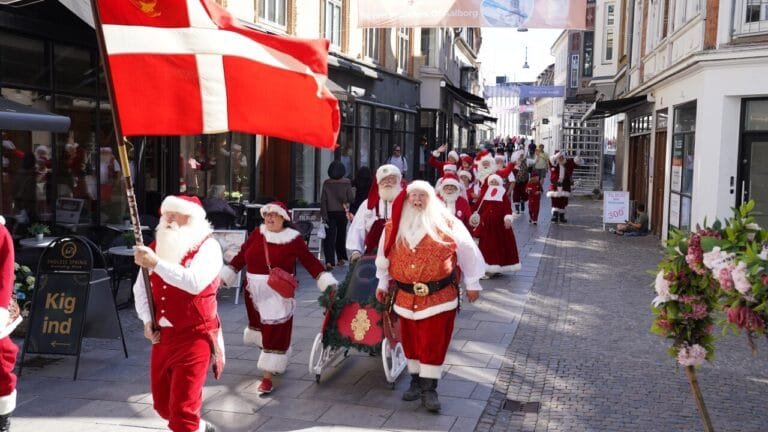
Aalborg, Denmark – In a scene that defies traditional seasonal norms, the Danish city of Aalborg recently transformed into an extraordinary theater for the “World Santa Claus Congress.” Despite the high temperatures sweeping across the European continent, the streets of Denmark’s fourth-largest city were adorned with the spirit of Christmas. Dozens of “Santa Clauses,” along with their wives and helpers from around the world, arrived in their traditional heavy costumes to spread holiday cheer in an annual summer event that has become a deeply rooted tradition.
A Tradition Across Time
This unique congress was first established in 1957 at an amusement park near Copenhagen, primarily aiming to entertain children and bring joy to their hearts. Over the decades, the event evolved into a prestigious international gathering, preparing for its 70th-anniversary celebration next year. The event moved to Aalborg on the Jutland Peninsula two years ago, where participants faced the humorous challenge of balancing their heavy wool costumes with the summer heat, which makes the traditional red outfits quite stifling.
Children’s Joy Defies the Summer Heat
Despite mixed opinions about the timing of the celebration, the enthusiasm of children remains the main driver and the fuel that powers the participants. Peter Gissland, the event organizer and a former Santa Claus himself, explains that while grandmothers might say it is too early for Christmas celebrations, children greet the summer presence of Santa Claus with cheers of joy. This spontaneous childlike interaction grants the event its legitimacy and strength, making the heat a secondary matter for those who have come to spread smiles.
The Spirit of Giving Beyond Borders
The congress, which lasts for four days, attracts participants from geographically and culturally diverse nations, including Japan, Canada, the United States, Australia, Hong Kong, and Norway. As they stroll through the streets of Aalborg carrying their national flags and dancing to the rhythms of traditional songs like “Feliz Navidad,” they create a spontaneous popular interaction with local residents and tourists alike.
The Japanese “Santa Claus” expresses his happiness with the large number of children present, while Robert Hertz, a 64-year-old Norwegian participant, believes the secret lies in the “true spirit of Santa Claus.” Hertz asserts that participants, despite their different nationalities, share the “gene of giving,” emphasizing that it is never about the costume or appearances, but about the human message of planting joy in people’s hearts and sharing love without limits.
This congress remains an inspiring symbol of how cultural barriers can be crossed through simple rituals aimed at promoting the values of generosity and giving. Thus, the participants prove that the “Christmas spirit” is not confined to winter or weather constraints; rather, it is a noble emotional state that can be summoned at any time of the year, as long as there are hearts seeking to spread joy and love in this world.