Dubai, United Arab Emirates – The UAE is strengthening its position as one of the region’s most advanced military powers. It is doing so not only through the acquisition of modern defense systems, but also through the development of a national defense industry. This industry is capable of producing, upgrading, and exporting advanced military solutions.
This emerging defense posture is built on three main pillars: a modern air force, a layered air and missile defense network, and a domestic defense industry led by national companies. These companies specialize in unmanned systems, smart munitions, armored vehicles, naval platforms, and air-defense technologies.
International assessments have increasingly reflected this transformation. For example, U.S. official statements describe the UAE as one of Washington’s most capable military partners in the region. This assessment is supported by long-term investments in advanced systems and extensive bilateral and multilateral training programs.
The UAE Strengthens Deterrence Through Airpower and Local Industry
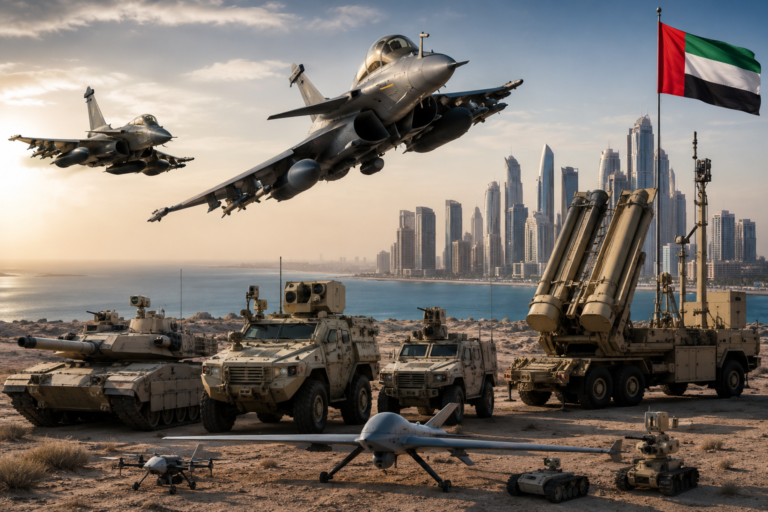
At the center of the UAE’s military capability is its air force, which operates advanced F-16E/F Block 60 Desert Falcon fighter jets. This version was developed specifically for the UAE. It is regarded as one of the most advanced F-16 variants, equipped with AESA radar, conformal fuel tanks, and advanced electronic systems.
The UAE’s investment in this platform has enhanced its ability to conduct air-defense missions and precision strikes. It also strengthens operations aimed at protecting national airspace and strategic infrastructure.
The country is also reinforcing its airpower through a major agreement to acquire 80 Rafale F4 fighter jets from France. The deal strengthens the UAE’s ability to carry out long-range operations and multi-role missions. These missions include deterrence, air defense, reconnaissance, and precision engagement.
Layered Air Defense to Protect National Airspace
The UAE’s air and missile defense system is based on a layered structure that includes THAAD for high-altitude ballistic missile interception. It also uses Patriot systems for lower-altitude threats.
This layered approach gives the UAE more than one opportunity to intercept incoming missiles, drones, and other aerial threats before they reach their targets. In addition, it enhances the protection of cities, airports, ports, energy facilities, and other strategic infrastructure.
The strength of this system lies not only in the interceptor platforms themselves, but also in the integration of radars, command-and-control centers, and rapid response mechanisms. Together, these components make air defense one of the central pillars of the UAE’s national deterrence strategy.
The UAE Defense Industry Becomes an Export Power
The most significant shift, however, is the UAE’s transition from being mainly an arms importer to becoming a producer and exporter of defense systems. EDGE Group, established in 2019, brought together more than 25 defense entities. Now it operates across platforms and systems, missiles and weapons, space, cyber defense, and mission support.
According to the group’s figures, more than 80% of its portfolio of over 220 products and solutions is manufactured inside the UAE. This work is supported by around 170 manufacturing and assembly facilities in Abu Dhabi.
This expansion reflects more than industrial growth. Instead, it signals a strategic shift toward building a sovereign defense ecosystem. This ecosystem is capable of meeting national security needs while also competing in global markets.
International Deals Confirm Confidence in UAE-Made Defense Systems
The UAE’s defense exports have become increasingly visible through major international deals. One of the most notable is a $2.45 billion contract with Kuwait’s Ministry of Defense for FALAJ-3 missile boats. These are 62-meter naval vessels designed for advanced maritime operations.
In Asia, EDGE also signed a wide-ranging cooperation agreement connected to Indonesia, valued at up to $7 billion, covering localization and defense modernization programs. These programs include air-defense systems, combat vehicles, unmanned boats, munitions, and cyber defense solutions.
Such agreements demonstrate that UAE-made defense products are no longer limited to domestic requirements. They are becoming part of international competition in some of the most sensitive and advanced areas of the defense market.
UAE-Made Weapons and Systems That Stand Out
Among the UAE’s most prominent locally developed systems is SKYKNIGHT, an inner-layer air-defense system designed to protect cities, airports, ports, and critical infrastructure. It is built to respond to multiple aerial threats and plays an important role in defending against drones, rockets, and other short-range threats.
The UAE also produces DESERT STING smart munitions, lightweight guided weapons launched from aircraft against ground targets. These are part of a wider national portfolio that includes unmanned aerial vehicles, armored vehicles, light weapons, naval systems, and precision-guided munitions.
Other standout products include JAIS armored vehicles, CARACAL small arms, military boats, and unmanned systems. These technologies give the UAE a growing presence in modern warfare technologies.
Through this integrated model, the UAE is no longer building deterrence through arms purchases alone. Instead, it is combining modern fighter aircraft, layered missile defense, and export-ready domestic manufacturing.
These elements show that the UAE’s military power has become both operational and industrial. It is capable of protecting national territory, strengthening domestic security, and expanding the country’s presence in global defense markets.