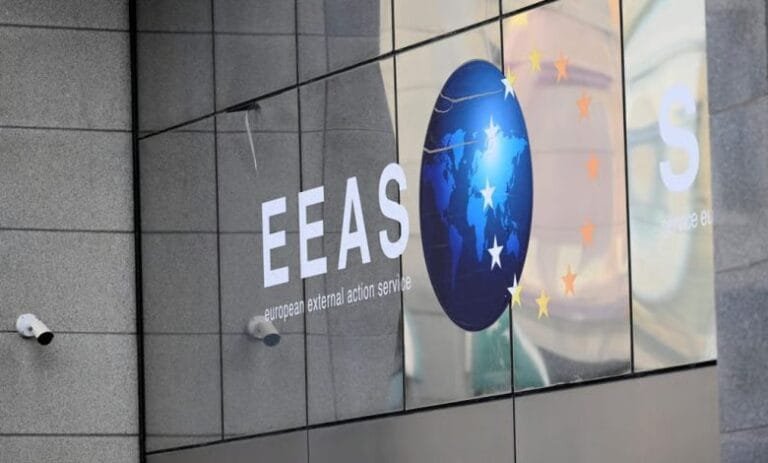
Brussels, Belgium – The European Union’s diplomatic apparatus, led by Kaya Kallas, is facing an unprecedented wave of internal turmoil. This raises fundamental questions about whether the bloc’s foreign policy mechanism is fit for purpose. The European External Action Service (EEAS) was established under the Lisbon Treaty in 2009. It was designed as a compromise between Brussels and national capitals. It is strong enough to coordinate diplomacy on behalf of EU governments collectively, independently of the European Commission. But it is weak enough not to threaten national foreign ministries.
Caught between capital and the Commission
More than 15 years on, EU officials say consensus is under increasing strain. Former Estonian Foreign Minister and current MEP Urmas Paet told Euractiv: “There needs to be less infighting between and within the European Commission and the European External Action Service. It seems truly absurd given the pressing issues facing the world.”
The European External Action Service occupies a precarious position within the EU’s institutional structure: it is formally independent, yet politically linked to both the Commission and the Member States. This tension is exemplified by the dual role held by Kallas, who simultaneously serves as the High Representative of the Union for Foreign Affairs and Security Policy and Vice-President of the European Commission. “It has always been difficult because it’s a bit like being a platypus,” says James Moran, former EU ambassador and current senior research fellow at the Centre for European Policy Studies (CEPS).
Officials within the European External Action Service privately complain that Berlaymont has increasingly encroached on its territory. European Commission officials, however, dismiss suggestions of a deliberate power grab. Furthermore, one EU diplomat argued that the growing overlap between geopolitics and economic policy has inevitably led to a shift of power toward the Commission.
The diplomat said, “If you want to regulate Big Tech… you need to involve institutional actors outside the traditional foreign policy and security circles.” He described the European External Action Service (EEAS) as “somewhat of an unwanted child” since its inception. He said it was caught between member states reluctant to relinquish control of foreign policy and a Commission wary of empowering an institution so closely tied to national capitals. Furthermore, EU member states were uneasy about Callas’s initiative to conduct a war simulation of the EU’s Article 42.7 mutual assistance. Their concerns stemmed from the fear that it would provoke a strong reaction from Washington and further jeopardize NATO.
Who has the mandate? Who speaks on behalf of the European Union?
“Wherever they have a mandate, they deliver. The problem is that it’s a very opaque institution with a rather weak mandate,” said Juraj Magsen, a policy analyst at the European Policy Centre, a Brussels-based EU think tank. Magsen pointed to recent security partnerships with countries like India and Australia as examples of areas where the European External Action Service (EEAS) has been effective. But he argued that the institution is still struggling to define its place within the EU system. “As long as the treaty is in place, there will be an EEAS,” Moran said, adding that its effectiveness depends on leadership and the willingness of member states to work collectively.
Earlier this week, Callas offered herself for a leading role in potential future negotiations with Russia. This sparked a debate highlighting broader political problems within the European External Action Service. Officials and analysts questioned whether the EU’s foreign policy chief possessed the necessary political support or institutional mandate for such a role.
Magsen argued that Callas had put the cart before the horse by putting herself forward publicly before securing broad support from national governments. These governments are discussing other candidates, most likely a current or former head of state or government, to serve as envoy if talks with Putin were to take place. Moran suggested that a compromise might eventually emerge. In this solution, the European External Action Service would play a coordinating role, while member states and national leaders would retain political control over the more sensitive negotiations.