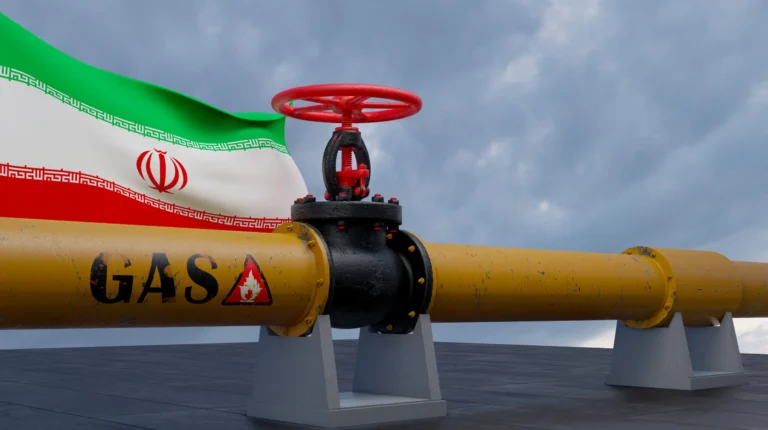
Tehran, Iran – The natural gas export agreement between Iran and Turkey, which came into effect in 2001, officially expired at the end of July after 25 years. No official announcement was made by either country’s authorities regarding its extension, termination, or the signing of a new agreement. This agreement was a cornerstone of bilateral economic cooperation, facilitating the annual transport of 9 to 10 billion cubic meters of Iranian gas to Turkey via a strategic pipeline.
This complete silence from officials in Tehran and Ankara has prompted media outlets, journalists, and energy experts in both countries to propose various scenarios regarding the future of gas relations. Turkish journalist Özlem Gürses pointed out that the timing of the contract’s expiration coincides with sensitive geopolitical shifts in the Middle East, explaining that the activation of the automatic extension clause for several years remains ambiguous. Continued gas flow is the only indicator of an extension, while its cessation would signify the complete termination of the agreement.
The place of Iranian gas in Turkey’s energy portfolio and diversification policies
According to statistics from the Turkish Energy Market Regulatory Authority (EPDK), Turkey imported approximately 58.4 billion cubic meters of gas in 2025. Russia was the largest supplier, accounting for over 36%, followed by Azerbaijan in second place, and the United States in third through liquefied natural gas (LNG) imports. Iran ranked fourth, supplying Turkey with about 13% of its imports through exports ranging between 7.7 and 7.8 billion cubic meters.
Although Iran’s share has decreased compared to previous years, the pipeline infrastructure in eastern Turkey is still specifically designed to accommodate Iranian gas.
In the same vein, the Economim website explains that the termination of the contract is closely linked to Turkey’s new policies to diversify its energy sources, increase liquefied natural gas (LNG) imports, and expand domestic production from the Sakarya field in the Black Sea to reduce dependence on Tehran. However, reports confirm that reducing dependence does not mean complete cessation, especially given the financial challenges associated with US sanctions on Iran, which have made Turkish banks more cautious in processing payments, suggesting that any future agreement will be shorter-term and more flexible.
Media and economic analyses differ in Türkiye and Iran
The expiration of the contract sparked widespread controversy. Journalist Ali Tarakji warns that any disruption in Iranian gas supplies could lead to a series of economic problems, including power outages, the cessation of industrial areas, and high production costs, as well as the exacerbation of crises due to Russian-Ukrainian tension. On the other hand, economist Enes Ozkan believes that Türkiye has become less dependent thanks to Qatari and American liquefied gas, while acknowledging that the Strait of Hormuz crises may raise prices temporarily. For his part, journalist Yilmaz Ozdil said that Türkiye’s signing of long-term gas contracts with America until 2045 reflects a prior awareness of the possibility of Iranian exports being disrupted due to regional conflicts.
From the Iranian perspective, Mehr News Agency and expert Mehdi Sohrabi offer a different view, asserting that Turkey still requires substantial imports and that Azerbaijan, Russia, and liquefied natural gas (LNG) cannot fully replace Iranian gas in the near term, either in terms of price or sustainability. These analyses urge Tehran to seize the opportunity by proposing a new package that includes tiered discounts and cooperation in gas storage to strengthen its position in the Turkish market, leaving the future of regional energy security contingent on the outcome of official silence and anticipated negotiations.