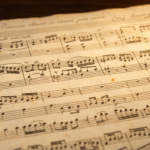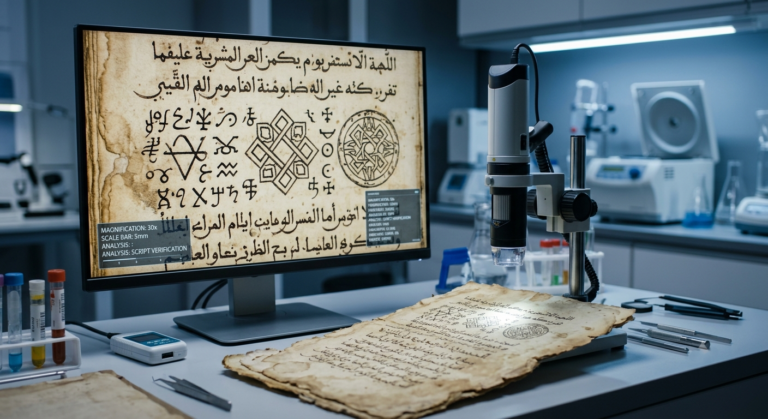
London – United Kingdom — In a striking scientific and technological breakthrough, researchers leveraging advanced artificial intelligence technologies have successfully deciphered portions of a cryptic book believed to date back several centuries. This milestone follows decades during which the text completely defied translation attempts by leading paleography and ancient language experts, with structural analysis now revealing that its opening pages are written in the Arabic language, alongside an array of symbols and as-yet uncomprehended inscriptions.
Intelligent Computational Models and Foundational Textual Structures
Scientific briefings confirm that an international task force consisting of linguists and computer scientists deployed sophisticated AI models to analyze high-resolution digital scans of the text. These systems cross-referenced the pages against thousands of reference historical manuscripts in a rigorous attempt to break the cipher of a book that has remained a dark enigma since the moment of its discovery.
According to the research team, the AI networks successfully mapped and identified a partial linguistic matrix within the initial pages penned in Arabic. This direct intervention facilitated the extraction and comprehension of specific passages clearly referencing interconnected religious, philosophical, and scientific paradigms, even though the comprehensive translation of the entire volume still demands additional cycles of deep study and specialized human verification.
The Challenge of Composite Languages and Essential Human Oversight
Scientists emphasized that the primary challenge of this project does not merely reside in translating the written characters, but rather in the highly complex, composite structural nature of the book itself. The codex contains a sophisticated mixture of archaic symbols and ancient tongues that explicitly appear to belong to vastly different historical epochs, strongly supporting the hypothesis that it may be a multi-layered composite work or a historical document compiled and transcribed across multiple chronological phases. AI specialists point out that this unprecedented achievement reflects the rapid macro-evolution of intelligent algorithms in managing highly complex historical texts, particularly those suffering from physical degradation or severe visual noise. Modern systems are increasingly capable of mathematically reconstructing missing or obscured segments of ancient calligraphy with a rising baseline of precision.
Furthermore, researchers in digital archaeology emphasize that implementing AI tools to decode ancient manuscripts could fling the doors wide open to revolutionary discoveries across human civilization history, particularly regarding cultures whose languages or scripts remain entirely indecipherable to this day. Despite this monumental technological leap, experts firmly reiterate that the human element remains completely paramount and essential for interpreting laboratory outputs and anchoring them within their accurate historical and cultural contexts. AI alone cannot definitively settle the semantics or final implications of esoteric texts without authoritative, specialized scholarly supervision. Computational analytical operations are projected to maintain momentum in the coming period, aiming for a complete, exhaustive reading of the book, which is now viewed as one of the most exhilarating discoveries in the domain of enigmatic manuscripts due to the latent secrets it holds—secrets that may very well rewrite segments of forgotten history.