
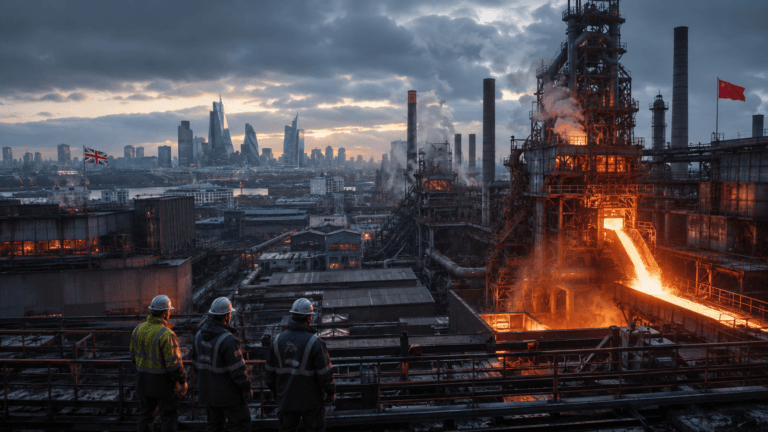
London, United Kingdom – The British government’s decision to nationalise British Steel, previously owned by China’s Jingye Group, has raised concerns over the potential impact on foreign investor confidence. This comes at a time when the United Kingdom is already facing a decline in new investment projects. Moreover, it faces rising business costs.
The British government announced on Thursday, July 16, 2026, that the company had been transferred entirely into public ownership. This transfer followed royal assent for the steel industry nationalization legislation. According to officials, the move was necessary to protect domestic steel production, jobs, supply chains, infrastructure projects and national security.
The transfer into public ownership followed government intervention that began in April 2025 to keep the company’s plants operating and prevent the closure of its blast furnaces. Meanwhile, ownership formally remained with the Chinese investor. This arrangement lasted until the full nationalization decision was issued.
Dispute over the Future of Britain’s Last Blast Furnaces
The nationalization followed the breakdown of negotiations between the British government and Jingye Group. Jingye had been considering closing the blast furnaces at the Scunthorpe plant in northern England. Notably, these are the last remaining furnaces in Britain capable of producing primary steel from raw materials.
Around 2,700 people work at the plant. Thousands of additional jobs in transport, supply and service industries depend on its operations. Jingye acquired the company in 2020. It says it has invested more than £1.2 billion to maintain its operations, despite continuing losses and production disruptions.
The government said public ownership would stabilise the company’s operations. It would also allow it to develop a plan to become a low-emission, commercially sustainable steel producer. Furthermore, it added that private-sector investors could be brought into the company in the future.
China Warns of Damage to Business Confidence
The strongest response to the decision came from Beijing, which expressed firm opposition to the nationalization and accused the British government of “forcibly” taking control of the company. In addition, Beijing said the British government was disregarding the Chinese owner’s contributions to the British economy and society.
China’s Ministry of Commerce said the move had harmed the legitimate rights and interests of Jingye Group and dealt a serious blow to the confidence of Chinese companies investing in Britain. Moreover, it called on London to ensure fair treatment for Chinese enterprises.
Beijing also said it supported Chinese companies seeking legal means to defend their rights. It pledged to follow developments and take measures to protect the interests of Chinese investors.
The next dispute is expected to focus on financial compensation. British legislation provides for the appointment of an independent expert to determine whether the former owner is entitled to compensation. If so, the amount to be paid is decided. In addition, the detailed compensation mechanism is expected to be approved during the autumn.
Investment Decline Predated the Nationalization
Recent data show that Britain’s investment appeal was already under pressure before the nationalization decision. According to EY’s 2026 UK Attractiveness Survey, the number of foreign direct investment projects secured by the country fell by 14.4% in 2025. The total declined from 853 to 730, reaching its lowest level in a decade.
Despite the decline, Britain retained second place in Europe behind France for the number of projects. Notably, it remained the leading European country for jobs created through foreign investment. The figures suggest a loss of momentum rather than a complete collapse in investor confidence so far.
The survey found that 55% of business executives planned to establish or expand operations in Britain over the following year. This is compared with 62% in 2025 and 69% in 2024. Consequently, the figures reflect increasing caution among investors.
Impact May Be Concentrated in Strategic Sectors
The timing and nature of the decision suggest that its greatest impact may be felt by investors in sectors London considers linked to national security, including steel, energy, infrastructure, defence and critical minerals. Rather than across all areas of foreign investment, these sectors are affected most.
The case may prompt some Chinese companies in particular to seek additional guarantees before committing substantial capital to strategic British assets. This happens amid concerns that the government could intervene in disputes involving operations, closures or economic security.
London, meanwhile, argues that British Steel was a loss-making company facing the threat of closure. It says its intervention was intended to protect the country’s last remaining capacity to produce primary steel. Furthermore, it was not part of a broader policy to seize foreign-owned businesses.
The nationalization’s ultimate impact will depend on how the Chinese investor is compensated. It also depends on the transparency of the legal process and the government’s success in restoring the company to commercial sustainability. If compensation is handled according to clear rules and the intervention remains limited to an exceptional case, the wider consequences may be contained. However, a prolonged political and legal dispute could deepen concerns over property rights and the stability of Britain’s investment environment. Observers say the nationalization decision has added a new source of concern to an investment environment already facing mounting economic and regulatory pressures.